WIDA writing prompts and practice for 2nd and 3rd grade
Writing tasks at each tier with the rubric and a sample answer. Not scored here, but you can ask for AI practice feedback on what you write.
Teaching this in class? It is all free online, and the Grades 2–3 printable pack ($8.99) has a booklet for every student, the answer key, rubrics and audio.
Write your response in the editor. You can see your word count, use the optional timer, save a draft in this browser, ask for AI practice feedback, and compare your writing with the rubric and sample response. It is not scored here — on the real test, writing is scored against a rubric.
Printable version with every prompt, rubric and sample response.
Prompt 1 of 4 — Tier A tasks — suggested time about 15 minutes
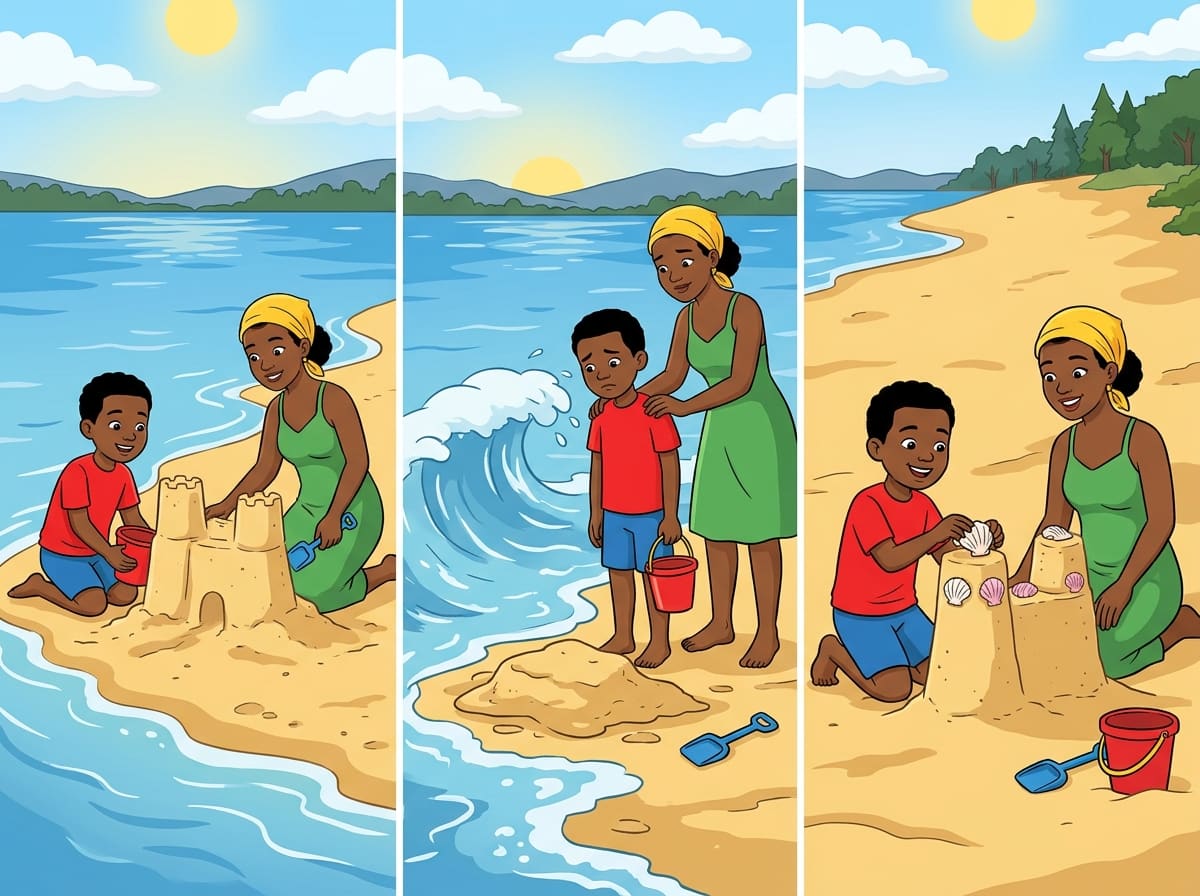
Look at the three pictures.
Language Arts: The Sandcastle
Read image description
Picture 1: Malik and his aunt build a big sandcastle on the beach, close to the water. Malik has a red bucket, and his aunt has a shovel.
Picture 2: A big wave washes over the sandcastle. Now it is only a flat pile of wet sand. Malik looks sad.
Picture 3: Malik and his aunt build a new sandcastle farther from the water. Malik puts shells on top, and he is smiling.
Look at the pictures. Write your story on paper.
Write a story about Malik and his aunt. Tell what happens first, next and last. Words you can use: sandcastle, beach, bucket, shovel, wave, water, sad, shells
View the practice scoring rubric
| Level | What it looks like |
|---|---|
| 7 — Fully developed |
|
| 6 — Well developed |
|
| 5 — Developed |
|
| 4 — Expanding |
|
| 3 — Emerging |
|
| 2 — Beginning |
|
| 1 — Starting |
|
Show a strong sample response
Malik and his aunt go to the beach. They make a big sandcastle with a bucket and a shovel. Next a big wave come and wash the sandcastle away. Malik is sad because the castle is gone. Last Malik and his aunt make a new sandcastle far from the water. He put shells on the top. Malik is happy because the wave can not get it.
About level 4: several related sentences that follow the three pictures in order, with first-next-last thinking and two reasons with "because." Verb endings are often missing and words come mostly from the word bank, which keeps it below level 5.
What to look for
- Students in grades 2 and 3 handwrite on the real test, in a paper booklet. Have the student print the answer on paper rather than type it.
- This is a narrate task. Check that the story follows the pictures in order and uses time words such as first, next, then and last.
- A response that only lists words from the word bank sits around level 2; whole sentences that connect move it up.
- A blank, copied or off-topic page is not scored at a level; note it and try again with the pictures.
All 4 writing prompts for 2nd and 3rd grade
- Tier A tasks (Language Arts: The Sandcastle): Write a story about Malik and his aunt. Tell what happens first, next and last. Words you can use: sandcastle, beach, bucket, shovel, wave, water, sad, shells
- Tier A tasks (Science: Birds in Winter): Birds need food, water and a safe place in winter. Look at the picture. Write about how people can help birds in winter. Words you can use: seeds, feeder, water, bush, safe, cold, snow
- Tier B/C tasks (Mathematics and Science: The Bounce Test): Write a short report for your class newsletter about the bounce test. Explain what the class did, what the graph shows and why you think the balls bounced to different heights. Use numbers from the graph.
- Tier B/C tasks (Language Arts and Social Studies: A New Project for Pine Park): Write a letter to the mayor of Brookfield. Tell which new project the town should build at Pine Park, a splash pad or a bike path. Give reasons from the information, and tell why your choice is better than the other one.
More WIDA practice for 2nd and 3rd grade
- WIDA listening practice for 2nd and 3rd grade
- WIDA reading practice for 2nd and 3rd grade
- WIDA speaking practice for 2nd and 3rd grade
- WIDA listening practice test for 2nd and 3rd grade
- WIDA reading practice test for 2nd and 3rd grade
- WIDA listening practice test 2 for 2nd and 3rd grade
- WIDA reading practice test 2 for 2nd and 3rd grade
Read next
- WIDA Writing Test: Tasks, Tiers, Scoring and Sample Answers: The WIDA ACCESS writing test asks students to write extended answers to a few tasks, each set up with a short scenario that gives them a reason to write. Grades 1–3 handwrite in a booklet and grades 4–12 type. Tasks come in two tiers, A and B/C, and trained raters score each answer on a 0–7 rubric. Here is how it works, with an original sample answer, and how to practise.
- How to Prepare for WIDA ACCESS: A Practical Plan for Parents: WIDA ACCESS measures English that grows over months and years, so there is no shortcut to a higher level. What preparation can do is make the test familiar, so your child's real English shows on the day. The best plan is the official WIDA demos, a few weeks of short practice in each domain, and plenty of talk and reading at home, in any language.
- WIDA Scale Scores: How They Relate to Proficiency Levels: Every WIDA ACCESS score report gives two numbers for each domain and composite: a scale score and a proficiency level. The proficiency level (1.0 to 6.0) is the number schools and states usually act on. The scale score is what the level is worked out from, and it is the better number for tracking growth. In 2025–26, WIDA reset the scale, so scale scores from before 2026 cannot be compared with scale scores from 2026 on.
Unofficial practice. This site is not affiliated with, endorsed by, or connected to WIDA, the Wisconsin Center for Education Research, or the Board of Regents of the University of Wisconsin System. WIDA and WIDA ACCESS are trademarks of the Board of Regents of the University of Wisconsin System. Every question here is original practice material written to match the published test design.