WIDA speaking prompts and practice for 2nd and 3rd grade
Speaking tasks with a model answer to hear first, as on the real test, then your own recording. Not scored here; optional AI practice feedback from the live transcript.
Teaching this in class? It is all free online, and the Grades 2–3 printable pack ($8.99) has a booklet for every student, the answer key, rubrics and audio.
Record your answer and play it back—no typing needed. Where supported, turn on automatic transcription to get AI practice feedback on what you said. The feedback reads only the transcript, so it does not judge pronunciation or pace, and it is not an official WIDA score — on the real test, speaking is scored against a rubric.
Printable version with every prompt, rubric and sample response.
Prompt 1 of 9 — Pre-A tier tasks — suggested time about 1 minute
Listen to the model first
A model student answers a similar question. Listen to how much they say and how they connect their ideas, then answer your own question below.
Model answer
Press play to listen. You can pause, rewind, and replay as often as you like.
Show transcript
Ms. Phillips: Look at the picture. What is on the wall?
Theo: A calendar.
Now it is your turn
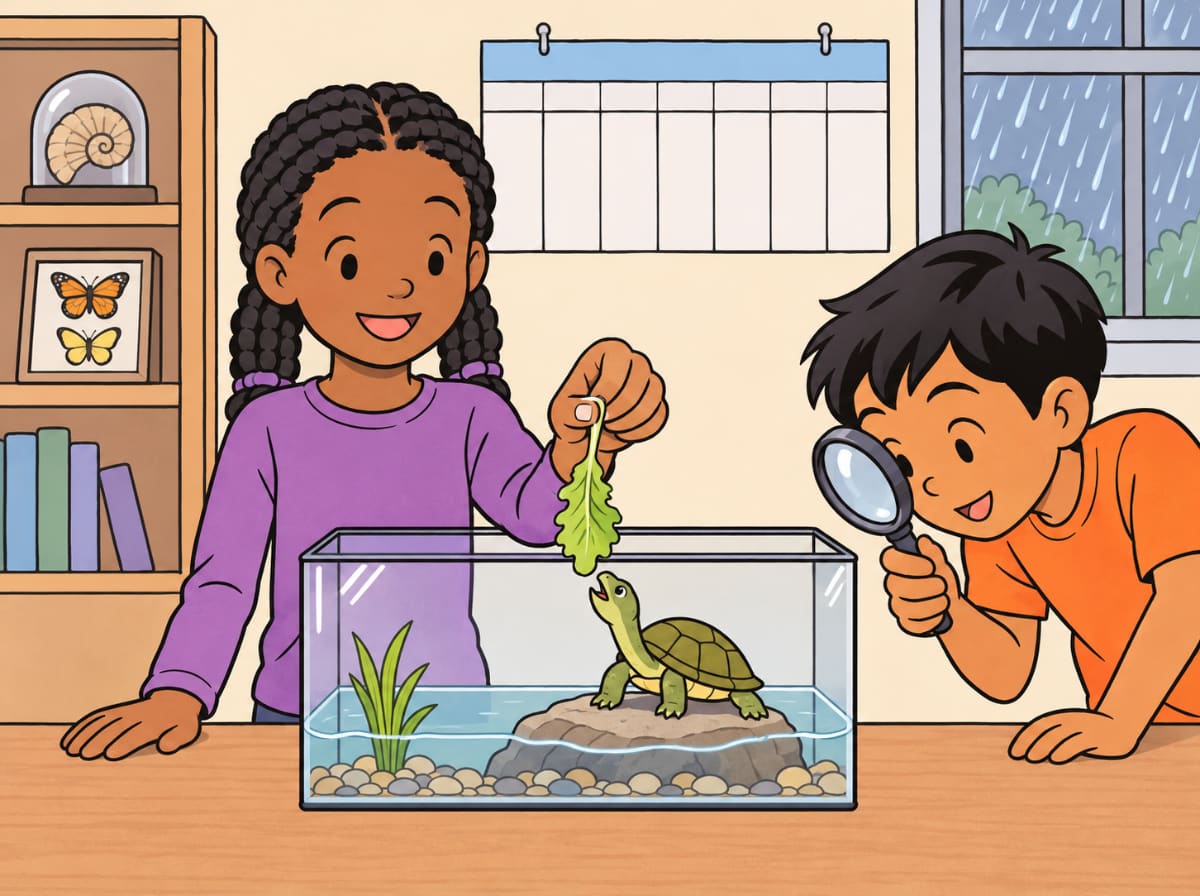
Look at the picture.
Social and Instructional: Our Classroom
Read image description
The picture shows a classroom science corner. A girl with braids is feeding a piece of lettuce to a green turtle in a glass tank. A boy next to her is looking at the turtle through a magnifying glass. A calendar hangs on the wall. Outside the window, it is raining.
Look at the picture. Listen to the question. Then answer.
Look at the picture. What animal is in the tank?
Answer the prompt aloud. After recording, listen back or try another take.
View the practice scoring rubric
| Level | What it looks like |
|---|---|
| 4 — Exemplary |
|
| 3 — Strong |
|
| 2 — Adequate |
|
| 1 — Attempted |
|
Show a strong sample response
A turtle. It's a turtle. A green turtle. It is in the water tank.
This matches the level 1 target of a Pre-A task: the right English word, repeated in a short memorized frame with one describing word. The single word "turtle" would also meet the target.
What to look for
- Pre-A tasks are for students just beginning English. One clear English word that answers the question meets the goal.
- If the student points without speaking, point too and say "turtle," then ask again.
- Answers in another language show understanding but stay at the lowest rubric level; note them and model the English word.
All 9 speaking prompts for 2nd and 3rd grade
- Pre-A tier tasks (Social and Instructional: Our Classroom): Look at the picture. What animal is in the tank?
- Pre-A tier tasks (Social and Instructional: Our Classroom): Look at the picture. What is the girl doing?
- Pre-A tier tasks (Social and Instructional: Our Classroom): Look at the picture. What is the weather like outside?
- Tier A tasks (Social Studies: Helpers on Our Street): Look at the picture. Who is helping the children cross the street?
- Tier A tasks (Social Studies: Helpers on Our Street): Tell what the crossing guard does and why that job is important.
- Tier A tasks (Social Studies: Helpers on Our Street): Look at the picture. Which place on this street would you like to visit? Tell why.
- Tier B/C tasks (Science: The Sunny Window Test): Look at the picture. Tell what happened to the temperature under each paper.
- Tier B/C tasks (Science: The Sunny Window Test): Explain why it got warmer under the black paper than under the white paper. Use what you know about sunlight and heat.
- Tier B/C tasks (Social Studies: A Class Decision): Your class can buy a class fish or twenty new books. Which should the class choose? Give reasons for your choice.
More WIDA practice for 2nd and 3rd grade
- WIDA listening practice for 2nd and 3rd grade
- WIDA reading practice for 2nd and 3rd grade
- WIDA writing practice for 2nd and 3rd grade
- WIDA listening practice test for 2nd and 3rd grade
- WIDA reading practice test for 2nd and 3rd grade
- WIDA listening practice test 2 for 2nd and 3rd grade
- WIDA reading practice test 2 for 2nd and 3rd grade
Read next
- WIDA Speaking Test: Tiers, the Model Student and How to Practice: On the WIDA ACCESS speaking test, students wear a headset and record answers on the computer. Before each task they hear a model student answer a similar question, then they give their own answer. Tasks are pitched at proficiency levels 1, 3 and 5, and the tier a student gets depends on their listening and reading results. Here is how it works and how to practise.
- How to Prepare for WIDA ACCESS: A Practical Plan for Parents: WIDA ACCESS measures English that grows over months and years, so there is no shortcut to a higher level. What preparation can do is make the test familiar, so your child's real English shows on the day. The best plan is the official WIDA demos, a few weeks of short practice in each domain, and plenty of talk and reading at home, in any language.
- WIDA Scale Scores: How They Relate to Proficiency Levels: Every WIDA ACCESS score report gives two numbers for each domain and composite: a scale score and a proficiency level. The proficiency level (1.0 to 6.0) is the number schools and states usually act on. The scale score is what the level is worked out from, and it is the better number for tracking growth. In 2025–26, WIDA reset the scale, so scale scores from before 2026 cannot be compared with scale scores from 2026 on.
Unofficial practice. This site is not affiliated with, endorsed by, or connected to WIDA, the Wisconsin Center for Education Research, or the Board of Regents of the University of Wisconsin System. WIDA and WIDA ACCESS are trademarks of the Board of Regents of the University of Wisconsin System. Every question here is original practice material written to match the published test design.