



WIDA practice test for 6th, 7th and 8th grade

Middle school students in grades 6, 7 and 8 share one test form, with longer passages and more academic topics from science, math and social studies.

This WIDA practice is for students in 6th grade, 7th grade and 8th grade.

The listening and reading questions below are checked as you go, with an explanation after every question. Speaking and writing are scored by trained raters on the real test, so those pages give you the task, the rubric and a sample answer instead of a score, and you can ask for AI practice feedback. Practice one domain at a time, or take a full practice test.

Mixed practice tests

Practice one part at a time

Try a reading question for 6th, 7th and 8th grade

A question from this band's practice. Decide on an answer, then open it to see why it is right.

Grades 6–8 reading: Level B folders

Read the article and the diagram. Then answer the questions.

Science: How Wetlands Clean Water
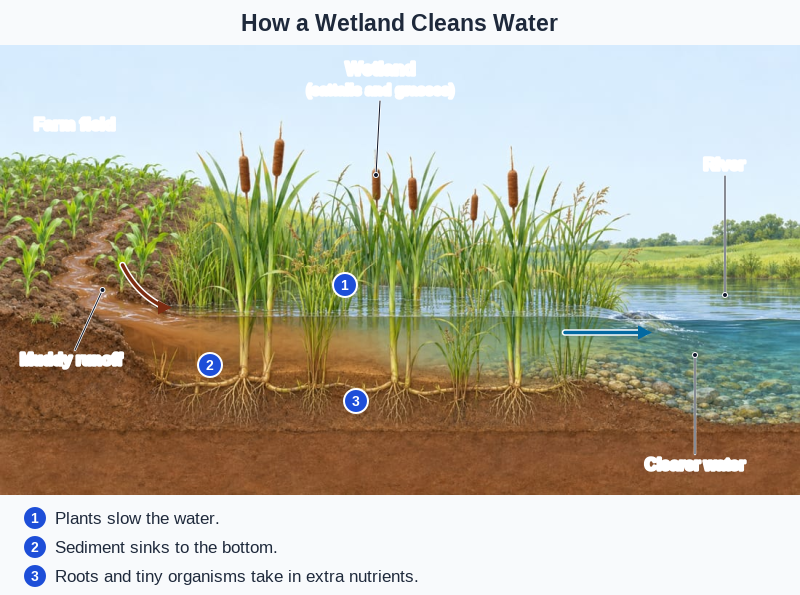
A cutaway diagram titled How a Wetland Cleans Water, with water flowing from left to right. On the left, muddy runoff flows off a farm field into a wetland full of cattails and grasses. Under the water, sediment settles on the bottom and plant roots spread through the soil. On the right, clearer water flows out into a river. Numbers on the picture match three steps listed below it: 1, Plants slow the water. 2, Sediment sinks to the bottom. 3, Roots and tiny organisms take in extra nutrients.
Read image description

When rain falls on a farm field or a parking lot, it does not just soak into the ground. Much of it runs across the surface, picking up soil, fertilizer and other materials along the way. This runoff can make rivers and lakes muddy and unhealthy. Wetlands, such as marshes and swamps, help solve this problem.

First, wetland plants slow the water down. Thick stems of cattails and grasses act like a crowded hallway: the water has to squeeze between them, so it loses speed.

Next, because the water is moving slowly, sediment can settle out. Sediment is the soil, sand and tiny pieces of rock carried by moving water. In fast water, these pieces stay mixed in. In slow water, they sink to the bottom of the wetland.

Finally, plant roots and tiny organisms called microbes take in extra nutrients, such as the nitrogen in fertilizer. A small amount of nitrogen helps living things grow, but too much can cause huge blooms of algae that use up the oxygen fish need.

By the time the water leaves the wetland, it is often much cleaner than when it arrived. For this reason, some scientists call wetlands "the kidneys of the landscape." Today, many towns protect wetlands or even build new ones to help keep their water clean.

Choose the best answer.

What is the main idea of the article?

  • Farm fields use too much fertilizer on their crops.
  • Algae is harmful to all fish.
  • Wetlands help clean water in several steps.
  • Cattails are the tallest wetland plants.
Show the answer

C. Wetlands help clean water in several steps. — This checks the central idea. The article introduces the runoff problem, then explains three steps (slowing, settling, absorbing) that make water cleaner. The other choices are details or ideas the article does not claim.

  • Farm fields use too much fertilizer on their crops. — Fertilizer is part of the runoff problem, but it is not the main idea.
  • Algae is harmful to all fish. — The article says too much algae can harm fish, not that all algae is harmful.
  • Cattails are the tallest wetland plants. — Cattails are an example of wetland plants; their height is not discussed.

More WIDA reading practice for Grades 6–8

Other recordings and texts in this band include: Social and Instructional: A Snow Day Change; Mathematics: Snacks for the Field Trip; Science: Why Lakes Freeze from the Top Down; Mathematics: A Cold Morning; Social and Instructional: Lost and Found; Mathematics: The Canned Food Drive; Language Arts: Keep the Library Open at Lunch; Social Studies: Where Rivers Meet.

Grades 6–8 printable pack

$8.99

The practice on this page, ready to print and teach from. Everything here stays free to practice online.

  • 53-page student booklet to print for every student
  • 96-page teacher guide with the answer key and every answer explained
  • Scoring rubrics with sample responses for speaking and writing
  • Listening transcripts, and 23 numbered MP3 tracks to play to the class

Print as many copies as you need for your own students. Parents can use it at home, too. Not buying today? Get one reminder before testing.

WIDA for 6th, 7th and 8th grade: common questions

Do 6th, 7th and 8th graders take the same WIDA test?

Yes, they share the grades 6–8 cluster. Levels are still set grade by grade, so an eighth grader needs a higher scale score than a sixth grader to earn the same proficiency level.

What is on the WIDA test for middle school?

Listening and reading use lectures, discussions, passages, charts and diagrams from school subjects, in groups of three questions. Speaking and writing ask students to explain and argue as well as describe, especially at the higher tiers. Writing is typed.

What WIDA score does a middle schooler need to exit?

It depends on the state. Most use the Overall proficiency level, sometimes with minimum domain levels and other evidence. Because the scale was reset in 2025–26 and new cut scores arrive in spring 2027, check your state's current rule with the school.

Guides for families and teachers

Practice for another grade

WIDA ACCESS practice

WIDA Screener practice

Unofficial practice. This site is not affiliated with, endorsed by, or connected to WIDA, the Wisconsin Center for Education Research, or the Board of Regents of the University of Wisconsin System. WIDA and WIDA ACCESS are trademarks of the Board of Regents of the University of Wisconsin System. Every question here is original practice material written to match the published test design.