WIDA speaking practice for 2nd and 3rd grade
Printable version. Original practice written to match the published WIDA format, not questions from the official test.
Speaking prompts
On the real test these are scored by a trained person against a rubric. The rubric and a sample response follow each prompt.
Prompt 1: Pre-A tier tasks
Suggested time: about 1 minutes
Model answer: read this aloud first
Listen to the model student answer a similar question first.
Model answer
Transcript for the adult to read aloud. The student listens and does not read it.
Ms. Phillips: Look at the picture. What is on the wall?
Theo: A calendar.
The student's own task
Look at the picture.
Social and Instructional: Our Classroom
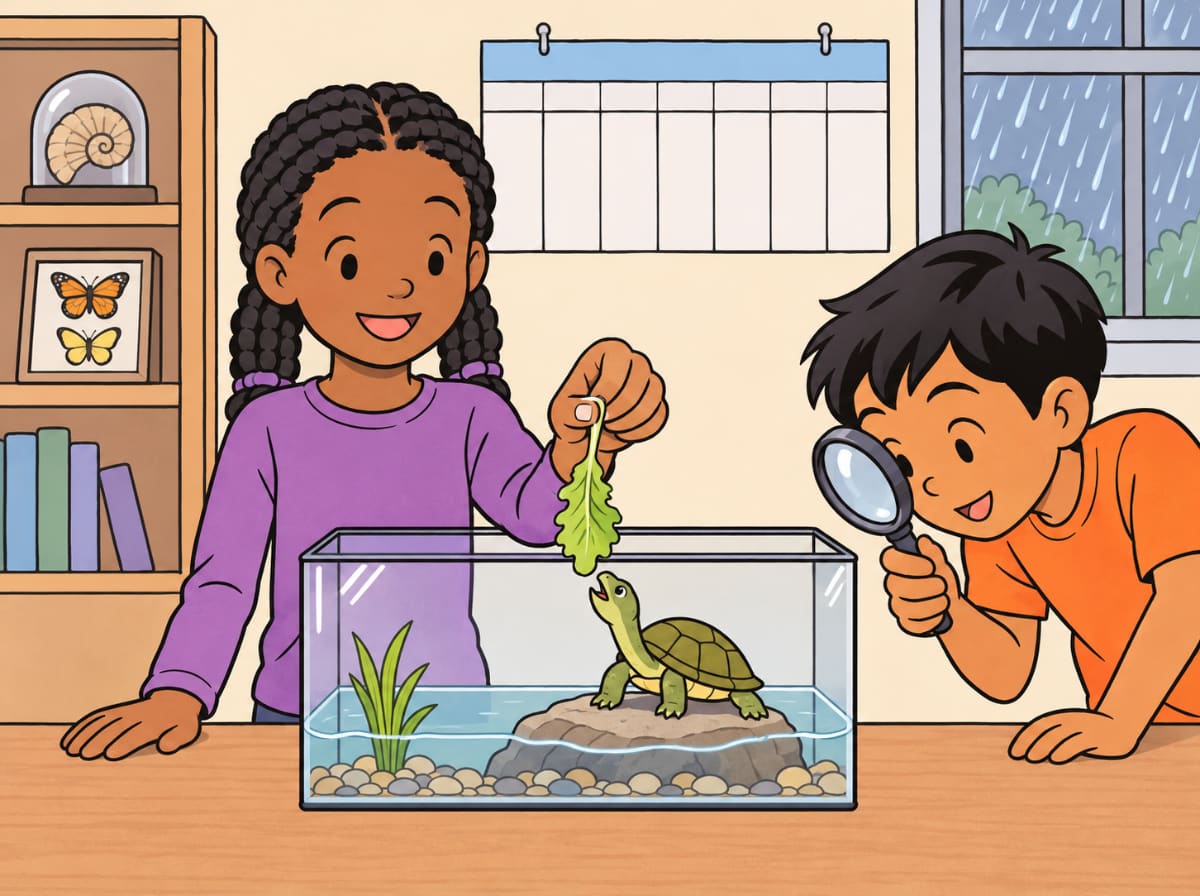
Picture description
The picture shows a classroom science corner. A girl with braids is feeding a piece of lettuce to a green turtle in a glass tank. A boy next to her is looking at the turtle through a magnifying glass. A calendar hangs on the wall. Outside the window, it is raining.
Look at the picture. Listen to the question. Then answer.
Look at the picture. What animal is in the tank?
Scoring rubric
| Level | What it looks like |
|---|---|
| 4: Exemplary |
|
| 3: Strong |
|
| 2: Adequate |
|
| 1: Attempted |
|
A strong sample response
A turtle. It's a turtle. A green turtle. It is in the water tank.
This matches the level 1 target of a Pre-A task: the right English word, repeated in a short memorized frame with one describing word. The single word "turtle" would also meet the target.
What to look for
- Pre-A tasks are for students just beginning English. One clear English word that answers the question meets the goal.
- If the student points without speaking, point too and say "turtle," then ask again.
- Answers in another language show understanding but stay at the lowest rubric level; note them and model the English word.
Prompt 2: Pre-A tier tasks
Suggested time: about 1 minutes
Model answer: read this aloud first
Listen to the model student answer a similar question first.
Model answer
Transcript for the adult to read aloud. The student listens and does not read it.
Ms. Phillips: Look at the picture. What is the boy holding?
Theo: A magnifying glass. He look at the turtle.
The student's own task
Look at the picture.
Social and Instructional: Our Classroom
Picture description
The picture shows a classroom science corner. A girl with braids is feeding a piece of lettuce to a green turtle in a glass tank. A boy next to her is looking at the turtle through a magnifying glass. A calendar hangs on the wall. Outside the window, it is raining.
Look at the picture. Listen to the question. Then answer.
Look at the picture. What is the girl doing?
Scoring rubric
| Level | What it looks like |
|---|---|
| 4: Exemplary |
|
| 3: Strong |
|
| 2: Adequate |
|
| 1: Attempted |
|
A strong sample response
Feeding. She is feeding the turtle. She give the turtle lettuce.
A level 1 action answer: the key verb, then the same idea in short memorized patterns. The missing -s on "give" is normal at this level and does not block meaning.
What to look for
- The question asks for an action, so listen for a verb such as feeding or giving.
- "Lettuce" or "turtle" alone is a fair start; ask "What is she doing?" to coax a verb.
- Don't correct grammar during the answer. Repeat it back correctly afterward: "Yes, she is feeding the turtle."
Prompt 3: Pre-A tier tasks
Suggested time: about 1 minutes
Model answer: read this aloud first
Listen to the model student answer a similar question first.
Model answer
Transcript for the adult to read aloud. The student listens and does not read it.
Ms. Phillips: Look at the picture. How many children are there?
Theo: Two. Two kids.
The student's own task
Look at the picture.
Social and Instructional: Our Classroom
Picture description
The picture shows a classroom science corner. A girl with braids is feeding a piece of lettuce to a green turtle in a glass tank. A boy next to her is looking at the turtle through a magnifying glass. A calendar hangs on the wall. Outside the window, it is raining.
Look at the picture. Listen to the question. Then answer.
Look at the picture. What is the weather like outside?
Scoring rubric
| Level | What it looks like |
|---|---|
| 4: Exemplary |
|
| 3: Strong |
|
| 2: Adequate |
|
| 1: Attempted |
|
A strong sample response
Rain. It's raining. It is rainy outside and the window is wet.
Both the single word and the short chunk "It's raining" meet the level 1 target. Weather words are among the first social words students learn.
What to look for
- Point to the window if the student is unsure where to look.
- Any weather word that fits (rain, rainy, wet) answers the task.
- Praise a full chunk like "It's raining," but don't require it at Pre-A.
Prompt 4: Tier A tasks
Suggested time: about 1 minutes
Model answer: read this aloud first
Listen to the model student answer a similar question first.
Model answer
Transcript for the adult to read aloud. The student listens and does not read it.
Ms. Phillips: Look at the picture. Who is bringing the letters?
Theo: The mail carrier. He has a big bag.
The student's own task
Look at the picture.
Social Studies: Helpers on Our Street
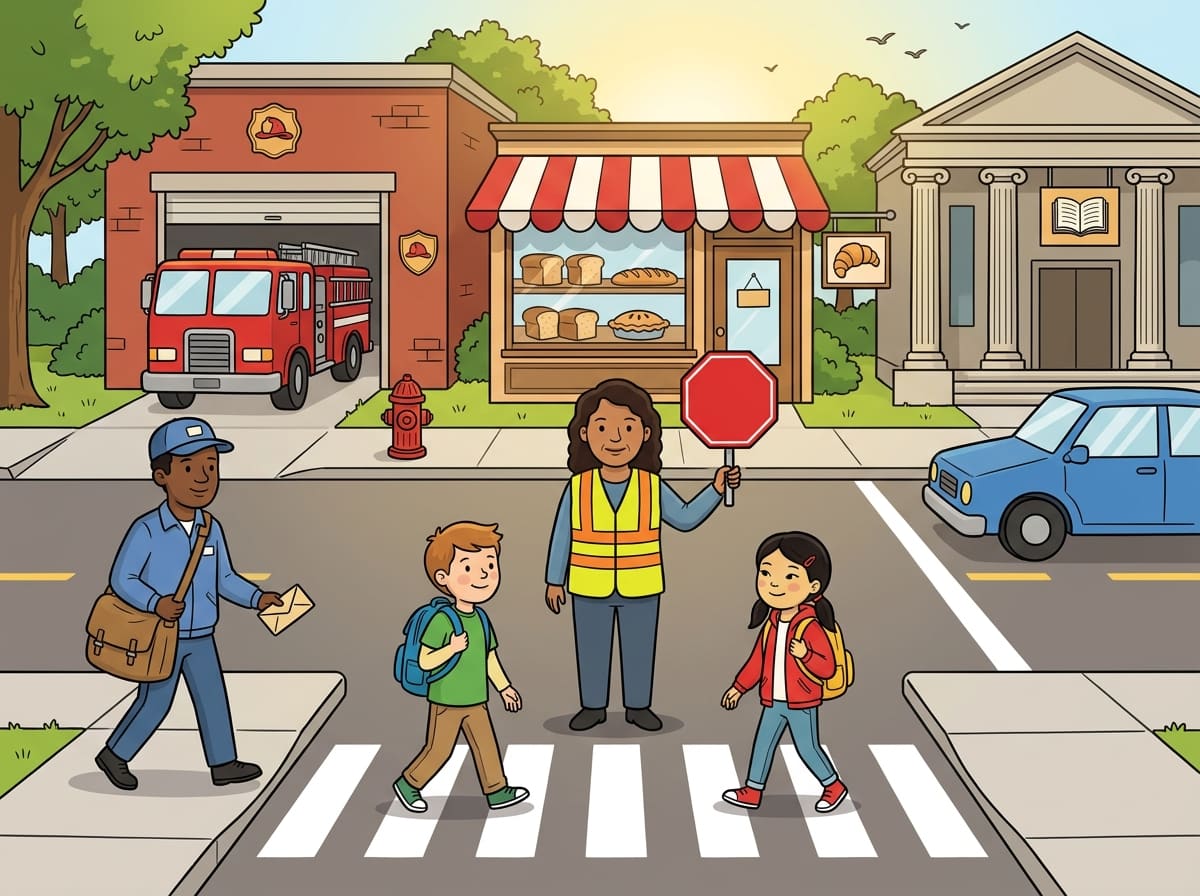
Picture description
The picture shows a busy town street in the morning. A crossing guard in a bright yellow vest holds up a red stop sign so two children with backpacks can cross the street. A mail carrier walks along the sidewalk with a bag full of letters. Along the street there is a fire station with a red fire truck parked in front, a bakery with bread in the window, and a library.
Look at the picture. Listen to the question. Then answer.
Look at the picture. Who is helping the children cross the street?
Scoring rubric
| Level | What it looks like |
|---|---|
| 4: Exemplary |
|
| 3: Strong |
|
| 2: Adequate |
|
| 1: Attempted |
|
A strong sample response
The crossing guard. She hold the stop sign so the kids can cross.
This is the level 1 task in the tier: it names the helper and adds one detail from the picture, as the model does.
What to look for
- "Crossing guard" is the precise word. "The lady" or "the helper" still answers but uses less specific language than the model.
- Listen for a detail that shows the student looked closely, such as the stop sign or vest.
Prompt 5: Tier A tasks
Suggested time: about 2 minutes
Model answer: read this aloud first
Listen to the model student answer a similar question first.
Model answer
Transcript for the adult to read aloud. The student listens and does not read it.
Ms. Phillips: A firefighter works at the fire station. Tell me what a firefighter does and why that job is important.
Theo: A firefighter puts out fires. They drive the big red truck to the fire, and they spray water on it. The job is important because firefighters keep people safe.
The student's own task
Look at the picture.
Social Studies: Helpers on Our Street
Picture description
The picture shows a busy town street in the morning. A crossing guard in a bright yellow vest holds up a red stop sign so two children with backpacks can cross the street. A mail carrier walks along the sidewalk with a bag full of letters. Along the street there is a fire station with a red fire truck parked in front, a bakery with bread in the window, and a library.
Look at the picture. Listen to the question. Then answer. Say as much as you can.
Tell what the crossing guard does and why that job is important.
Scoring rubric
| Level | What it looks like |
|---|---|
| 4: Exemplary |
|
| 3: Strong |
|
| 2: Adequate |
|
| 1: Attempted |
|
A strong sample response
The crossing guard help kids cross the street. She hold up the stop sign and the cars stop. Her job is important because the kids can go to school safe and not get hurt by a car.
A level 3 answer: several connected sentences that say what the helper does and give a reason with "because," like the model. Small errors ("help," "safe") don't get in the way.
What to look for
- The task has two parts: what the job is and why it matters. Check for both.
- A reason with "because" or "so" is the step up from level 1 to level 3.
- If the student stops after one sentence, ask, "Why do we need crossing guards?"
Prompt 6: Tier A tasks
Suggested time: about 2 minutes
Model answer: read this aloud first
Listen to the model student answer a similar question first.
Model answer
Transcript for the adult to read aloud. The student listens and does not read it.
Ms. Phillips: Which place on a street does your family go to the most? Tell why.
Theo: My family goes to the grocery store the most. We go every Saturday because we need food for the week. I like it because my mom lets me pick the apples.
The student's own task
Look at the picture.
Social Studies: Helpers on Our Street
Picture description
The picture shows a busy town street in the morning. A crossing guard in a bright yellow vest holds up a red stop sign so two children with backpacks can cross the street. A mail carrier walks along the sidewalk with a bag full of letters. Along the street there is a fire station with a red fire truck parked in front, a bakery with bread in the window, and a library.
Look at the picture. Listen to the question. Then answer. Say as much as you can.
Look at the picture. Which place on this street would you like to visit? Tell why.
Scoring rubric
| Level | What it looks like |
|---|---|
| 4: Exemplary |
|
| 3: Strong |
|
| 2: Adequate |
|
| 1: Attempted |
|
A strong sample response
I want to go to the library. I like books about animals, and I can get a library card. Also it is quiet there, so I can read.
A level 3 answer that names a place and gives two reasons, joined with "and," "also" and "so." It is close to the model in length and connection.
What to look for
- Any place in the picture is fine; the reason is what counts.
- Listen for joining words such as because, and, also and so.
- Students may talk about their own lives here. That is a good sign, not a problem.
Prompt 7: Tier B/C tasks
Suggested time: about 2 minutes
Model answer: read this aloud first
Listen to the model student answer a similar question first.
Model answer
Transcript for the adult to read aloud. The student listens and does not read it.
Ms. Phillips: Our class did a test with two wet towels. We hung one towel in the sun and one in the shade. After an hour, the towel in the sun was dry, and the towel in the shade was still wet. Tell me what happened to the towels.
Theo: We hung up two wet towels. One was in the sun and one was in the shade. After one hour, the sunny towel was all dry, but the towel in the shade was still wet.
The student's own task
Look at the picture and listen.
Science: The Sunny Window Test
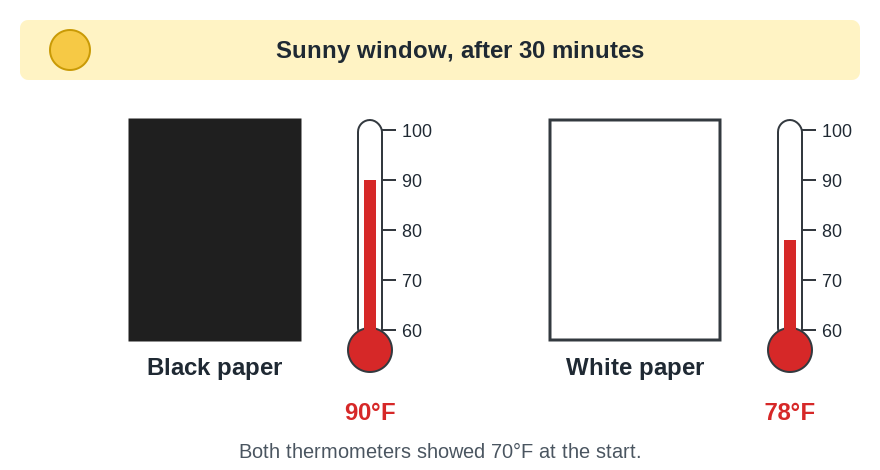
Picture description
Room 6 put two thermometers on a sunny windowsill. They covered one with a sheet of black paper and the other with a sheet of white paper. At the start, both thermometers showed 70 degrees. After thirty minutes, the class looked again. The thermometer under the black paper showed 90 degrees. The thermometer under the white paper showed 78 degrees.
Look at the picture. Listen to the question. Then answer. Say as much as you can.
Look at the picture. Tell what happened to the temperature under each paper.
Scoring rubric
| Level | What it looks like |
|---|---|
| 4: Exemplary |
|
| 3: Strong |
|
| 2: Adequate |
|
| 1: Attempted |
|
A strong sample response
The class put two thermometers in the sunny window. One had black paper on it and one had white paper. At the start they were both 70 degrees. After thirty minutes, the black paper one went up to 90 degrees, but the white paper one only went up to 78. So it got hotter under the black paper.
This is the level 3 task in the tier, describing the two results. The answer sets up the test, compares the two papers with "but," and uses time and number details, as the model does.
What to look for
- This task asks what happened, not why. A clear comparison of the two papers is enough.
- Strong answers use words like temperature, degrees, hotter and after thirty minutes.
- If the student describes only one paper, ask, "And the other paper?"
Prompt 8: Tier B/C tasks
Suggested time: about 2 minutes
Model answer: read this aloud first
Listen to the model student answer a similar question first.
Model answer
Transcript for the adult to read aloud. The student listens and does not read it.
Ms. Phillips: Now explain why the towel in the sun dried faster. Use what you know about heat and water.
Theo: The towel in the sun dried faster because the sun heats things up. When the water in the towel got warm, it evaporated, which means it turned into water vapor and went into the air. The towel in the shade stayed cooler, so the water evaporated much more slowly. So heat makes water dry up faster.
The student's own task
Look at the picture and listen.
Science: The Sunny Window Test
Picture description
Room 6 put two thermometers on a sunny windowsill. They covered one with a sheet of black paper and the other with a sheet of white paper. At the start, both thermometers showed 70 degrees. After thirty minutes, the class looked again. The thermometer under the black paper showed 90 degrees. The thermometer under the white paper showed 78 degrees.
Listen to the question. Then answer. Say as much as you can.
Explain why it got warmer under the black paper than under the white paper. Use what you know about sunlight and heat.
Scoring rubric
| Level | What it looks like |
|---|---|
| 4: Exemplary |
|
| 3: Strong |
|
| 2: Adequate |
|
| 1: Attempted |
|
A strong sample response
It got warmer under the black paper because dark colors soak up more of the sunlight. When the paper takes in the light, the light turns into heat, so the thermometer went up a lot. White paper bounces most of the light away, so it did not get as hot. That's why people wear light colors in the summer. If we did the test on a cloudy day, I think both would stay almost the same.
A level 5 explanation: it gives a cause, uses science words (sunlight, heat, soak up, bounces) and links ideas with because, so and if. It connects the result to everyday life and adds a prediction, matching the model's depth.
What to look for
- At level 5 the student explains cause and effect, not just what they saw.
- Listen for the science idea that dark colors take in more sunlight and turn it into heat, and for linking words such as because, so, when and if.
- An answer that only repeats the temperatures is closer to the level 3 task; ask, "Why do you think that happened?"
Prompt 9: Tier B/C tasks
Suggested time: about 2 minutes
Model answer: read this aloud first
Listen to the model student answer a similar question first.
Model answer
Transcript for the adult to read aloud. The student listens and does not read it.
Ms. Phillips: Our school can have a longer recess or a longer art class. Which should it choose? Give reasons.
Theo: I think the school should choose a longer recess. First, kids need to move their bodies after sitting all morning, and running helps us pay attention later. Also, recess is when we make friends from other classes. Some kids might want more art, but we already have art two times a week. That's why a longer recess is the better choice.
The student's own task
Read and listen.
Social Studies: A Class Decision
The parent group gave Room 6 some money. The class can spend it on one of two things.
Choice 1: a class pet, a small fish in a tank. The class would take turns feeding it and cleaning the tank.
Choice 2: twenty new books for the class library, chosen by the students.
Read and listen. Then answer. Say as much as you can.
Your class can buy a class fish or twenty new books. Which should the class choose? Give reasons for your choice.
Scoring rubric
| Level | What it looks like |
|---|---|
| 4: Exemplary |
|
| 3: Strong |
|
| 2: Adequate |
|
| 1: Attempted |
|
A strong sample response
I think our class should get the new books. First, everybody can use the books at the same time, but only one or two kids can feed the fish. Second, we get to pick the books, so there will be books that everyone likes. Some people want the fish because it's fun to watch, but a fish needs a lot of care, and if we forget to feed it, it could die. That's why the books are the better choice for our class.
A level 5 argument: a clear opinion, two ordered reasons, an answer to the other side and a closing sentence, held together with first, second, because, but and if. Either choice can earn this level.
What to look for
- Either choice is fine. Judge the reasons, not the opinion.
- Strong answers give more than one reason and connect them with words like first, also and because.
- Answering the other side ("Some people want...") is a mark of level 5 argument; point it out in the model if the student skips it.
Unofficial practice. This site is not affiliated with, endorsed by, or connected to WIDA, the Wisconsin Center for Education Research, or the Board of Regents of the University of Wisconsin System. WIDA and WIDA ACCESS are trademarks of the Board of Regents of the University of Wisconsin System. Every question here is original practice material written to match the published test design.