WIDA reading practice questions for 2nd and 3rd grade
Passages, charts and pictures with questions in groups of three, from social and classroom language to language arts, math, science and social studies.
Teaching this in class? It is all free online, and the Grades 2–3 printable pack ($8.99) has a booklet for every student, the answer key, rubrics and audio.
These 30 questions are grouped by task type, one group at a time. Answer a question to see whether it was right and why. Nothing is timed and nothing is recorded. Printable version with the answer key.
Set 1 of 3. 0 of 30 questions answered.
Level A folders
Easier folders, aimed at proficiency levels 1 to 3: short texts with pictures, labels and simple sentences.
Read the passage. Then answer the questions.
Social and Instructional: Indoor Recess Rules
When it rains, we have recess in our classroom. Here are our rules.
1. Pick one game or one book.
2. Use quiet voices.
3. Share the games with your friends.
4. When the timer rings, clean up.
Have fun!
Question 1 of 12
Choose the best answer.
When do students have recess in the classroom?
Question 2 of 12
Choose the best answer.
What kind of voices should students use?
Question 3 of 12
Choose the best answer.
What should students do when the timer rings?
Look at the menu. Then answer the questions.
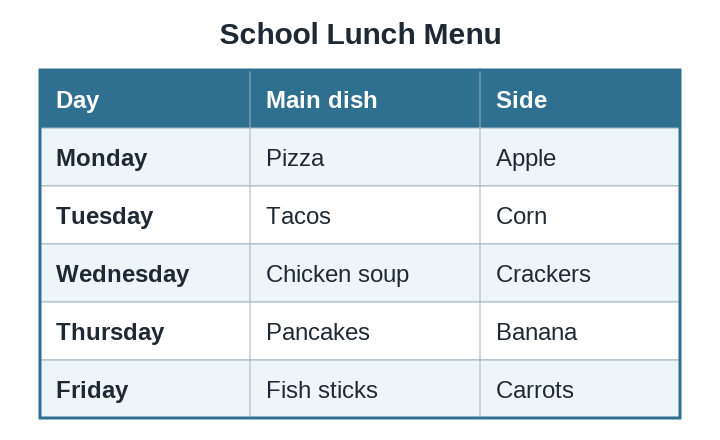
Social and Instructional: This Week's Lunch Menu
Read image description
The menu shows school lunch for one week.
Monday: pizza and an apple. Tuesday: tacos and corn. Wednesday: chicken soup and crackers. Thursday: pancakes and a banana. Friday: fish sticks and carrots.
Question 4 of 12
Choose the best answer.
What is for lunch on Wednesday?
Question 5 of 12
Choose the best answer.
Which day has pancakes for lunch?
Question 6 of 12
Choose the best answer.
Megan does not eat fish. On which day might she bring lunch from home?
Read the passage. Then answer the questions.
Language Arts: Omar's Library Card
Omar got his very first library card. It was blue, and it had his name on it.
He picked out three books. One was about sharks. One was about trains. One was a funny story about a dog.
The librarian smiled. "Bring them back in two weeks," she said.
At home, Omar read the shark book first. He liked it so much that he read it two times.
Question 7 of 12
Choose the best answer.
What color was Omar's library card?
Question 8 of 12
Choose the best answer.
When does Omar need to return the books?
Question 9 of 12
Choose the best answer.
Which book did Omar like best?
Look at the picture graph and read. Then answer the questions.
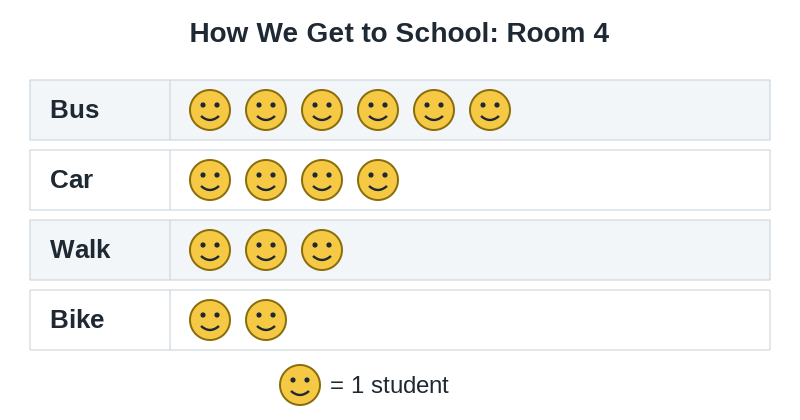
Mathematics: How We Get to School
Read image description
Room 4 made a picture graph. It shows how students get to school. Each face stands for one student.
Bus: 6 students. Car: 4 students. Walk: 3 students. Bike: 2 students.
Question 10 of 12
Choose the best answer.
How do most students in Room 4 get to school?
Question 11 of 12
Choose the best answer.
How many students walk to school?
Question 12 of 12
Choose the best answer.
How many more students ride the bus than come by car?
12 questions in this set are still unanswered. You can move on without answering them.
Ready for the whole thing? Take the reading practice test for Grades 2–3.
Answer key: every answer, explained
The correct answer to every question above, with why it is right and why each other choice is wrong. Open a question to see its answer.
Level A folders
1. When do students have recess in the classroom?
From “Social and Instructional: Indoor Recess Rules”
- When it is sunny
- When it rainsCorrect answer
- Every Friday
- Before school
Why “When it rains” is correct
The first sentence answers this: "When it rains, we have recess in our classroom." This is a common classroom sign, the kind of social and instructional text that opens the test.
Why the other answers are wrong
- When it is sunny — On sunny days students would go outside.
- Every Friday — No day of the week is named.
- Before school — The sign is about recess, not before school.
2. What kind of voices should students use?
From “Social and Instructional: Indoor Recess Rules”
- Loud voices
- Silly voices
- Quiet voicesCorrect answer
- No voices
Why “Quiet voices” is correct
Rule 2 says, "Use quiet voices." The "No voices" choice checks that the student knows quiet does not mean silent.
Why the other answers are wrong
- Loud voices — This is the opposite of rule 2.
- Silly voices — Silly voices are not in the rules.
- No voices — Students may talk, but quietly.
3. What should students do when the timer rings?
From “Social and Instructional: Indoor Recess Rules”
- Pick a book
- Go outside
- Share a game
- Clean upCorrect answer
Why “Clean up” is correct
Rule 4 links the timer to cleaning up. The wrong choices are the other rules, so the student must find the right line, not just a familiar phrase.
Why the other answers are wrong
- Pick a book — Picking a game or book is rule 1, at the start of recess.
- Go outside — Recess is inside because of rain.
- Share a game — Sharing happens during recess, not when the timer rings.
4. What is for lunch on Wednesday?
From “Social and Instructional: This Week's Lunch Menu”
- Chicken soup and crackersCorrect answer
- Tacos and corn
- Pizza and an apple
- Fish sticks and carrots
Why “Chicken soup and crackers” is correct
The student reads across the Wednesday row of the menu. Each wrong choice is a real lunch from a different day, so the student has to match day and food.
Why the other answers are wrong
- Tacos and corn — Tacos and corn are on Tuesday.
- Pizza and an apple — Pizza and an apple are on Monday.
- Fish sticks and carrots — Fish sticks and carrots are on Friday.
5. Which day has pancakes for lunch?
From “Social and Instructional: This Week's Lunch Menu”
- Monday
- ThursdayCorrect answer
- Tuesday
- Friday
Why “Thursday” is correct
This works in the other direction: find the food, then read the day. Pancakes are on Thursday.
Why the other answers are wrong
- Monday — Monday has pizza.
- Tuesday — Tuesday has tacos.
- Friday — Friday has fish sticks.
6. Megan does not eat fish. On which day might she bring lunch from home?
From “Social and Instructional: This Week's Lunch Menu”
- FridayCorrect answer
- Wednesday
- Monday
- Thursday
Why “Friday” is correct
This asks the student to apply the menu to a new situation. Friday is the only day with fish, so that is the day Megan would want another lunch. Wednesday is tempting because soup is less familiar, but it is chicken soup.
Why the other answers are wrong
- Wednesday — Wednesday has chicken soup, not fish.
- Monday — Monday has pizza, not fish.
- Thursday — Thursday has pancakes, not fish.
7. What color was Omar's library card?
From “Language Arts: Omar's Library Card”
- Red
- Green
- Yellow
- BlueCorrect answer
Why “Blue” is correct
The first lines say the card "was blue, and it had his name on it." This is a key-detail question at level A.
Why the other answers are wrong
- Red — Red is not mentioned.
- Green — Green is not mentioned.
- Yellow — Yellow is not mentioned.
8. When does Omar need to return the books?
From “Language Arts: Omar's Library Card”
- In two days
- In one month
- In two weeksCorrect answer
- The next morning
Why “In two weeks” is correct
The librarian's words give the time: "Bring them back in two weeks." "Two days" checks whether the student read the whole phrase.
Why the other answers are wrong
- In two days — The librarian says weeks, not days.
- In one month — A month is not mentioned.
- The next morning — The librarian gives Omar two weeks.
9. Which book did Omar like best?
From “Language Arts: Omar's Library Card”
- The book about trains
- The book about sharksCorrect answer
- The funny dog story
- A book about the library
Why “The book about sharks” is correct
The passage never says "best," so the student has to infer it. Omar read the shark book first and then read it two times, which shows it was his favorite.
Why the other answers are wrong
- The book about trains — Omar does not say anything about the train book.
- The funny dog story — The story is mentioned, but Omar reads the shark book twice.
- A book about the library — There is no book about the library.
10. How do most students in Room 4 get to school?
From “Mathematics: How We Get to School”
- By car
- They walk
- By busCorrect answer
- By bike
Why “By bus” is correct
"Most" means the row with the most faces. The bus row has six, the longest row on the graph.
Why the other answers are wrong
- By car — Four students come by car; more come by bus.
- They walk — Three students walk.
- By bike — Only two students ride bikes, the fewest.
11. How many students walk to school?
From “Mathematics: How We Get to School”
- 3Correct answer
- 2
- 4
- 6
Why “3” is correct
The student finds the Walk row and counts the faces: three. Every wrong choice is the count from another row.
Why the other answers are wrong
- 2 — Two is the bike row.
- 4 — Four is the car row.
- 6 — Six is the bus row.
12. How many more students ride the bus than come by car?
From “Mathematics: How We Get to School”
- 4
- 10
- 6
- 2Correct answer
Why “2” is correct
"How many more" asks for a difference: six bus riders minus four car riders is two. The language of comparison is the real challenge here, so a student who adds the rows gets ten.
Why the other answers are wrong
- 4 — Four is the number who come by car, not the difference.
- 10 — Ten adds the two rows instead of comparing them.
- 6 — Six is the number who ride the bus.
Level B folders
13. Why does a dandelion seed have a fluffy top?
From “Science: How Seeds Travel”
- So the wind can carry it far awayCorrect answer
- So birds will want to eat it
- So it can stick to a dog's fur
- So it can float across the ocean
Why “So the wind can carry it far away” is correct
The passage compares the fluffy top to a parachute and says that when the wind blows, "it floats far away." The student must link a part of the seed to its job. Each wrong choice borrows the way a different seed travels.
Why the other answers are wrong
- So birds will want to eat it — Birds eat berries in the passage, not dandelion seeds.
- So it can stick to a dog's fur — Hooks on burdock seeds are what stick to fur.
- So it can float across the ocean — The coconut is the seed that floats across the ocean.
14. Why is it good for a seed to land away from its parent plant?
From “Science: How Seeds Travel”
- Seeds need to grow in the dark, under the big plant
- It has more room and light to growCorrect answer
- Animals cannot find it there
- The wind is stronger far away
Why “It has more room and light to grow” is correct
The first paragraph says seeds need space, sunlight and water to grow, "so it helps when they land away from the parent plant." The student must find the reason and recognize it in new words, a key skill in science reading.
Why the other answers are wrong
- Seeds need to grow in the dark, under the big plant — The passage says seeds need sunlight, not darkness.
- Animals cannot find it there — The passage says animals help carry some seeds; it does not say seeds hide from them.
- The wind is stronger far away — The strength of the wind is not the reason given.
15. How do burdock seeds travel to new places?
From “Science: How Seeds Travel”
- They float on water
- The wind blows them like parachutes
- Their hooks stick to fur or socksCorrect answer
- They roll down hills
Why “Their hooks stick to fur or socks” is correct
The third paragraph says burdock seeds "have tiny hooks" that stick to a dog's fur or a person's socks and later fall off somewhere new. The question checks that the student can match a seed to its way of traveling.
Why the other answers are wrong
- They float on water — Floating on water is how a coconut travels.
- The wind blows them like parachutes — The wind carries dandelion seeds.
- They roll down hills — Rolling is not mentioned in the passage.
16. What is directly north of the school?
From “Social Studies: A Map of Brookfield”
- Pine Park
- Clear Creek
- The fire station
- The libraryCorrect answer
Why “The library” is correct
The student uses direction words and the compass rose. The library is across Oak Street to the north of the school. Mixing up north and east leads to Pine Park.
Why the other answers are wrong
- Pine Park — The park is east of the school.
- Clear Creek — The creek is south of the park.
- The fire station — The fire station is on Main Street, farther east.
17. What does the map key help you do?
From “Social Studies: A Map of Brookfield”
- Know what the colors on the map meanCorrect answer
- Find out what time the library opens
- Learn who lives in each house
- Tell which way is north
Why “Know what the colors on the map mean” is correct
This checks map vocabulary. The passage says the map key "tells what the colors mean." The north choice is a trap because the compass rose, a different map part, does that.
Why the other answers are wrong
- Find out what time the library opens — A map key does not give times.
- Learn who lives in each house — A map key does not list people.
- Tell which way is north — The compass rose shows directions, not the key.
18. Which building is next to the post office?
From “Social Studies: A Map of Brookfield”
- The library
- Brookfield School
- The fire stationCorrect answer
- The town hall
Why “The fire station” is correct
The passage and the map both show the fire station "right next to the post office" on Main Street. The student can find it on the map or in the text.
Why the other answers are wrong
- The library — The library is on Oak Street, north of the school.
- Brookfield School — The school is on Oak Street, on the other side of the map.
- The town hall — There is no town hall on this map.
19. Why did the snowballs keep falling apart?
From “Language Arts: The Snow Fort”
- The snow was melting fast in the morning sun
- The snow was too light and powderyCorrect answer
- Lucas stepped on them
- The bucket was too small
Why “The snow was too light and powdery” is correct
The second paragraph gives the cause with "But": the snow was too light and powdery. This is a cause-and-effect question in a story.
Why the other answers are wrong
- The snow was melting fast in the morning sun — The story does not say the snow was melting.
- Lucas stepped on them — Lucas does not break the snowballs.
- The bucket was too small — The bucket comes later and works well.
20. What did the children do after the snowballs fell apart?
From “Language Arts: The Snow Fort”
- They went inside to play
- They asked Keisha's mom to come help them build
- They waited for more snow
- They used a bucket to make blocksCorrect answer
Why “They used a bucket to make blocks” is correct
This tests sequence. After the snowball plan failed, Lucas packed snow into a bucket and flipped it to make blocks. The student must place events in order.
Why the other answers are wrong
- They went inside to play — They kept working outside.
- They asked Keisha's mom to come help them build — Mom comes later with cocoa, not help.
- They waited for more snow — They found a new way right away.
21. Why does Keisha's mom say, "Builders need a break"?
From “Language Arts: The Snow Fort”
- She wants them to stop building for good
- She can see they have worked hardCorrect answer
- She is a builder at her job
- She thinks the fort is too small
Why “She can see they have worked hard” is correct
Mom calls the children "builders" and brings cocoa after a morning of work. The student must infer that she is recognizing their effort, a common character question at this level.
Why the other answers are wrong
- She wants them to stop building for good — She offers a break and cocoa, not an end.
- She is a builder at her job — She calls the children builders.
- She thinks the fort is too small — The fort is already taller than Lucas.
Level C folders
22. Which item will the class probably bake more of next year?
From “Mathematics: The Room 12 Bake Sale”
- CookiesCorrect answer
- Muffins
- Brownies
- Banana bread
Why “Cookies” is correct
The last sentence says they will bake more of the item that sold the most. The student must connect that sentence to the tallest bar on the graph, which is cookies at 24.
Why the other answers are wrong
- Muffins — Muffins sold well, but fewer than cookies.
- Brownies — Brownies sold 12, half as many as cookies.
- Banana bread — Banana bread sold the fewest.
23. How many more cookies than brownies did the class sell?
From “Mathematics: The Room 12 Bake Sale”
- 24
- 36
- 6
- 12Correct answer
Why “12” is correct
Cookies sold 24 and brownies 12, so the difference is 12. The student must read two bars and understand that "how many more" means subtract.
Why the other answers are wrong
- 24 — Twenty-four is the number of cookies, not the difference.
- 36 — Thirty-six adds the two items instead of comparing them.
- 6 — Six is the banana bread bar.
24. How much more money did the class raise than its goal?
From “Mathematics: The Room 12 Bake Sale”
- $60
- $50
- $10Correct answer
- $5
Why “$10” is correct
This is a two-step problem. Each item was one dollar, so the total is 18 + 24 + 12 + 6 = 60 dollars, and 60 minus the goal of 50 is 10. The passage only says they had "some left over," so the student must use the graph.
Why the other answers are wrong
- $60 — Sixty dollars is the total raised, not the amount over the goal.
- $50 — Fifty dollars is the goal itself.
- $5 — This does not match the numbers on the graph.
25. What is the main job of chlorophyll?
From “Science: Why Leaves Change Color”
- To keep the tree warm in winter
- To make leaves turn red in fall
- To help leaves fall off the tree before winter comes
- To help leaves use sunlight to make foodCorrect answer
Why “To help leaves use sunlight to make food” is correct
The first paragraph defines chlorophyll and its job. The student must pick that job from choices that mention other real events from the passage.
Why the other answers are wrong
- To keep the tree warm in winter — The passage does not say chlorophyll keeps the tree warm.
- To make leaves turn red in fall — Red colors are made by some trees in fall, after chlorophyll stops.
- To help leaves fall off the tree before winter comes — Leaves fall after they dry up, not because of chlorophyll.
26. Why do yellow and orange colors show in the fall?
From “Science: Why Leaves Change Color”
- The green fades, so the hidden colors showCorrect answer
- Cold nights paint the leaves yellow
- The tree makes new yellow leaves to stay warm
- New yellow leaves grow on top
Why “The green fades, so the hidden colors show” is correct
This asks for a cause the student must piece together from two paragraphs: the yellow and orange were "hidden all along" under the green, and in fall the green fades. The cold-nights choice is a common misunderstanding that the passage corrects.
Why the other answers are wrong
- Cold nights paint the leaves yellow — The colors were already in the leaves; nothing paints them.
- The tree makes new yellow leaves to stay warm — The passage does not connect yellow to warmth.
- New yellow leaves grow on top — No new leaves grow until spring.
27. Which of these happens first in the fall?
From “Science: Why Leaves Change Color”
- The leaves fall to the ground
- The tree grows new green leaves
- The days get shorterCorrect answer
- The leaves dry up
Why “The days get shorter” is correct
This tests sequence in a science text. Shorter days and cooler nights start the change; drying and falling come later, and new leaves come in spring.
Why the other answers are wrong
- The leaves fall to the ground — Leaves fall later, after they dry up.
- The tree grows new green leaves — New leaves grow in spring.
- The leaves dry up — Leaves dry up after the colors change.
28. Which of these is a service?
From “Social Studies: Goods and Services on Maple Street”
- A loaf of bread
- A haircutCorrect answer
- A cherry pie
- A bag of flour
Why “A haircut” is correct
The passage defines a service as work one person does for another and gives the haircut as the example. Every other choice is a good from the passage.
Why the other answers are wrong
- A loaf of bread — Bread is a good: something made that you can hold.
- A cherry pie — A pie is a good, sold at the bakery.
- A bag of flour — Flour is a good, grown and sold by the farm.
29. How do Mr. Wilson and Ms. Ortiz depend on each other?
From “Social Studies: Goods and Services on Maple Street”
- They work in the same shop
- Ms. Ortiz bakes the bread
- They both grow flour
- Each one buys from the otherCorrect answer
Why “Each one buys from the other” is correct
The third paragraph explains: she buys his bread, and he gets his hair cut at her salon. The student must combine two sentences to describe the relationship.
Why the other answers are wrong
- They work in the same shop — Their shops are next door to each other, not the same shop.
- Ms. Ortiz bakes the bread — Mr. Wilson bakes; Ms. Ortiz buys bread.
- They both grow flour — The flour comes from a farm outside of town.
30. What is the main idea of the passage?
From “Social Studies: Goods and Services on Maple Street”
- Bread is the best thing to buy on Maple Street on a Saturday
- Haircuts cost more than pies
- Buying goods and services in town helps everyoneCorrect answer
- Farms are far away from towns
Why “Buying goods and services in town helps everyone” is correct
Level C reading asks for the main idea of a whole passage. The details about goods, services and buying from each other all lead to the last sentence: spending in town helps local businesses.
Why the other answers are wrong
- Bread is the best thing to buy on Maple Street on a Saturday — The passage does not say any item is best.
- Haircuts cost more than pies — Prices are not given.
- Farms are far away from towns — The farm is "just outside of town."
More WIDA practice for 2nd and 3rd grade
- WIDA listening practice for 2nd and 3rd grade
- WIDA speaking practice for 2nd and 3rd grade
- WIDA writing practice for 2nd and 3rd grade
- WIDA listening practice test for 2nd and 3rd grade
- WIDA reading practice test for 2nd and 3rd grade
- WIDA listening practice test 2 for 2nd and 3rd grade
- WIDA reading practice test 2 for 2nd and 3rd grade
Read next
- WIDA Listening and Reading Test: Folders, Levels and Adaptivity: On WIDA ACCESS Online, listening and reading questions come in folders: one recording or text with a small group of questions about it. The test is adaptive, so after each folder it moves the student to easier or harder material. Listening and reading are taken first, and the results decide the tier of speaking and writing. Here is how they work.
- How to Prepare for WIDA ACCESS: A Practical Plan for Parents: WIDA ACCESS measures English that grows over months and years, so there is no shortcut to a higher level. What preparation can do is make the test familiar, so your child's real English shows on the day. The best plan is the official WIDA demos, a few weeks of short practice in each domain, and plenty of talk and reading at home, in any language.
- WIDA Scale Scores: How They Relate to Proficiency Levels: Every WIDA ACCESS score report gives two numbers for each domain and composite: a scale score and a proficiency level. The proficiency level (1.0 to 6.0) is the number schools and states usually act on. The scale score is what the level is worked out from, and it is the better number for tracking growth. In 2025–26, WIDA reset the scale, so scale scores from before 2026 cannot be compared with scale scores from 2026 on.
Unofficial practice. This site is not affiliated with, endorsed by, or connected to WIDA, the Wisconsin Center for Education Research, or the Board of Regents of the University of Wisconsin System. WIDA and WIDA ACCESS are trademarks of the Board of Regents of the University of Wisconsin System. Every question here is original practice material written to match the published test design.