WIDA writing practice for 2nd and 3rd grade
Printable version. Original practice written to match the published WIDA format, not questions from the official test.
Writing prompts
On the real test these are scored by a trained person against a rubric. The rubric and a sample response follow each prompt.
Prompt 1: Tier A tasks
Suggested time: about 15 minutes
Look at the three pictures.
Language Arts: The Sandcastle
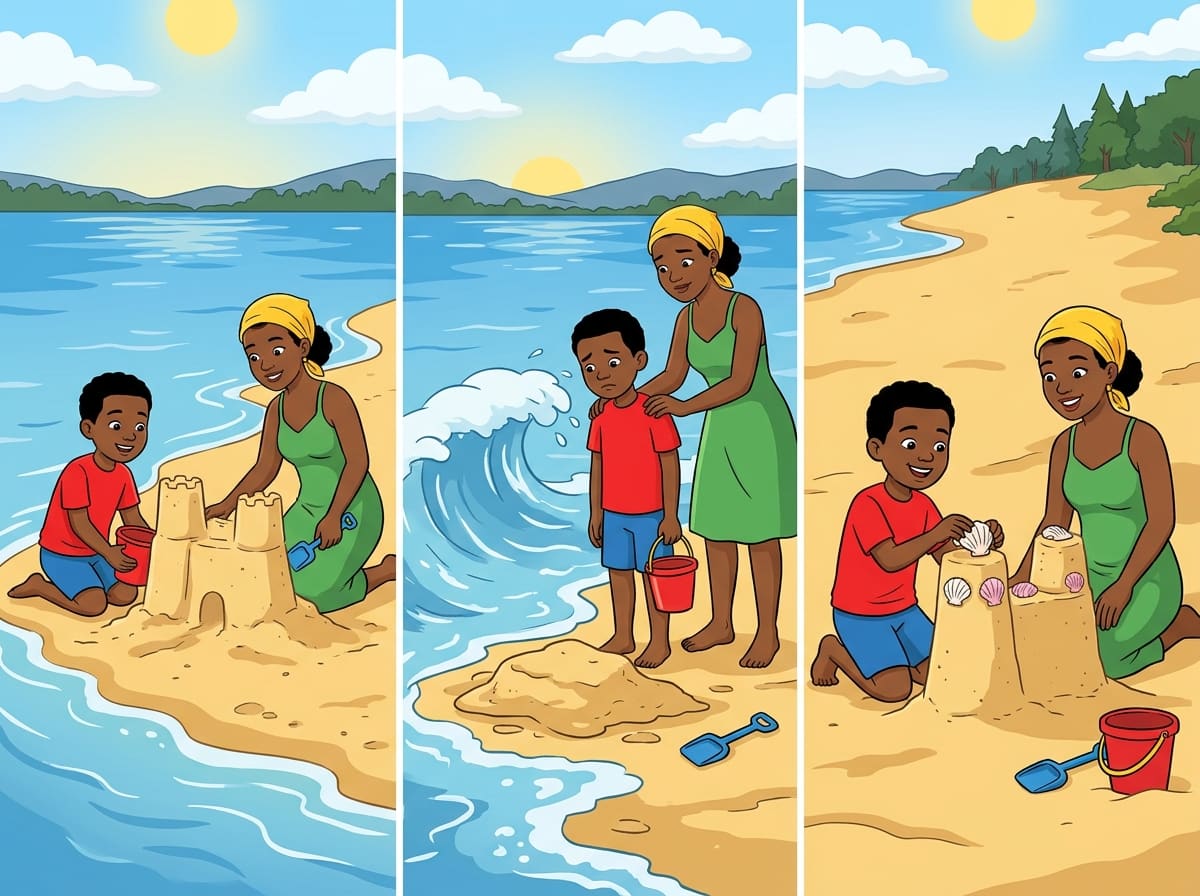
Picture description
Picture 1: Malik and his aunt build a big sandcastle on the beach, close to the water. Malik has a red bucket, and his aunt has a shovel.
Picture 2: A big wave washes over the sandcastle. Now it is only a flat pile of wet sand. Malik looks sad.
Picture 3: Malik and his aunt build a new sandcastle farther from the water. Malik puts shells on top, and he is smiling.
Look at the pictures. Write your story on paper.
Write a story about Malik and his aunt. Tell what happens first, next and last. Words you can use: sandcastle, beach, bucket, shovel, wave, water, sad, shells
Scoring rubric
| Level | What it looks like |
|---|---|
| 7: Fully developed |
|
| 6: Well developed |
|
| 5: Developed |
|
| 4: Expanding |
|
| 3: Emerging |
|
| 2: Beginning |
|
| 1: Starting |
|
A strong sample response
Malik and his aunt go to the beach. They make a big sandcastle with a bucket and a shovel. Next a big wave come and wash the sandcastle away. Malik is sad because the castle is gone. Last Malik and his aunt make a new sandcastle far from the water. He put shells on the top. Malik is happy because the wave can not get it.
About level 4: several related sentences that follow the three pictures in order, with first-next-last thinking and two reasons with "because." Verb endings are often missing and words come mostly from the word bank, which keeps it below level 5.
What to look for
- Students in grades 2 and 3 handwrite on the real test, in a paper booklet. Have the student print the answer on paper rather than type it.
- This is a narrate task. Check that the story follows the pictures in order and uses time words such as first, next, then and last.
- A response that only lists words from the word bank sits around level 2; whole sentences that connect move it up.
- A blank, copied or off-topic page is not scored at a level; note it and try again with the pictures.
Prompt 2: Tier A tasks
Suggested time: about 15 minutes
Look at the picture.
Science: Birds in Winter
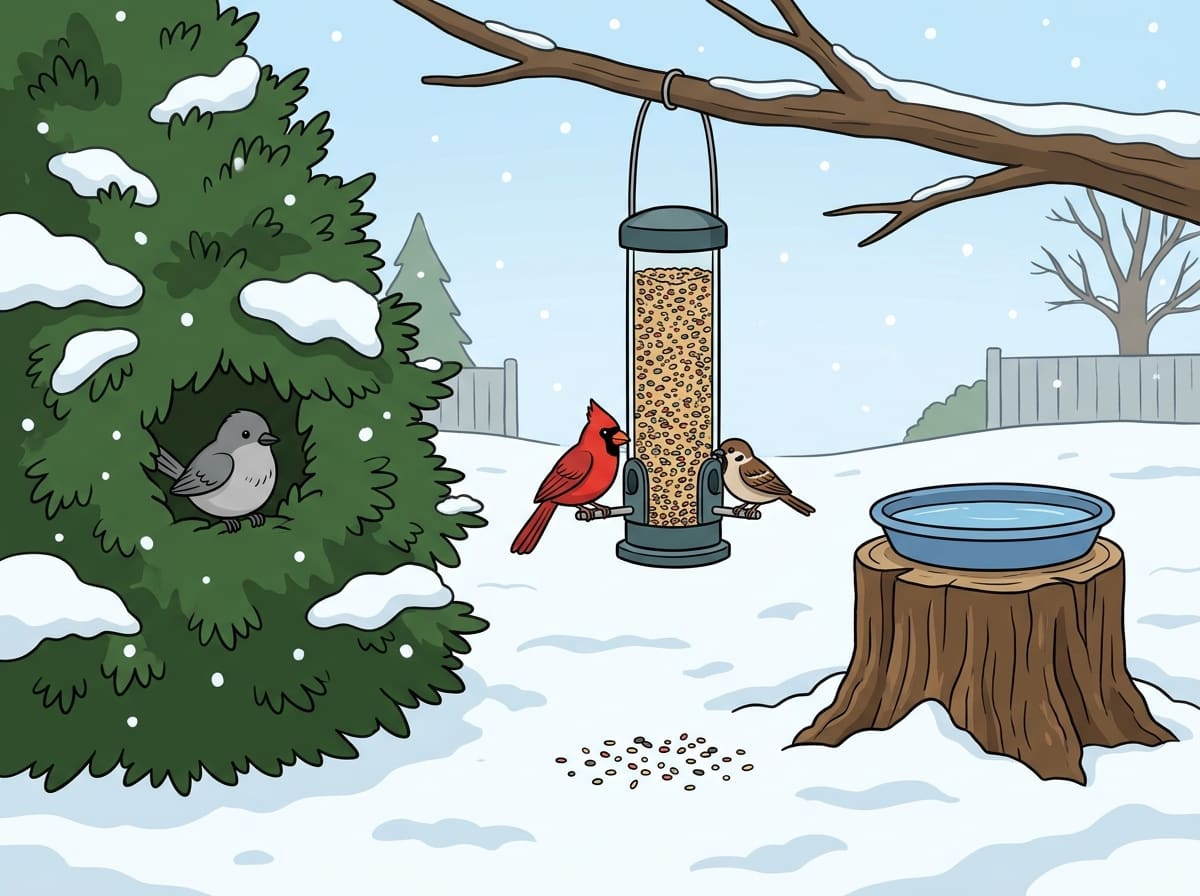
Picture description
The picture shows a snowy backyard in winter. Two birds are eating seeds at a bird feeder that hangs from a tree. A shallow dish of water sits on a tree stump. A small bird is sitting inside a thick, green bush, out of the wind.
Look at the picture. Write your answer on paper.
Birds need food, water and a safe place in winter. Look at the picture. Write about how people can help birds in winter. Words you can use: seeds, feeder, water, bush, safe, cold, snow
Scoring rubric
| Level | What it looks like |
|---|---|
| 7: Fully developed |
|
| 6: Well developed |
|
| 5: Developed |
|
| 4: Expanding |
|
| 3: Emerging |
|
| 2: Beginning |
|
| 1: Starting |
|
A strong sample response
In winter it is cold and there is snow. Birds need help. People can put seeds in a feeder so the birds can eat. People can give water in a dish. Birds need a safe place to hide from the wind, like a bush. Then the birds are ok in winter.
About level 4: the response informs, covering food, water and a safe place in connected sentences, with "so," "like" and "then." Vocabulary leans on the word bank, and sentences repeat the "People can..." pattern.
What to look for
- Students in grades 2 and 3 handwrite on the real test, in a paper booklet. Have the student print the answer on paper rather than type it.
- This is an inform task. Look for all three needs from the prompt: food, water and a safe place.
- Words from the word bank are expected. Reward a sentence that explains, such as "so the birds can eat."
- If the student writes in another language, note which ideas they have and help them say one in English.
Prompt 3: Tier B/C tasks
Suggested time: about 20 minutes
Read and look at the graph.
Mathematics and Science: The Bounce Test
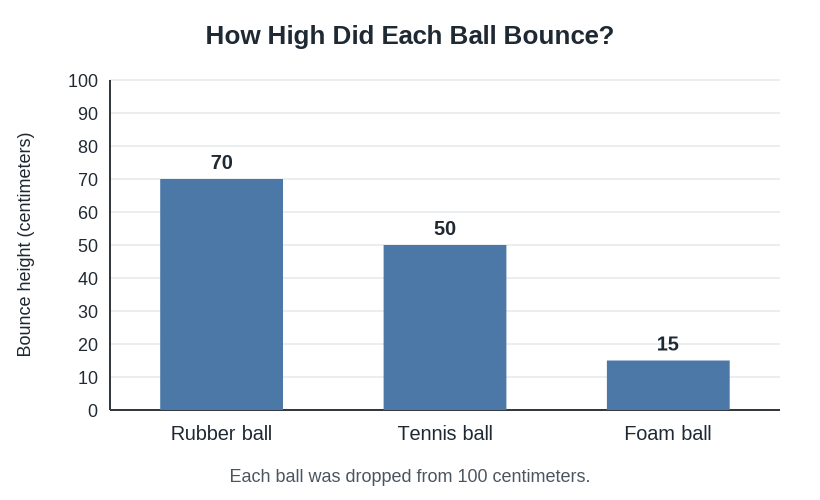
Picture description
Room 6 tested three balls: a rubber ball, a tennis ball and a foam ball. They dropped each ball from 100 centimeters, the same height every time, and measured how high it bounced.
The graph shows the results. The rubber ball bounced 70 centimeters. The tennis ball bounced 50 centimeters. The foam ball bounced 15 centimeters.
Read the information and look at the graph. Write your answer on paper.
Write a short report for your class newsletter about the bounce test. Explain what the class did, what the graph shows and why you think the balls bounced to different heights. Use numbers from the graph.
Scoring rubric
| Level | What it looks like |
|---|---|
| 7: Fully developed |
|
| 6: Well developed |
|
| 5: Developed |
|
| 4: Expanding |
|
| 3: Emerging |
|
| 2: Beginning |
|
| 1: Starting |
|
A strong sample response
Room 6 did a bounce test to find out which ball bounces the highest. We dropped a rubber ball, a tennis ball and a foam ball from 100 centimeters. We used the same height every time so the test would be fair.
The graph shows that the rubber ball bounced the highest, 70 centimeters. The tennis ball bounced 50 centimeters, which is 20 centimeters lower. The foam ball only bounced 15 centimeters, so the rubber ball bounced more than four times as high as the foam ball.
I think the balls bounced differently because they are made of different materials. The rubber ball is hard and springy, so it pushes back off the floor. The foam ball is soft and squishy, so when it hits the floor, it squashes and loses its bounce. Next time we could try a basketball to see if a bigger ball bounces even higher.
About level 6 to 7: organized into what the class did, what the data shows and an explanation, with linking words (so, which, because, when). It compares numbers precisely and uses math and science words (centimeters, fair, materials, springy).
What to look for
- Students in grades 2 and 3 handwrite on the real test, in a paper booklet. Have the student print the answer on paper rather than type it.
- This task joins math and science. Strong reports use exact numbers from the graph and compare them, not just list them.
- The "why" part is where higher levels show: look for a reason tied to what the balls are made of.
- Grade 2 students may write less than this sample; organization and linking words matter more than length.
Prompt 4: Tier B/C tasks
Suggested time: about 20 minutes
Read about the two choices.
Language Arts and Social Studies: A New Project for Pine Park
The town of Brookfield has enough money to build one new thing at Pine Park. The mayor wants to hear from students before the town decides.
Choice 1: A splash pad. A splash pad has fountains and sprayers for children to play in. It would be open from June to August. It would be free, and it would sit next to the playground.
Choice 2: A bike path. The path would go all the way around the park and connect to Brookfield School. It would be open all year, except when there is snow. People could ride bikes, scooters and skates away from cars.
Read about the two choices. Write your letter on paper.
Write a letter to the mayor of Brookfield. Tell which new project the town should build at Pine Park, a splash pad or a bike path. Give reasons from the information, and tell why your choice is better than the other one.
Scoring rubric
| Level | What it looks like |
|---|---|
| 7: Fully developed |
|
| 6: Well developed |
|
| 5: Developed |
|
| 4: Expanding |
|
| 3: Emerging |
|
| 2: Beginning |
|
| 1: Starting |
|
A strong sample response
Dear Mayor,
I think Brookfield should build the bike path at Pine Park. My first reason is that the bike path would be open almost all year. The splash pad would only be open from June to August, so for most of the school year nobody could use it.
My second reason is safety. Right now my brother and I ride our bikes on the street, and the cars go really fast. The path would connect the park to Brookfield School, so kids could ride to school away from the cars.
Some people want the splash pad because it would be fun on hot days, and I agree it would be fun. But a bike path helps more people, because grown-ups and kids can both use it every day.
Please choose the bike path.
Sincerely,
Marcus
About level 6 to 7: an argument in letter form, with a clear opinion, two developed reasons from the information, a fair answer to the other side and a closing request. Linking words (first, so, because, but) join ideas across paragraphs.
What to look for
- Students in grades 2 and 3 handwrite on the real test, in a paper booklet. Have the student print the answer on paper rather than type it.
- This task joins language arts (writing a letter to argue) with social studies (a town making a choice). Either project can earn a high level.
- Check for reasons taken from the information, such as months open or safety from cars, and for a sentence that answers the other choice.
- Letter parts (greeting, closing) are a plus but matter less than clear reasons.
Unofficial practice. This site is not affiliated with, endorsed by, or connected to WIDA, the Wisconsin Center for Education Research, or the Board of Regents of the University of Wisconsin System. WIDA and WIDA ACCESS are trademarks of the Board of Regents of the University of Wisconsin System. Every question here is original practice material written to match the published test design.