WIDA reading practice questions for high school (grades 9–12)
Passages, charts and pictures with questions in groups of three, from social and classroom language to language arts, math, science and social studies.
Teaching this in class? It is all free online, and the Grades 9–12 printable pack ($8.99) has a booklet for every student, the answer key, rubrics and audio.
These 30 questions are grouped by task type, one group at a time. Answer a question to see whether it was right and why. Nothing is timed and nothing is recorded. Printable version with the answer key.
Set 1 of 3. 0 of 30 questions answered.
Level A folders
Easier folders, aimed at proficiency levels 1 to 3: short texts with pictures, labels and simple sentences.
Look at the flyer. Then answer the questions.
Social and Instructional: Driver Education Sign-Up
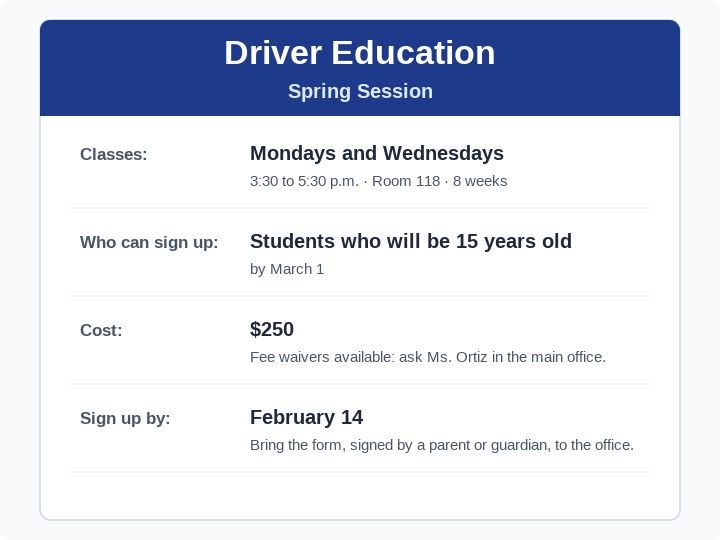
Read image description
The flyer is a notice from the main office. At the top it says: Driver Education, Spring Session.
Classes: Mondays and Wednesdays, 3:30 to 5:30 p.m., in Room 118. The session runs for eight weeks.
Who can sign up: students who will be 15 years old by March 1.
Cost: $250. Fee waivers are available. Ask Ms. Ortiz in the main office.
Sign up by February 14. Bring the sign-up form with a parent or guardian's signature to the main office.
Question 1 of 12
Choose the best answer.
When do driver education classes meet?
Question 2 of 12
Choose the best answer.
Who can sign up for the spring session?
Question 3 of 12
Choose the best answer.
A student wants to take the class but cannot pay $250. What should the student do?
Read the email. Then answer the questions.
Social and Instructional: An Email About Yearbook Photos
From: Ms. Rogers. To: Rafael Torres. Subject: Your first yearbook job.
Hi Rafael, Thank you for joining the yearbook team! Your first job is to take photos at the girls' soccer game on Thursday at 4:00 at Riverside Field.
Please pick up the school camera from Room 205 before 3:30 on Thursday. Do not take the camera home after the game. Bring it back to Room 205 on Friday morning.
Send me your ten best photos by Monday. Reply to this email to tell me you can do it. Thank you, Ms. Rogers
Question 4 of 12
Choose the best answer.
Why did Ms. Rogers write to Rafael?
Question 5 of 12
Choose the best answer.
When should Rafael pick up the camera?
Question 6 of 12
Choose the best answer.
What is Rafael NOT allowed to do?
Read the passage. Then answer the questions.
Language Arts: The Bookshelf
Jamal opened the big flat box. Inside were twelve boards, a bag of screws and one page of instructions with no words, only drawings. The bookshelf was a birthday present for his little sister, Aisha, and her party was the next day.
After an hour, the shelf leaned to one side like a tired tree. Jamal threw the instructions on the floor. "This makes no sense!" he said.
His mother picked up the page and turned it around. "You were reading it upside down," she said, smiling. Jamal laughed. He took the shelf apart and started again. This time, every board fit.
The next day, Aisha put all her books on the shelf and gave him a big hug. Jamal stood a little taller.
Question 7 of 12
Choose the best answer.
How does Jamal feel after the first hour?
Question 8 of 12
Choose the best answer.
What does the author mean by saying the shelf "leaned to one side like a tired tree"?
Question 9 of 12
Choose the best answer.
What does "Jamal stood a little taller" show at the end of the story?
Look at the table. Then answer the questions.
Math: Comparing Summer Jobs
Read image description
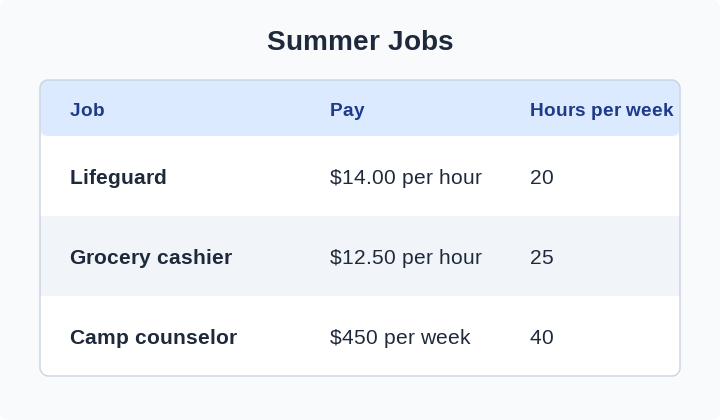
The table compares three summer jobs.
Lifeguard: $14.00 per hour, 20 hours per week.
Grocery cashier: $12.50 per hour, 25 hours per week.
Camp counselor: $450 per week, 40 hours per week.
Question 10 of 12
Choose the best answer.
Which job pays the most for each hour of work?
Question 11 of 12
Choose the best answer.
How much does a grocery cashier earn in one week?
Question 12 of 12
Choose the best answer.
Which job pays the most money in one week?
12 questions in this set are still unanswered. You can move on without answering them.
Ready for the whole thing? Take the reading practice test for Grades 9–12.
Answer key: every answer, explained
The correct answer to every question above, with why it is right and why each other choice is wrong. Open a question to see its answer.
Level A folders
1. When do driver education classes meet?
From “Social and Instructional: Driver Education Sign-Up”
- Every day after school
- Tuesdays and Thursdays during the lunch period
- Saturdays in the morning
- Mondays and Wednesdays after schoolCorrect answer
Why “Mondays and Wednesdays after school” is correct
The flyer lists 'Mondays and Wednesdays, 3:30 to 5:30 p.m.' Since school usually ends before 3:30, 'after school' is a fair restatement. Reading a schedule and matching it to a paraphrase is a basic level A skill.
Why the other answers are wrong
- Every day after school — Classes meet two days a week, not every day.
- Tuesdays and Thursdays during the lunch period — The days and time are wrong; classes are Monday and Wednesday afternoons.
- Saturdays in the morning — No Saturday classes are listed.
2. Who can sign up for the spring session?
From “Social and Instructional: Driver Education Sign-Up”
- Only students who already have a license
- Students who will be 15 by March 1Correct answer
- Any student in grades 9 to 12
- Students who are 16 or older
Why “Students who will be 15 by March 1” is correct
The flyer says the class is for 'students who will be 15 years old by March 1.' Choice c sounds reasonable for a high school, but the flyer sets an age rule, not a grade rule.
Why the other answers are wrong
- Only students who already have a license — Driver education is for students who do not have a license yet; the flyer says nothing about one.
- Any student in grades 9 to 12 — The rule is about age, not grade level.
- Students who are 16 or older — The flyer says 15, not 16.
3. A student wants to take the class but cannot pay $250. What should the student do?
From “Social and Instructional: Driver Education Sign-Up”
- Ask Ms. Ortiz about a fee waiverCorrect answer
- Wait until the summer session
- Pay half now and half later
- Ask the driving teacher in Room 118
Why “Ask Ms. Ortiz about a fee waiver” is correct
The flyer says, 'Fee waivers are available. Ask Ms. Ortiz in the main office.' A fee waiver means the student does not have to pay. The student must connect the problem in the question to the right line on the flyer.
Why the other answers are wrong
- Wait until the summer session — No summer session is mentioned.
- Pay half now and half later — A payment plan is not offered on the flyer.
- Ask the driving teacher in Room 118 — Room 118 is where classes meet, not where to ask about cost.
4. Why did Ms. Rogers write to Rafael?
From “Social and Instructional: An Email About Yearbook Photos”
- To tell him his grade in yearbook
- To ask him to play in the soccer game
- To give him his first yearbook jobCorrect answer
- To invite him to join the yearbook team
Why “To give him his first yearbook job” is correct
The subject line and the first sentences say this is Rafael's "first yearbook job": taking photos at the soccer game. The rest of the email explains the details. A purpose question asks why the message was written.
Why the other answers are wrong
- To tell him his grade in yearbook — Grades are not mentioned.
- To ask him to play in the soccer game — He will take photos at the game, not play in it.
- To invite him to join the yearbook team — Ms. Rogers thanks him for joining, so he is already on the team.
5. When should Rafael pick up the camera?
From “Social and Instructional: An Email About Yearbook Photos”
- Monday after school
- Thursday before 3:30Correct answer
- Thursday after the game
- Friday morning
Why “Thursday before 3:30” is correct
The email says to pick up the camera "from Room 205 before 3:30 on Thursday." The other choices use other days and times from the email, so the student must match the right action to the right time.
Why the other answers are wrong
- Monday after school — Monday is when the photos are due.
- Thursday after the game — After the game, he should not take the camera home; he needs it before the game starts.
- Friday morning — Friday morning is when he returns the camera.
6. What is Rafael NOT allowed to do?
From “Social and Instructional: An Email About Yearbook Photos”
- Take photos at Riverside Field
- Go to Room 205 on Friday
- Reply to Ms. Rogers's email
- Take the camera home after the gameCorrect answer
Why “Take the camera home after the game” is correct
The email says, "Do not take the camera home after the game." The word NOT in the question is important: the other choices are things the email asks him to do.
Why the other answers are wrong
- Take photos at Riverside Field — Taking photos at the game is his job.
- Go to Room 205 on Friday — He is told to bring the camera back to Room 205 on Friday morning.
- Reply to Ms. Rogers's email — Ms. Rogers asks him to reply.
7. How does Jamal feel after the first hour?
From “Language Arts: The Bookshelf”
- UpsetCorrect answer
- Bored
- Sleepy
- Very proud
Why “Upset” is correct
Jamal throws the instructions on the floor and says, "This makes no sense!" These actions show he is upset. The question asks the reader to infer a feeling from what a character does and says.
Why the other answers are wrong
- Bored — He is busy working on the shelf, not bored.
- Sleepy — Nothing in the story says he is sleepy.
- Very proud — He feels proud at the end, not after the first hour.
8. What does the author mean by saying the shelf "leaned to one side like a tired tree"?
From “Language Arts: The Bookshelf”
- The shelf was made from a tree.
- The shelf was too tall for the room.
- Jamal was tired and wanted to sleep.
- The shelf was not straight.Correct answer
Why “The shelf was not straight.” is correct
A tired tree bends over, so the comparison shows the shelf was crooked. The next events, Jamal's anger and the upside-down instructions, confirm that he had built it wrong.
Why the other answers are wrong
- The shelf was made from a tree. — The comparison is about the shelf's shape, not what it is made of.
- The shelf was too tall for the room. — The room and its size are not mentioned.
- Jamal was tired and wanted to sleep. — The word "tired" describes how the shelf looks, not how Jamal feels.
9. What does "Jamal stood a little taller" show at the end of the story?
From “Language Arts: The Bookshelf”
- He grew during the night.
- He was standing on the shelf.
- He felt proud of his work.Correct answer
- He wanted to be taller than Aisha.
Why “He felt proud of his work.” is correct
The shelf is finished, and Aisha hugs him. "Stood a little taller" is an expression for feeling proud. Students need to read the phrase as figurative, not literal.
Why the other answers are wrong
- He grew during the night. — This takes the phrase literally.
- He was standing on the shelf. — Nothing says he stood on the shelf.
- He wanted to be taller than Aisha. — His height compared with Aisha's is never discussed.
10. Which job pays the most for each hour of work?
From “Math: Comparing Summer Jobs”
- Camp counselor
- Grocery cashier
- All three pay the same
- LifeguardCorrect answer
Why “Lifeguard” is correct
Lifeguard pays $14.00 an hour, and cashier pays $12.50. The counselor's pay is given per week: $450 for 40 hours is $11.25 an hour. A student who picks 'camp counselor' because $450 is the biggest number has not compared pay per hour.
Why the other answers are wrong
- Camp counselor — $450 is the largest number in the table, but it is weekly pay; it works out to $11.25 an hour.
- Grocery cashier — $12.50 an hour is less than the lifeguard's $14.00.
- All three pay the same — The hourly rates are different.
11. How much does a grocery cashier earn in one week?
From “Math: Comparing Summer Jobs”
- $300.00
- $280.00
- $312.50Correct answer
- $337.50
Why “$312.50” is correct
Multiply the hourly pay by the hours: $12.50 times 25 is $312.50. The question checks reading two cells in the same row and using them together.
Why the other answers are wrong
- $300.00 — $300 would be $12 an hour, not $12.50.
- $280.00 — $280 is what a lifeguard earns in a week.
- $337.50 — $337.50 would need 27 hours at $12.50.
12. Which job pays the most money in one week?
From “Math: Comparing Summer Jobs”
- Lifeguard
- Camp counselorCorrect answer
- Grocery cashier
- Lifeguard and cashier pay the same
Why “Camp counselor” is correct
Each week, the lifeguard earns $280, the cashier earns $312.50, and the counselor earns $450. The counselor pays the least per hour but the most per week, because of the long hours. Comparing the two questions shows why it matters which rate a question asks about.
Why the other answers are wrong
- Lifeguard — The lifeguard has the best hourly pay but works only 20 hours, so earns $280.
- Grocery cashier — The cashier earns $312.50, less than the counselor's $450.
- Lifeguard and cashier pay the same — They earn $280 and $312.50, so not the same.
Level B folders
13. What happens inside the battery when a phone is charging?
From “Science: How a Phone Battery Stores Energy”
- Lithium ions move from the cathode to the anode.Correct answer
- Electrons pass through the separator.
- The electrolyte turns into graphite.
- Lithium ions leave the phone through the charger.
Why “Lithium ions move from the cathode to the anode.” is correct
Paragraph 2 says the charger 'pushes lithium ions out of the cathode... and into the anode.' The question asks the reader to follow the direction of a process, which the next paragraph reverses for using the phone.
Why the other answers are wrong
- Electrons pass through the separator. — The passage says electrons cannot cross the separator.
- The electrolyte turns into graphite. — Graphite is the material of the anode; the electrolyte does not change into it.
- Lithium ions leave the phone through the charger. — The ions stay inside the battery; they move between the electrodes.
14. Why does the author compare a charged battery to 'water pumped to the top of a hill'?
From “Science: How a Phone Battery Stores Energy”
- To show that batteries contain water
- To explain that batteries work better in high places
- To show that charging stores energy for laterCorrect answer
- To explain why batteries get hot
Why “To show that charging stores energy for later” is correct
Pumped water has stored energy that is released when it flows down; a charged battery stores energy the same way until the phone is used. Understanding an analogy means seeing what the two things have in common.
Why the other answers are wrong
- To show that batteries contain water — The comparison is about energy, not what is inside the battery.
- To explain that batteries work better in high places — Height is part of the picture, not a fact about batteries.
- To explain why batteries get hot — Heat is discussed in the last paragraph, not in this comparison.
15. According to the passage, why should people avoid leaving a phone in a hot car?
From “Science: How a Phone Battery Stores Energy”
- The screen could crack in the heat.
- Heat pushes the electrons through the separator.
- The phone will stop charging until it cools down.
- Heat speeds up the wear on a battery.Correct answer
Why “Heat speeds up the wear on a battery.” is correct
The last paragraph says that small changes on the electrodes build up and that 'heat speeds up these changes.' The advice about hot cars follows directly from that. The reader must connect a cause to the recommendation.
Why the other answers are wrong
- The screen could crack in the heat. — A cracked screen is not mentioned.
- Heat pushes the electrons through the separator. — Electrons cannot cross the separator, and heat is not said to change that.
- The phone will stop charging until it cools down. — The passage does not say a hot phone stops charging.
16. What did people in the boycott do instead of riding the buses?
From “Social Studies: The Montgomery Bus Boycott”
- They bought new buses for the city.
- They walked or shared rides in carpools.Correct answer
- They moved to cities in the North.
- They rode trains to work.
Why “They walked or shared rides in carpools.” is correct
Paragraph 3 says some people "walked several miles to work each day" and others "shared rides in a carpool system." The reader has to find how people got around once they stopped riding.
Why the other answers are wrong
- They bought new buses for the city. — Nobody in the passage buys buses.
- They moved to cities in the North. — The passage does not say people moved away.
- They rode trains to work. — Trains are not mentioned.
17. According to paragraph 3, why did the bus company lose so much money?
From “Social Studies: The Montgomery Bus Boycott”
- The city lowered the bus fare.
- Bus drivers went on strike.
- Most of its riders stopped using the buses.Correct answer
- The police took buses off the road.
Why “Most of its riders stopped using the buses.” is correct
Paragraph 3 explains that Black riders "had made up about three-quarters of the bus company's passengers," so when they stayed off the buses, the company lost much of its income. The reader must connect a fact to its effect.
Why the other answers are wrong
- The city lowered the bus fare. — Fares are not mentioned.
- Bus drivers went on strike. — The drivers did not strike; the riders boycotted.
- The police took buses off the road. — The police ticketed carpool drivers; they did not stop the buses.
18. Why does the author include the last paragraph?
From “Social Studies: The Montgomery Bus Boycott”
- To show the boycott's wider effect on the civil rights movementCorrect answer
- To explain how the carpool system worked
- To describe the day Rosa Parks was arrested
- To argue that the boycott did not succeed
Why “To show the boycott's wider effect on the civil rights movement” is correct
The first four paragraphs tell what happened in Montgomery. The last paragraph explains what it meant beyond the city: it showed what ordinary people could do and inspired later protests. A purpose question asks what a part adds to the whole text.
Why the other answers are wrong
- To explain how the carpool system worked — The carpools are described in paragraph 3.
- To describe the day Rosa Parks was arrested — The arrest is described in paragraph 1.
- To argue that the boycott did not succeed — The boycott succeeded: buses were desegregated after 381 days.
19. Why does Grandpa Walt keep looking out the window at the fields?
From “Language Arts: The Last Drive”
- He is worried about the snowstorm coming back.
- He is checking whether Rachel is driving too fast.
- He is looking for the Larsons' farm.
- He knows he may not make this drive again.Correct answer
Why “He knows he may not make this drive again.” is correct
The author says he looked 'as if he were trying to memorize them,' and then he shares that he will soon have to stop driving. Together, these details suggest he is taking in a view he may lose. This is an inference about a character's feelings.
Why the other answers are wrong
- He is worried about the snowstorm coming back. — The snow has stopped, and nothing suggests he expects more.
- He is checking whether Rachel is driving too fast. — He trusts her driving and says very little about it.
- He is looking for the Larsons' farm. — The Larsons' farm is a place from earlier lessons, not what he is searching for now.
20. When Rachel asks, "So who's going to take you places?" the author says 'she already knew.' What did she know?
From “Language Arts: The Last Drive”
- That the eye doctor would change his mind
- That he would stop going to town
- That her parents would drive him every week
- That she would be the one driving himCorrect answer
Why “That she would be the one driving him” is correct
The whole story builds toward this: Grandpa Walt has been teaching her, and now he can no longer drive. The last line confirms that the lessons were preparing her to take his place. The reader must infer an unstated answer.
Why the other answers are wrong
- That the eye doctor would change his mind — Nothing suggests the doctor will change the decision.
- That he would stop going to town — He still points out the ice on the bridge, which shows he expects to keep going places.
- That her parents would drive him every week — Her parents are never mentioned.
21. Which sentence best states a theme of the story?
From “Language Arts: The Last Drive”
- Driving in snow is far too dangerous for brand-new drivers.
- Older people should not trust young drivers.
- Teaching a skill can prepare someone to care for you.Correct answer
- Learning to drive is mostly about passing a test.
Why “Teaching a skill can prepare someone to care for you.” is correct
The final sentence says 'the lessons had never really been about passing a test.' Grandpa Walt has been preparing Rachel to drive him, and he relaxes once she handles the bridge well. Choice d is the idea the story rejects.
Why the other answers are wrong
- Driving in snow is far too dangerous for brand-new drivers. — Rachel drives safely in the snow, so the story does not suggest this.
- Older people should not trust young drivers. — Grandpa Walt trusts Rachel and relaxes beside her.
- Learning to drive is mostly about passing a test. — The last sentence says the opposite of this.
Level C folders
22. What is the key difference between simple and compound interest, according to the passage?
From “Math: The Slow Power of Compound Interest”
- Simple interest is paid monthly, and compound interest is paid yearly.
- Compound interest is also paid on earlier interest.Correct answer
- Simple interest uses a higher rate than compound interest.
- Compound interest grows by the same amount every year.
Why “Compound interest is also paid on earlier interest.” is correct
Paragraph 3 defines compound interest as interest 'calculated on the whole balance, including the interest you have already earned.' Choice d describes simple interest, so a reader who mixes up the two definitions will choose it.
Why the other answers are wrong
- Simple interest is paid monthly, and compound interest is paid yearly. — Both accounts in the passage are paid yearly.
- Simple interest uses a higher rate than compound interest. — Both use the same 5 percent rate; only the method differs.
- Compound interest grows by the same amount every year. — Growing by the same amount each year describes simple interest, not compound.
23. In paragraph 3, the word 'trivial' is closest in meaning to
From “Math: The Slow Power of Compound Interest”
- unfair
- surprising
- very smallCorrect answer
- complicated
Why “very small” is correct
The difference between $50 and $52.50 is only $2.50, and the sentence goes on with 'but,' signaling that the small difference grows. Context clues like a contrast word help readers figure out academic vocabulary at level C.
Why the other answers are wrong
- unfair — Nothing in the sentence is about fairness.
- surprising — The point is that the difference does not seem important, not that it is surprising.
- complicated — A $2.50 difference is simple to calculate, not complicated.
24. Based on the passage and the graph, which statement is best supported?
From “Math: The Slow Power of Compound Interest”
- The two accounts grow apart more quickly as the years go on.Correct answer
- The simple interest account is larger for the first ten years.
- The rule of 72 gives the exact doubling time for any account.
- Both accounts double in value about every 14 years.
Why “The two accounts grow apart more quickly as the years go on.” is correct
The graph shows the lines close at first and then spreading apart, and the passage says the compound balance 'increases faster and faster.' Choice d is a trap: the rule of 72 applies to the compound account; the simple account takes 20 years to double.
Why the other answers are wrong
- The simple interest account is larger for the first ten years. — The compound account is never smaller; the two are nearly equal at first.
- The rule of 72 gives the exact doubling time for any account. — The passage calls the rule of 72 'an approximation,' not exact.
- Both accounts double in value about every 14 years. — The simple account reaches $2,000 only at year 20, so it does not double every 14 years.
25. What role does marine snow play in the biological pump?
From “Science: The Ocean's Biological Pump”
- It carries carbon down to the deep ocean.Correct answer
- It blocks sunlight so that phytoplankton cannot grow.
- It releases carbon dioxide back into the atmosphere.
- It brings nutrients up from the ocean floor.
Why “It carries carbon down to the deep ocean.” is correct
Paragraph 3 explains that marine snow is made of sinking particles and that the carbon that reaches the deep ocean can be stored for centuries. The reader must understand the function of one step in a multi-step process.
Why the other answers are wrong
- It blocks sunlight so that phytoplankton cannot grow. — Marine snow sinks below the sunlit layer; nothing says it blocks light.
- It releases carbon dioxide back into the atmosphere. — Carbon recycled near the surface returns to the air; marine snow is the part that escapes that cycle.
- It brings nutrients up from the ocean floor. — Nutrients rise through mixing of water layers, not through marine snow.
26. As it is used in paragraph 3, the word 'sequestered' most nearly means
From “Science: The Ocean's Biological Pump”
- stored and kept apartCorrect answer
- broken down quickly
- pushed toward the surface
- turned into sunlight
Why “stored and kept apart” is correct
The sentence says the carbon can be sequestered 'for centuries, isolated from the atmosphere.' The word 'isolated' is a strong context clue for 'stored and kept apart.' Academic words like this are typical of level C reading.
Why the other answers are wrong
- broken down quickly — 'For centuries' suggests the carbon stays put, not that it breaks down quickly.
- pushed toward the surface — The carbon is in the deep ocean, not moving toward the surface.
- turned into sunlight — Carbon cannot be turned into sunlight, and the passage never suggests it.
27. Which statement would the author most likely agree with?
From “Science: The Ocean's Biological Pump”
- Warming will certainly destroy the biological pump within a few years.
- Phytoplankton are less important than land plants for absorbing carbon.
- Warming's effect on the pump is uncertain but worth study.Correct answer
- Marine snow is easy to measure because it falls in a straight line.
Why “Warming's effect on the pump is uncertain but worth study.” is correct
The last paragraph says 'the picture is not settled,' describes studies that disagree, and ends with scientists agreeing the pump is 'too important... to leave unmeasured.' Choice a overstates the concern in paragraph 4, a common trap in author's-view questions.
Why the other answers are wrong
- Warming will certainly destroy the biological pump within a few years. — The author presents this as a concern, not a certainty, and gives evidence on both sides.
- Phytoplankton are less important than land plants for absorbing carbon. — Paragraph 2 says phytoplankton carry out nearly half of Earth's photosynthesis, which makes them very important.
- Marine snow is easy to measure because it falls in a straight line. — The passage says marine snow is hard to measure because it is eaten and broken apart as it sinks.
28. What is the central claim of View 1?
From “Social Studies: Should Sixteen-Year-Olds Vote in City Elections?”
- Teenagers should be required to take civics classes.
- Voting at 16 could build a lifelong habit.Correct answer
- City elections matter less than state elections.
- Most young people move away from home at 16.
Why “Voting at 16 could build a lifelong habit.” is correct
The civics teacher argues that 'voting is a habit' and that letting people start at 16, when they are settled, creates 'lifelong voters.' The other details support this claim. Identifying a central claim means finding the idea the evidence is meant to prove.
Why the other answers are wrong
- Teenagers should be required to take civics classes. — Civics programs are proposed in View 2, not View 1.
- City elections matter less than state elections. — View 1 says city elections are the right place to start because they matter to teenagers.
- Most young people move away from home at 16. — View 1 says many people move away at 18, not 16.
29. How does the author of View 2 respond to the goal of raising participation?
From “Social Studies: Should Sixteen-Year-Olds Vote in City Elections?”
- She rejects the goal as unimportant.
- She shares the goal but doubts the plan.Correct answer
- She says teenagers already vote at high rates.
- She argues that the voting age should be raised to 21.
Why “She shares the goal but doubts the plan.” is correct
View 2 opens, 'I share the goal... but this proposal confuses eligibility with engagement.' That is a concession followed by a counterargument: she accepts the goal and disputes the method. Recognizing this structure is a key level C skill.
Why the other answers are wrong
- She rejects the goal as unimportant. — She says directly that she shares the goal.
- She says teenagers already vote at high rates. — She gives low turnout numbers for all ages; she does not say teenagers vote at high rates.
- She argues that the voting age should be raised to 21. — She argues voting should match other legal ages of 18, not move to 21.
30. Which piece of evidence, if true, would most strengthen View 1?
From “Social Studies: Should Sixteen-Year-Olds Vote in City Elections?”
- Turnout in city elections is low for voters of every age.
- Most legal responsibilities in the state begin at age 18.
- Polling places in Millbrook are hard to reach without a car.
- Teens who voted at 16 elsewhere kept voting as adults.Correct answer
Why “Teens who voted at 16 elsewhere kept voting as adults.” is correct
View 1 rests on the idea that starting young builds a habit. Evidence that early voters kept voting as adults would directly support that claim. Choices a and b support View 2, and c supports one of View 2's alternative proposals.
Why the other answers are wrong
- Turnout in city elections is low for voters of every age. — Low turnout for everyone is View 2's evidence that eligibility is not the real problem.
- Most legal responsibilities in the state begin at age 18. — This supports View 2's argument that voting should match other legal ages.
- Polling places in Millbrook are hard to reach without a car. — Hard-to-reach polling places support View 2's suggested alternatives.
More WIDA practice for high school (grades 9–12)
- WIDA listening practice for high school (grades 9–12)
- WIDA speaking practice for high school (grades 9–12)
- WIDA writing practice for high school (grades 9–12)
- WIDA listening practice test for high school (grades 9–12)
- WIDA reading practice test for high school (grades 9–12)
- WIDA listening practice test 2 for high school (grades 9–12)
- WIDA reading practice test 2 for high school (grades 9–12)
Read next
- WIDA Listening and Reading Test: Folders, Levels and Adaptivity: On WIDA ACCESS Online, listening and reading questions come in folders: one recording or text with a small group of questions about it. The test is adaptive, so after each folder it moves the student to easier or harder material. Listening and reading are taken first, and the results decide the tier of speaking and writing. Here is how they work.
- How to Prepare for WIDA ACCESS: A Practical Plan for Parents: WIDA ACCESS measures English that grows over months and years, so there is no shortcut to a higher level. What preparation can do is make the test familiar, so your child's real English shows on the day. The best plan is the official WIDA demos, a few weeks of short practice in each domain, and plenty of talk and reading at home, in any language.
- WIDA Scale Scores: How They Relate to Proficiency Levels: Every WIDA ACCESS score report gives two numbers for each domain and composite: a scale score and a proficiency level. The proficiency level (1.0 to 6.0) is the number schools and states usually act on. The scale score is what the level is worked out from, and it is the better number for tracking growth. In 2025–26, WIDA reset the scale, so scale scores from before 2026 cannot be compared with scale scores from 2026 on.
Unofficial practice. This site is not affiliated with, endorsed by, or connected to WIDA, the Wisconsin Center for Education Research, or the Board of Regents of the University of Wisconsin System. WIDA and WIDA ACCESS are trademarks of the Board of Regents of the University of Wisconsin System. Every question here is original practice material written to match the published test design.