WIDA listening practice questions for high school (grades 9–12)
Short recorded conversations, announcements, stories and lessons, each followed by questions, in groups of three like the real test's folders. A written transcript sits under each one.
Teaching this in class? It is all free online, and the Grades 9–12 printable pack ($8.99) has a booklet for every student, the answer key, rubrics and audio.
These 24 questions are grouped by task type, one group at a time. Answer a question to see whether it was right and why. Nothing is timed and nothing is recorded. Printable version with the answer key.
Set 1 of 3. 0 of 24 questions answered.
Level A folders
Easier folders, aimed at proficiency levels 1 to 3: short, everyday language with pictures and simple questions.
Press Play to hear the morning announcement. Then answer the questions.
Social and Instructional: Picture Day Schedule
Press play to listen. You can pause, rewind, and replay as often as you like.
Show transcript
Ms. Campbell: Good morning, students. This is Ms. Campbell, your assistant principal, with a change to Thursday's schedule.
Ms. Campbell: On Thursday, all ninth and tenth graders will have their school pictures taken in the gym. Please bring your student ID card with you.
Ms. Campbell: Because of picture day, second period will be fifteen minutes longer. Lunch will start at twelve fifteen instead of twelve o'clock.
Ms. Campbell: If you are absent on Thursday, you can have your picture taken on Friday after school, in the same place. Thank you, and have a great day.
Question 1 of 9
Choose the best answer.
Where will students have their pictures taken?
Question 2 of 9
Choose the best answer.
What should students bring on Thursday?
Question 3 of 9
Choose the best answer.
What can a student do if they are absent on Thursday?
Press Play to hear a teacher talk about a short story. Then answer the questions.
Language Arts: The Setting of a Story
Press play to listen. You can pause, rewind, and replay as often as you like.
Show transcript
Ms. Brandt: Today we are starting a new short story called 'The Orchard Road.' Open your books to page forty.
Ms. Brandt: The story takes place on an apple farm in western Michigan. It is early fall, and the apples are ready to pick.
Ms. Brandt: The person telling the story is a girl named Lena. She is sixteen, and she helps her grandmother pick apples and sell them at a farm stand by the road.
Ms. Brandt: As you read, look for words that show how busy and noisy the farm is. Write down two of those words in your notebook.
Question 4 of 9
Choose the best answer.
Where does the story take place?
Question 5 of 9
Choose the best answer.
Who tells the story?
Question 6 of 9
Choose the best answer.
What does Ms. Brandt want students to do while they read?
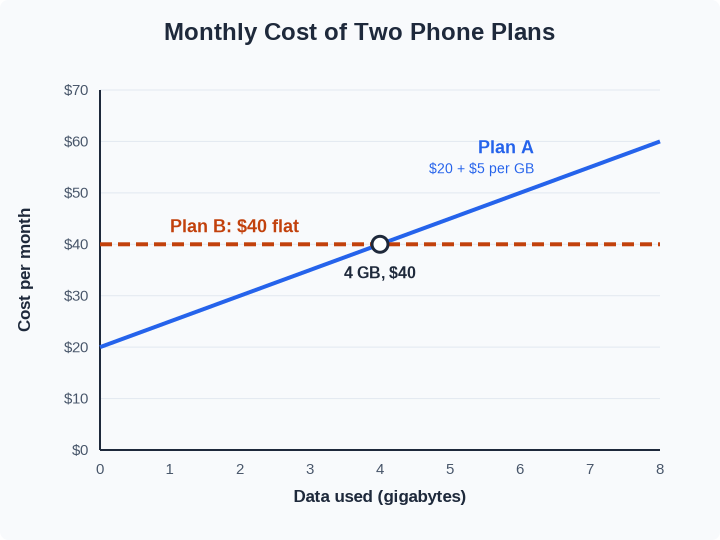
Look at the graph. Press Play to hear the teacher. Then answer the questions.
Math: Comparing Two Phone Plans
Press play to listen. You can pause, rewind, and replay as often as you like.
Show transcript
Mr. Mitchell: Look at the graph. It shows the monthly cost of two phone plans. The bottom of the graph shows gigabytes of data. The side shows the cost in dollars.
Mr. Mitchell: Plan A is the line that goes up. It costs twenty dollars a month, plus five dollars for each gigabyte you use.
Mr. Mitchell: Plan B is the flat line. It costs forty dollars a month, no matter how much data you use.
Mr. Mitchell: Find the point where the two lines cross. At four gigabytes, both plans cost exactly forty dollars.
Question 7 of 9
Choose the best answer.
Which plan costs the same amount every month?
Question 8 of 9
Choose the best answer.
At how many gigabytes do the two plans cost the same?
Question 9 of 9
Choose the best answer.
Sofia uses about two gigabytes of data each month. Which plan costs her less?
9 questions in this set are still unanswered. You can move on without answering them.
Ready for the whole thing? Take the listening practice test for Grades 9–12.
Answer key: every answer, explained
The correct answer to every question above, with why it is right and why each other choice is wrong. Open a question to see its answer.
Level A folders
1. Where will students have their pictures taken?
From “Social and Instructional: Picture Day Schedule”
- In the library
- In the gymCorrect answer
- In the cafeteria
- In the main office
Why “In the gym” is correct
This is a detail question about place. Ms. Campbell says the pictures will be taken 'in the gym' and repeats that make-up pictures are 'in the same place.' A student who catches the key noun can answer it.
Why the other answers are wrong
- In the library — The library is not mentioned in the announcement.
- In the cafeteria — The cafeteria connects to the lunch change, but pictures are not taken there.
- In the main office — The main office is a common place for announcements, but it is not where pictures are taken.
2. What should students bring on Thursday?
From “Social and Instructional: Picture Day Schedule”
- A permission form
- A lunch ticket
- A calendar of school events
- Their student ID cardCorrect answer
Why “Their student ID card” is correct
The announcement says, 'Please bring your student ID card with you.' The other choices are things students often bring to school events, so the student has to listen for the exact item named.
Why the other answers are wrong
- A permission form — No form is mentioned; this is a guess based on other school events.
- A lunch ticket — Lunch is mentioned only because its time changes, not as something to bring.
- A calendar of school events — A calendar is not mentioned.
3. What can a student do if they are absent on Thursday?
From “Social and Instructional: Picture Day Schedule”
- Have their picture taken on Friday after schoolCorrect answer
- Send a photo from home to the main office by email
- Have their picture taken next month
- Ask their second-period teacher for help
Why “Have their picture taken on Friday after school” is correct
The last part of the announcement gives the make-up plan: Friday after school, in the gym. Listening to the end of an announcement matters, because the most useful detail often comes last.
Why the other answers are wrong
- Send a photo from home to the main office by email — Sending a photo from home is never mentioned.
- Have their picture taken next month — The make-up day is the next day, Friday, not next month.
- Ask their second-period teacher for help — Second period is mentioned only because it will be longer.
4. Where does the story take place?
From “Language Arts: The Setting of a Story”
- In a busy city near the Atlantic Ocean
- In a desert town in summer
- In a mountain town in spring
- On an apple farm in the fallCorrect answer
Why “On an apple farm in the fall” is correct
The setting is the time and place of a story. Ms. Brandt says the story happens 'on an apple farm in western Michigan' in 'early fall.' Only one choice matches both the place and the season.
Why the other answers are wrong
- In a busy city near the Atlantic Ocean — The story is on a farm, not in a city by the ocean.
- In a desert town in summer — It is fall on a Michigan farm, so a desert in summer is wrong.
- In a mountain town in spring — The season is fall, and mountains are not mentioned.
5. Who tells the story?
From “Language Arts: The Setting of a Story”
- Lena's grandmother
- A girl named LenaCorrect answer
- Ms. Brandt
- A farmer from the next town
Why “A girl named Lena” is correct
The teacher says, 'The person telling the story is a girl named Lena.' This introduces the idea of a narrator. The grandmother is in the story, but she is not the one telling it.
Why the other answers are wrong
- Lena's grandmother — The grandmother is a character Lena helps, not the narrator.
- Ms. Brandt — Ms. Brandt is the teacher talking about the story, not the narrator.
- A farmer from the next town — No farmer from another town is mentioned.
6. What does Ms. Brandt want students to do while they read?
From “Language Arts: The Setting of a Story”
- Draw a map of the farm and label the road
- Answer the questions about apple picking on page forty
- Write two words that show the busy, noisy farmCorrect answer
- Read the story out loud with a partner in class
Why “Write two words that show the busy, noisy farm” is correct
The last instruction asks students to look for words that show how busy and noisy the farm is and to write two in their notebooks. Following a multi-part classroom direction is an important skill at every level.
Why the other answers are wrong
- Draw a map of the farm and label the road — A map is not part of the instructions.
- Answer the questions about apple picking on page forty — Apple picking is part of the story, but there are no questions to answer.
- Read the story out loud with a partner in class — Reading with a partner is not mentioned.
7. Which plan costs the same amount every month?
From “Math: Comparing Two Phone Plans”
- Plan BCorrect answer
- Plan A
- Both plans
- Neither plan
Why “Plan B” is correct
Mr. Mitchell says Plan B is the flat line and costs forty dollars 'no matter how much data you use.' A flat line on a graph means the value does not change, which is the key idea here.
Why the other answers are wrong
- Plan A — Plan A goes up by five dollars for each gigabyte, so its cost changes.
- Both plans — Only Plan B stays the same; Plan A rises.
- Neither plan — Plan B does stay the same every month.
8. At how many gigabytes do the two plans cost the same?
From “Math: Comparing Two Phone Plans”
- Two gigabytes
- Eight gigabytes
- Four gigabytesCorrect answer
- Five gigabytes
Why “Four gigabytes” is correct
The teacher points to where the lines cross: 'At four gigabytes, both plans cost exactly forty dollars.' Students who hear 'five dollars' for each gigabyte may pick five, so the question checks careful listening to numbers.
Why the other answers are wrong
- Two gigabytes — At two gigabytes Plan A costs thirty dollars and Plan B costs forty, so they are different.
- Eight gigabytes — Eight gigabytes is the right edge of the graph, where Plan A costs sixty dollars.
- Five gigabytes — Five is the price for each gigabyte, not the point where the lines cross.
9. Sofia uses about two gigabytes of data each month. Which plan costs her less?
From “Math: Comparing Two Phone Plans”
- Plan B, because its line stays flat across the graph
- Plan A, because it costs less at low data useCorrect answer
- Both plans cost the same for her
- Plan B, because it has no limit
Why “Plan A, because it costs less at low data use” is correct
At two gigabytes, Plan A costs twenty dollars plus ten dollars, which is thirty dollars, less than Plan B's forty. On the graph, Plan A's line is below Plan B's line to the left of the crossing point. This asks the student to apply what they heard.
Why the other answers are wrong
- Plan B, because its line stays flat across the graph — Being flat does not make Plan B cheaper; at two gigabytes it is the more expensive plan.
- Both plans cost the same for her — The plans cost the same only at four gigabytes.
- Plan B, because it has no limit — Plan B has no data limit, but that does not make it cheaper for someone who uses little data.
Level B folders
10. Why does Justin go to see Mr. Delgado?
From “Social and Instructional: Changing an Elective”
- To ask about the spring band concert
- To get help with an art project
- To change one of his classesCorrect answer
- To find out his grade in engineering
Why “To change one of his classes” is correct
This asks for the purpose of the conversation, which Justin states in his first line: he wants to switch from Art One into Intro to Engineering. Purpose questions usually reward listening closely to the opening.
Why the other answers are wrong
- To ask about the spring band concert — The concert comes up only as his reason for keeping band.
- To get help with an art project — He is leaving Art One, not asking for help in it.
- To find out his grade in engineering — He is not in engineering yet, so he has no grade in it.
11. Why can't Justin take engineering during sixth period?
From “Social and Instructional: Changing an Elective”
- He has band during that period.Correct answer
- There are no open seats in that class.
- His parents want him to stay in Art One.
- Mr. Delgado says the class is too advanced.
Why “He has band during that period.” is correct
Justin explains that sixth period 'is when I have band' and that he can't drop it because of the spring concert. The student must connect the class time to the conflict, which is a level B skill.
Why the other answers are wrong
- There are no open seats in that class. — Mr. Delgado says sixth period has two open seats; it is third period that is full.
- His parents want him to stay in Art One. — His parents are mentioned only because one must sign the form.
- Mr. Delgado says the class is too advanced. — Nobody says the class is too hard for him.
12. What does Mr. Delgado tell Justin to do until a seat opens?
From “Social and Instructional: Changing an Elective”
- Wait in the counseling office during third period
- Join the engineering class as a visitor
- Drop band for the rest of the semester
- Keep attending Art One so he doesn't fall behindCorrect answer
Why “Keep attending Art One so he doesn't fall behind” is correct
Mr. Delgado's last sentence gives this advice: 'keep going to Art One, so you don't fall behind.' The question checks whether the student follows the full set of instructions, not just the first step.
Why the other answers are wrong
- Wait in the counseling office during third period — He is not told to wait in the office; he stays in his class.
- Join the engineering class as a visitor — Visiting the engineering class is never offered.
- Drop band for the rest of the semester — Justin says he can't drop band, and Mr. Delgado agrees with a different plan.
13. What did the students measure in their experiment?
From “Science: Enzymes and Temperature”
- The weight of each potato piece
- The height of the foam in each test tubeCorrect answer
- How long each potato piece took to boil in water
- The color of the hydrogen peroxide
Why “The height of the foam in each test tube” is correct
Kayla says, 'We measured how tall the foam got in each test tube,' and explains that foam shows how fast the enzyme worked. Identifying what was measured is a basic step in describing any experiment.
Why the other answers are wrong
- The weight of each potato piece — Weight is never mentioned.
- How long each potato piece took to boil in water — Only one potato was boiled, and the time was not measured.
- The color of the hydrogen peroxide — Color is not part of the results.
14. Which potato sample made the least foam?
From “Science: Enzymes and Temperature”
- The sample from the refrigerator
- The sample at room temperature
- The warm sample at about thirty-seven degrees
- The sample that was boiledCorrect answer
Why “The sample that was boiled” is correct
Kayla says the boiled potato 'made almost no foam at all,' even less than the cold one at one centimeter. Students who assume that colder always means slower may choose the refrigerator sample, but heat past the enzyme's best temperature stopped it working altogether.
Why the other answers are wrong
- The sample from the refrigerator — The cold sample made about one centimeter of foam, which is more than almost none.
- The sample at room temperature — The room-temperature sample made three centimeters.
- The warm sample at about thirty-seven degrees — The warm sample made the most foam, five centimeters.
15. Why does Adam think the boiled potato made so little foam?
From “Science: Enzymes and Temperature”
- Heat changed the shape of the enzyme.Correct answer
- Boiling removed all the hydrogen peroxide.
- The boiled potato was too small to make foam.
- The test tube was too hot to hold the foam.
Why “Heat changed the shape of the enzyme.” is correct
Adam explains that boiling changed the enzyme's shape so it could no longer fit the hydrogen peroxide. Ms. Perry gives the term 'denatured.' This checks whether the student can follow a cause-and-effect explanation.
Why the other answers are wrong
- Boiling removed all the hydrogen peroxide. — The hydrogen peroxide was added after boiling; nothing says boiling removed it.
- The boiled potato was too small to make foam. — The size of the potato pieces is never mentioned.
- The test tube was too hot to hold the foam. — Nobody says the tube itself affected the foam.
16. What is the main idea of the lesson?
From “Social Studies: The First Railroad Across the Country”
- Building through the mountains was difficult and dangerous.
- Cheyenne and Reno became the largest cities in the West.
- The railroad made travel faster and changed the West, for better and worse.Correct answer
- Most Americans did not want a railroad across the country.
Why “The railroad made travel faster and changed the West, for better and worse.” is correct
The teacher gives facts about who built the railroad, how it changed travel and where towns grew, then ends by asking students to think about 'who gained and who lost.' A main-idea question asks for the choice that covers the whole talk, not one detail.
Why the other answers are wrong
- Building through the mountains was difficult and dangerous. — The dangerous work is one detail about the Central Pacific, not the main idea.
- Cheyenne and Reno became the largest cities in the West. — The towns are examples of growth; the teacher does not rank cities by size.
- Most Americans did not want a railroad across the country. — Nothing suggests Americans opposed the railroad.
17. According to the lesson, how did the railroad change a trip from the East Coast to California?
From “Social Studies: The First Railroad Across the Country”
- It took about a week instead of months.Correct answer
- It took longer, but it cost less.
- It became more expensive and more dangerous.
- It went from about a week to a few days.
Why “It took about a week instead of months.” is correct
Mr. Albright says the trip 'took months by wagon or by ship' before the railroad and 'about a week' after it. The student must hear two time spans and compare them, a typical level B listening task.
Why the other answers are wrong
- It took longer, but it cost less. — The trip became much shorter, not longer.
- It became more expensive and more dangerous. — The teacher describes the trip as faster; he does not say it got more dangerous.
- It went from about a week to a few days. — About a week was the new time; a few days is not mentioned.
18. Why did towns like Cheyenne and Reno grow?
From “Social Studies: The First Railroad Across the Country”
- The government paid families to move there.
- They were built on the largest farms in the West.
- They were the first towns in California.
- Businesses wanted to be near the trains.Correct answer
Why “Businesses wanted to be near the trains.” is correct
The teacher says these towns grew 'because businesses wanted to be close to the trains.' The word 'because' signals the cause, which the student needs to catch and match.
Why the other answers are wrong
- The government paid families to move there. — No government payments are mentioned.
- They were built on the largest farms in the West. — Farm size is not mentioned.
- They were the first towns in California. — Cheyenne is in Wyoming and Reno is in Nevada, as the teacher says.
Level C folders
19. According to the discussion, why does Ana Gonzalez begin by agreeing that the budget is tight?
From “Language Arts: Analyzing a Persuasive Speech”
- To show that she has changed her mind about the center
- To build trust before she argues against the closingCorrect answer
- To prove that the city has plenty of money
- To introduce the story about the student
Why “To build trust before she argues against the closing” is correct
Ashley says opening with agreement 'makes her sound fair,' so the audience is 'more willing to listen' to her counterpoint. Dr. Richards names the move: a concession followed by a rebuttal. The student must understand the purpose of a rhetorical choice, not just what was said.
Why the other answers are wrong
- To show that she has changed her mind about the center — She still opposes the closing; agreeing about the budget is a strategy, not a change of mind.
- To prove that the city has plenty of money — She admits the budget is tight, which is the opposite of saying money is plentiful.
- To introduce the story about the student — The story comes later and is discussed as a separate part of the speech.
20. What does Andre mean when he says the anecdote 'does work that statistics can't'?
From “Language Arts: Analyzing a Persuasive Speech”
- Statistics about the center are not accurate.
- The story is shorter and easier for listeners to remember than the numbers.
- One story makes listeners feel the loss more than numbers do.Correct answer
- The speaker should remove the numbers from her speech.
Why “One story makes listeners feel the loss more than numbers do.” is correct
Andre explains that a number 'is easy to forget,' while 'one person's story makes people feel what they'd lose.' He is talking about emotional effect, not accuracy. This checks understanding of figurative, academic phrasing at level C.
Why the other answers are wrong
- Statistics about the center are not accurate. — Andre never says the numbers are wrong, only that they are less memorable.
- The story is shorter and easier for listeners to remember than the numbers. — Length is not his point; his point is about the emotional effect on the audience.
- The speaker should remove the numbers from her speech. — He does not suggest removing the statistics; he compares what each one does.
21. What weakness does Ashley find in the speech?
From “Language Arts: Analyzing a Persuasive Speech”
- It is too long for a council meeting.
- It relies on only one statistic.
- It agrees too much with the people on the other side.
- It never says how the city would pay for the center.Correct answer
Why “It never says how the city would pay for the center.” is correct
Ashley says the speaker 'never explains where the money would come from' and that the other side would attack this first. Dr. Richards connects it to anticipating counterarguments. Choice c is tempting because Ashley talked about agreement earlier, but there she praised it.
Why the other answers are wrong
- It is too long for a council meeting. — Nobody comments on the speech's length.
- It relies on only one statistic. — Only one statistic is mentioned, but Ashley's criticism is about the missing funding plan.
- It agrees too much with the people on the other side. — Ashley earlier praised the speaker for agreeing with the other side, so this is not the weakness she finds.
22. What is the main problem with the student council's survey?
From “Math: Is the Survey Fair?”
- It asked only students already in the fitness room.Correct answer
- Two hundred responses are too many to count accurately.
- The question about library hours was confusing.
- Students were asked during class instead of after school.
Why “It asked only students already in the fitness room.” is correct
Ms. Morgan explains that the survey reached 'mostly students who already use the fitness room after school,' leaving out bus riders, workers and athletes. That is a sampling problem, which she calls undercoverage. The question checks whether the student understood the central concept.
Why the other answers are wrong
- Two hundred responses are too many to count accurately. — She never says the number of responses is a problem.
- The question about library hours was confusing. — The wording of the question is not criticized.
- Students were asked during class instead of after school. — The survey was given after school in the fitness room; asking in class is part of her better plan.
23. According to the lesson, what does the 85 percent result most likely do?
From “Math: Is the Survey Fair?”
- Show that most students across the school want the later hours
- Prove that most students would vote no
- Overestimate how much the whole school supports later hoursCorrect answer
- Measure only the opinions of student athletes
Why “Overestimate how much the whole school supports later hours” is correct
The teacher says the result 'probably overestimates support across the whole school' and adds that it 'doesn't mean most students would say no.' The student has to hold both ideas: the number is biased, but the true answer is unknown.
Why the other answers are wrong
- Show that most students across the school want the later hours — This is the conclusion the council wanted to draw, which the teacher says the sample can't support.
- Prove that most students would vote no — She says directly that the result does not mean most students would say no.
- Measure only the opinions of student athletes — Athletes are among the students who were left out, not the ones measured.
24. Which survey method does Ms. Morgan recommend?
From “Math: Is the Survey Fair?”
- Asking every student who walks past the fitness room during one full week
- Randomly picking names from the full list, then surveying in advisoryCorrect answer
- Posting the survey online so that any student in the school can answer it
- Repeating the same library survey for a second week
Why “Randomly picking names from the full list, then surveying in advisory” is correct
She describes starting with 'the full list of students,' choosing names at random, and giving the survey in advisory so nearly everyone selected responds. Choices a and c sound broader but still let people choose themselves, which is the kind of bias she warns about.
Why the other answers are wrong
- Asking every student who walks past the fitness room during one full week — This still depends on who happens to pass the fitness room, so it is not a random sample.
- Posting the survey online so that any student in the school can answer it — An open online survey lets people choose whether to answer, so it is not random either.
- Repeating the same library survey for a second week — Repeating the same method would repeat the same undercoverage.
More WIDA practice for high school (grades 9–12)
- WIDA reading practice for high school (grades 9–12)
- WIDA speaking practice for high school (grades 9–12)
- WIDA writing practice for high school (grades 9–12)
- WIDA listening practice test for high school (grades 9–12)
- WIDA reading practice test for high school (grades 9–12)
- WIDA listening practice test 2 for high school (grades 9–12)
- WIDA reading practice test 2 for high school (grades 9–12)
Read next
- WIDA Listening and Reading Test: Folders, Levels and Adaptivity: On WIDA ACCESS Online, listening and reading questions come in folders: one recording or text with a small group of questions about it. The test is adaptive, so after each folder it moves the student to easier or harder material. Listening and reading are taken first, and the results decide the tier of speaking and writing. Here is how they work.
- How to Prepare for WIDA ACCESS: A Practical Plan for Parents: WIDA ACCESS measures English that grows over months and years, so there is no shortcut to a higher level. What preparation can do is make the test familiar, so your child's real English shows on the day. The best plan is the official WIDA demos, a few weeks of short practice in each domain, and plenty of talk and reading at home, in any language.
- WIDA Scale Scores: How They Relate to Proficiency Levels: Every WIDA ACCESS score report gives two numbers for each domain and composite: a scale score and a proficiency level. The proficiency level (1.0 to 6.0) is the number schools and states usually act on. The scale score is what the level is worked out from, and it is the better number for tracking growth. In 2025–26, WIDA reset the scale, so scale scores from before 2026 cannot be compared with scale scores from 2026 on.
Unofficial practice. This site is not affiliated with, endorsed by, or connected to WIDA, the Wisconsin Center for Education Research, or the Board of Regents of the University of Wisconsin System. WIDA and WIDA ACCESS are trademarks of the Board of Regents of the University of Wisconsin System. Every question here is original practice material written to match the published test design.