What is the key difference between simple and compound interest, according to the passage?
Level C folders · WIDA Grades 9–12 reading. The correct answer, and the reasoning behind it.
Harder folders, aimed at levels 3 to 5: longer academic texts that ask about main ideas, evidence and word meaning.
Read the passage and look at the graph. Then answer the questions.
Math: The Slow Power of Compound Interest
Read image description
Imagine that you put $1,000 in a savings account that pays 5 percent interest each year. How much money you end up with depends on a detail that is easy to overlook: whether the interest is simple or compound.
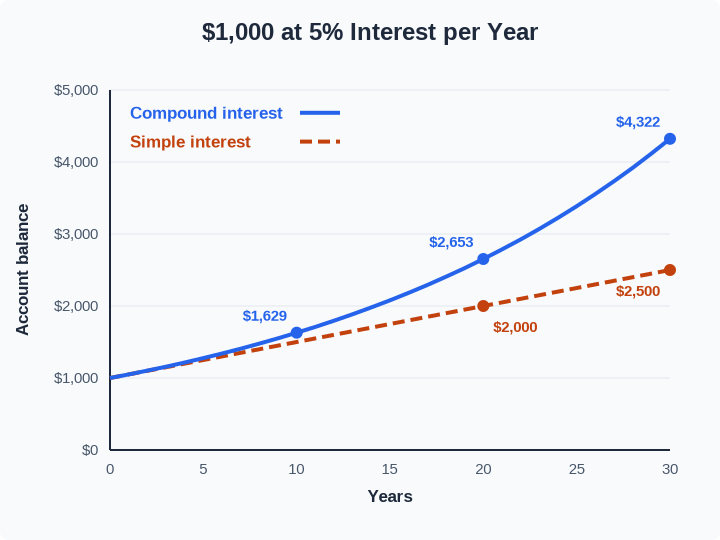
With simple interest, the bank pays 5 percent of your original $1,000, or $50, every year. The balance grows by the same amount each year, so its graph is a straight line. After 30 years, you would have $1,000 plus 30 payments of $50, or $2,500.
With compound interest, each year's interest is calculated on the whole balance, including the interest you have already earned. In the first year, you earn $50. In the second year, you earn 5 percent of $1,050, which is $52.50. The difference seems trivial at first, but because each year's growth is built on a larger base, the balance increases faster and faster. Mathematically, the balance after t years is 1,000 times 1.05 raised to the power t. This is exponential growth, and its graph is a curve that bends upward.
As the graph shows, the two accounts stay close for the first few years. By year 20, however, the compound account holds about $2,650, compared with $2,000 for simple interest. By year 30, it holds about $4,320, more than one and a half times as much as the simple account.
Investors often estimate doubling time with a shortcut called the rule of 72: divide 72 by the interest rate. At 5 percent, 72 divided by 5 is about 14.4, so the money doubles roughly every 14 years. The rule is an approximation, but it captures the central lesson: with compound growth, time matters more than almost anything else.
The question
Choose the best answer.
What is the key difference between simple and compound interest, according to the passage?
- Simple interest is paid monthly, and compound interest is paid yearly.
- Compound interest is also paid on earlier interest.Correct answer
- Simple interest uses a higher rate than compound interest.
- Compound interest grows by the same amount every year.
Why “Compound interest is also paid on earlier interest.” is correct
Paragraph 3 defines compound interest as interest 'calculated on the whole balance, including the interest you have already earned.' Choice d describes simple interest, so a reader who mixes up the two definitions will choose it.
Why the other answers are wrong
- Simple interest is paid monthly, and compound interest is paid yearly. — Both accounts in the passage are paid yearly.
- Simple interest uses a higher rate than compound interest. — Both use the same 5 percent rate; only the method differs.
- Compound interest grows by the same amount every year. — Growing by the same amount each year describes simple interest, not compound.
Practice more of this
More reading practice for Grades 9–12, or see the WIDA practice test for high school (grades 9–12).
Unofficial practice. This site is not affiliated with, endorsed by, or connected to WIDA, the Wisconsin Center for Education Research, or the Board of Regents of the University of Wisconsin System. WIDA and WIDA ACCESS are trademarks of the Board of Regents of the University of Wisconsin System. Every question here is original practice material written to match the published test design.