WIDA writing prompts and practice for 4th and 5th grade
Writing tasks at each tier with the rubric and a sample answer. Not scored here, but you can ask for AI practice feedback on what you write.
Teaching this in class? It is all free online, and the Grades 4–5 printable pack ($8.99) has a booklet for every student, the answer key, rubrics and audio.
Write your response in the editor. You can see your word count, use the optional timer, save a draft in this browser, ask for AI practice feedback, and compare your writing with the rubric and sample response. It is not scored here — on the real test, writing is scored against a rubric.
Printable version with every prompt, rubric and sample response.
Prompt 1 of 4 — Tier A tasks — suggested time about 15 minutes
Look at the picture and the word bank. Then write.
Science: How a Butterfly Grows
Read image description
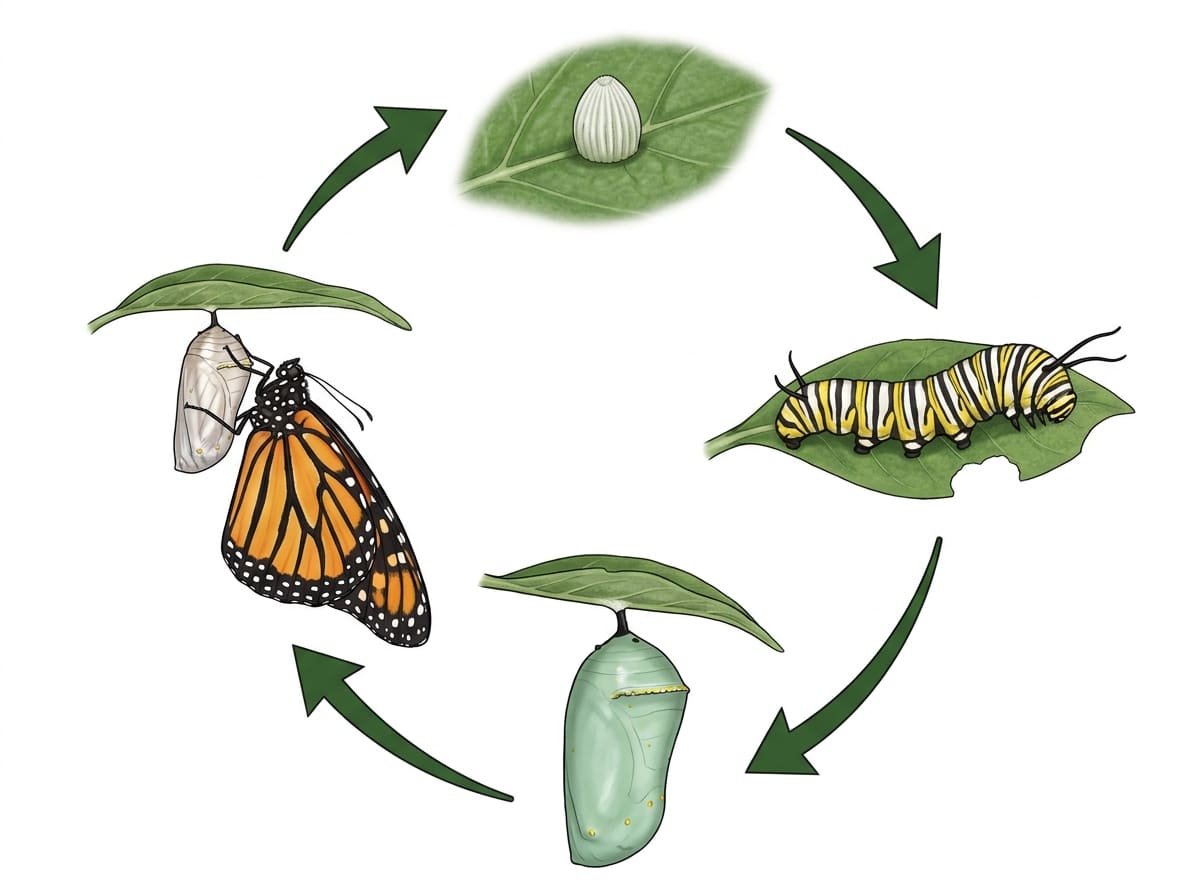
The picture shows the life cycle of a monarch butterfly in four steps, with arrows going around in a circle.
Step 1: A tiny white egg sits on a green milkweed leaf.
Step 2: A striped caterpillar, yellow, black and white, is eating the leaf.
Step 3: A green chrysalis hangs from the bottom of a leaf.
Step 4: An orange and black butterfly comes out of the chrysalis and hangs from it while its wings dry.
Word bank: egg, caterpillar, chrysalis, butterfly, leaf, hatch, eat, grow, first, next, then, finally.
Look at the picture. Use words from the word bank. Type your answer.
Your class is making a science book about animals. Write about how a butterfly grows. Tell what happens in each step, from the egg to the butterfly.
View the practice scoring rubric
| Level | What it looks like |
|---|---|
| 7 — Fully developed |
|
| 6 — Well developed |
|
| 5 — Developed |
|
| 4 — Expanding |
|
| 3 — Emerging |
|
| 2 — Beginning |
|
| 1 — Starting |
|
Show a strong sample response
A butterfly grow in four steps. First, the butterfly lay a tiny egg on a leaf. Next, a caterpillar hatch from the egg. The caterpillar eat the leaf a lot and it get very big. Then the caterpillar make a chrysalis. It hang under the leaf and it is green. It change inside. Finally, a butterfly come out of the chrysalis. It is orange and black and it can fly. Then the butterfly lay eggs and it start again.
This sits at about level 4 (Expanding). The writer explains all four steps in order, uses the sequence words and content words from the word bank (hatch, chrysalis), and ends by showing that the cycle repeats. The repeated verb errors (grow, lay, eat without -s) and simple sentence patterns keep it from level 5.
What to look for
- This is a Tier A task. A strong response at this tier is several connected sentences with some errors; it does not need to be perfect. A blank, copied, off-topic or non-English response does not get a level; say that it does not yet show writing on this task.
- Check that all four stages appear in the right order. Sequence words (first, next, then, finally) are the main organizing tool at this level.
- Using word-bank words is expected and fine. Look for sentences that add something the picture shows, like color or what the caterpillar does.
All 4 writing prompts for 4th and 5th grade
- Tier A tasks (Science: How a Butterfly Grows): Your class is making a science book about animals. Write about how a butterfly grows. Tell what happens in each step, from the egg to the butterfly.
- Tier A tasks (Language Arts: The Night the Lights Went Out): Write a story about what happens to Sam and his family. Tell what happens first, next and at the end. Tell how the people feel.
- Tier B/C tasks (Mathematics and Science: The Paper Towel Test): Write a report to the cafeteria manager. Explain how the class tested the paper towels and what the results show. Then explain which towel the cafeteria should buy. Use numbers from the chart and the price list to support your answer.
- Tier B/C tasks (Language Arts and Social Studies: The Harmon Street Station): The Millbrook town council wants to hear from students. Write a letter to the council. Tell whether the town should turn the Harmon Street Station into a community center or replace it with a parking lot. Give reasons from the facts and the letters, and explain why the other choice is not as good.
More WIDA practice for 4th and 5th grade
- WIDA listening practice for 4th and 5th grade
- WIDA reading practice for 4th and 5th grade
- WIDA speaking practice for 4th and 5th grade
- WIDA listening practice test for 4th and 5th grade
- WIDA reading practice test for 4th and 5th grade
- WIDA listening practice test 2 for 4th and 5th grade
- WIDA reading practice test 2 for 4th and 5th grade
Read next
- WIDA Writing Test: Tasks, Tiers, Scoring and Sample Answers: The WIDA ACCESS writing test asks students to write extended answers to a few tasks, each set up with a short scenario that gives them a reason to write. Grades 1–3 handwrite in a booklet and grades 4–12 type. Tasks come in two tiers, A and B/C, and trained raters score each answer on a 0–7 rubric. Here is how it works, with an original sample answer, and how to practise.
- How to Prepare for WIDA ACCESS: A Practical Plan for Parents: WIDA ACCESS measures English that grows over months and years, so there is no shortcut to a higher level. What preparation can do is make the test familiar, so your child's real English shows on the day. The best plan is the official WIDA demos, a few weeks of short practice in each domain, and plenty of talk and reading at home, in any language.
- WIDA Scale Scores: How They Relate to Proficiency Levels: Every WIDA ACCESS score report gives two numbers for each domain and composite: a scale score and a proficiency level. The proficiency level (1.0 to 6.0) is the number schools and states usually act on. The scale score is what the level is worked out from, and it is the better number for tracking growth. In 2025–26, WIDA reset the scale, so scale scores from before 2026 cannot be compared with scale scores from 2026 on.
Unofficial practice. This site is not affiliated with, endorsed by, or connected to WIDA, the Wisconsin Center for Education Research, or the Board of Regents of the University of Wisconsin System. WIDA and WIDA ACCESS are trademarks of the Board of Regents of the University of Wisconsin System. Every question here is original practice material written to match the published test design.