WIDA writing practice for 4th and 5th grade
Printable version. Original practice written to match the published WIDA format, not questions from the official test.
Writing prompts
On the real test these are scored by a trained person against a rubric. The rubric and a sample response follow each prompt.
Prompt 1: Tier A tasks
Suggested time: about 15 minutes
Look at the picture and the word bank. Then write.
Science: How a Butterfly Grows
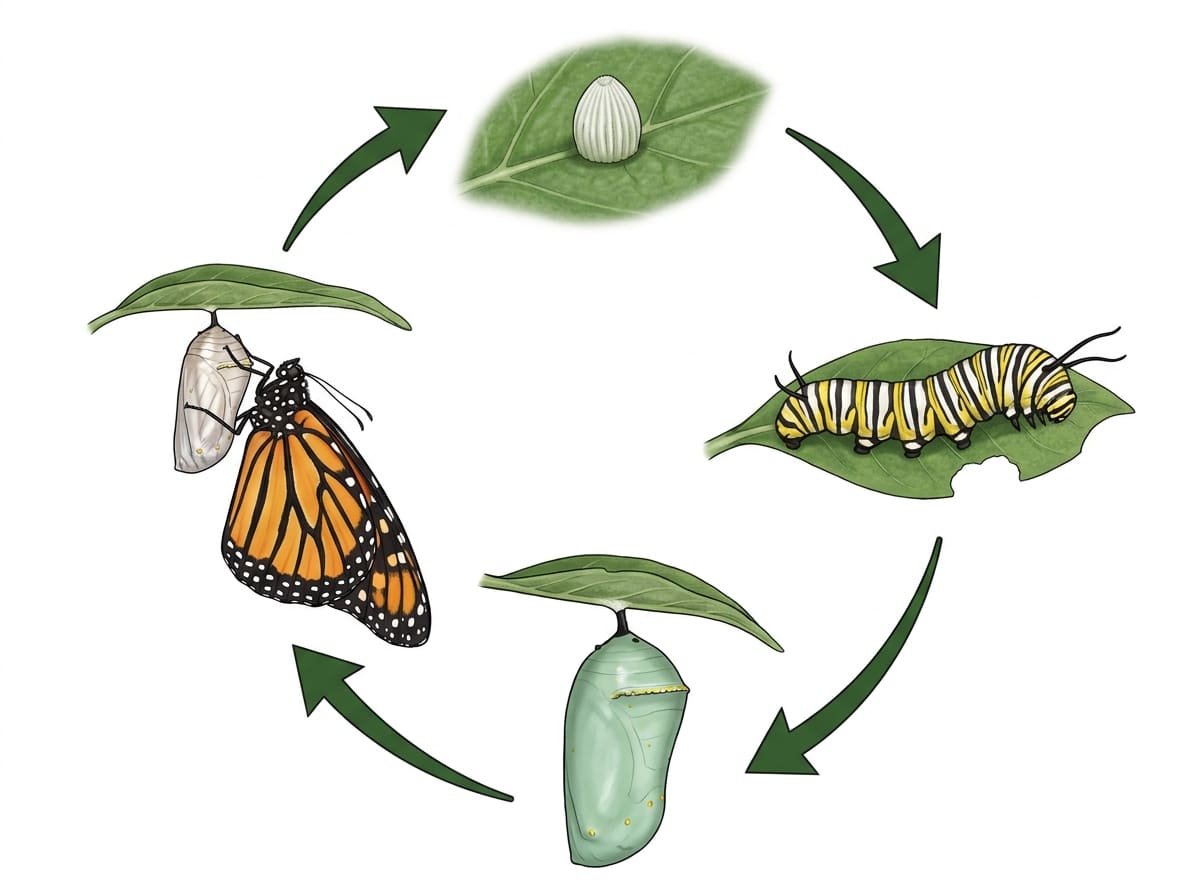
Picture description
The picture shows the life cycle of a monarch butterfly in four steps, with arrows going around in a circle.
Step 1: A tiny white egg sits on a green milkweed leaf.
Step 2: A striped caterpillar, yellow, black and white, is eating the leaf.
Step 3: A green chrysalis hangs from the bottom of a leaf.
Step 4: An orange and black butterfly comes out of the chrysalis and hangs from it while its wings dry.
Word bank: egg, caterpillar, chrysalis, butterfly, leaf, hatch, eat, grow, first, next, then, finally.
Look at the picture. Use words from the word bank. Type your answer.
Your class is making a science book about animals. Write about how a butterfly grows. Tell what happens in each step, from the egg to the butterfly.
Scoring rubric
| Level | What it looks like |
|---|---|
| 7: Fully developed |
|
| 6: Well developed |
|
| 5: Developed |
|
| 4: Expanding |
|
| 3: Emerging |
|
| 2: Beginning |
|
| 1: Starting |
|
A strong sample response
A butterfly grow in four steps. First, the butterfly lay a tiny egg on a leaf. Next, a caterpillar hatch from the egg. The caterpillar eat the leaf a lot and it get very big. Then the caterpillar make a chrysalis. It hang under the leaf and it is green. It change inside. Finally, a butterfly come out of the chrysalis. It is orange and black and it can fly. Then the butterfly lay eggs and it start again.
This sits at about level 4 (Expanding). The writer explains all four steps in order, uses the sequence words and content words from the word bank (hatch, chrysalis), and ends by showing that the cycle repeats. The repeated verb errors (grow, lay, eat without -s) and simple sentence patterns keep it from level 5.
What to look for
- This is a Tier A task. A strong response at this tier is several connected sentences with some errors; it does not need to be perfect. A blank, copied, off-topic or non-English response does not get a level; say that it does not yet show writing on this task.
- Check that all four stages appear in the right order. Sequence words (first, next, then, finally) are the main organizing tool at this level.
- Using word-bank words is expected and fine. Look for sentences that add something the picture shows, like color or what the caterpillar does.
Prompt 2: Tier A tasks
Suggested time: about 15 minutes
Look at the four pictures and the word bank. Then write.
Language Arts: The Night the Lights Went Out
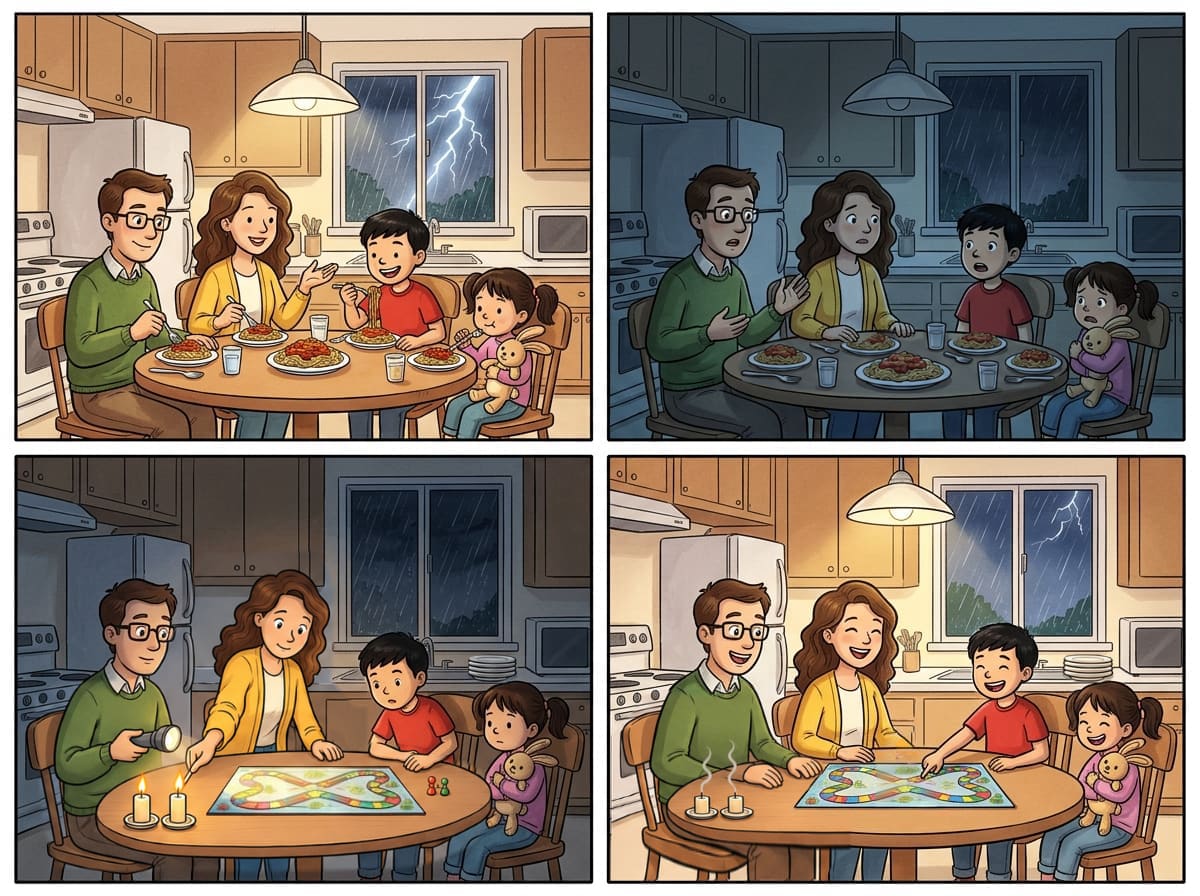
Picture description
Picture 1: A family of four is eating dinner at the kitchen table. Outside the window, there is rain and a flash of lightning.
Picture 2: The kitchen is dark. The boy, Sam, looks surprised. His little sister is hugging her stuffed rabbit and looks scared.
Picture 3: The father is holding a flashlight. The mother is lighting candles on the table. The family is playing a board game by the candlelight.
Picture 4: The lights are on again. Sam is laughing and pointing at the game board.
Word bank: storm, lightning, dark, scared, flashlight, candles, board game, first, then, after that, at the end.
Look at the four pictures. Use words from the word bank. Type your answer.
Write a story about what happens to Sam and his family. Tell what happens first, next and at the end. Tell how the people feel.
Scoring rubric
| Level | What it looks like |
|---|---|
| 7: Fully developed |
|
| 6: Well developed |
|
| 5: Developed |
|
| 4: Expanding |
|
| 3: Emerging |
|
| 2: Beginning |
|
| 1: Starting |
|
A strong sample response
One night there was a big storm with lightning. Sam and his family was eating dinner. Then the lights go out and it was very dark! Sam was surprised and his little sister was scared. She hug her rabbit. After that Dad got a flashlight and Mom light some candles. They play a board game on the table. It was fun. At the end the lights came back on. Sam was laughing because he win the game.
This is about level 4 (Expanding). The story follows all four pictures in order, uses time words (then, after that, at the end), names feelings for two characters, and adds a reason with "because." Mixed past and present tense (go, hug, light, win) and simple sentence patterns are typical of this level.
What to look for
- This is a Tier A task. A strong response at this tier is several connected sentences with some errors; it does not need to be perfect. A blank, copied, off-topic or non-English response does not get a level; say that it does not yet show writing on this task.
- Narrative writing needs events in order. Check that the story moves through all four pictures.
- Feeling words (scared, surprised, happy) and one reason ("because he won the game") are what lift a list of actions into a story.
- Tense mix-ups are common here. Note them for later practice, but judge first whether the story is clear.
Prompt 3: Tier B/C tasks
Suggested time: about 25 minutes
Read about the test and look at the chart. Then write.
Mathematics and Science: The Paper Towel Test
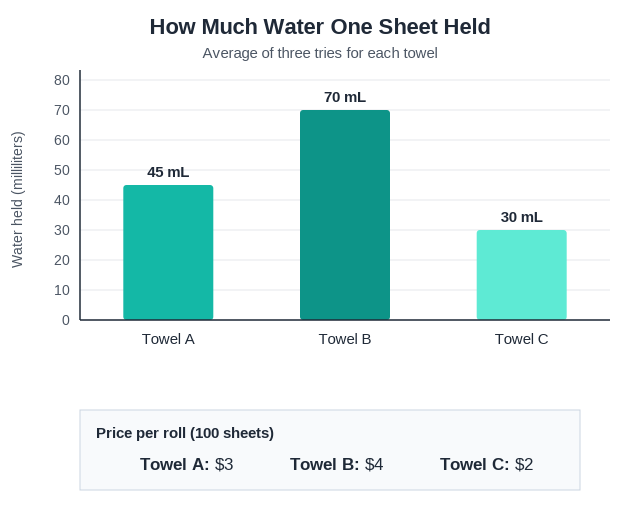
Picture description
The school cafeteria wants to buy a new kind of paper towel for cleaning up spills. Ms. Gonzalez's fifth-grade class offered to test three kinds: Towel A, Towel B and Towel C.
For a fair test, the class used one sheet of each towel, the same size. They dipped each sheet into a cup of water for 10 seconds, let it drip for 10 seconds, and then squeezed the water into a measuring cup. They did this three times for each towel and found the average.
Results: One sheet of Towel A held about 45 milliliters of water. One sheet of Towel B held about 70 milliliters. One sheet of Towel C held about 30 milliliters.
Prices: Each roll has 100 sheets. A roll of Towel A costs $3. A roll of Towel B costs $4. A roll of Towel C costs $2.
A typical spilled carton of milk in the cafeteria is about 140 milliliters.
Read about the test and look at the chart. Type your answer.
Write a report to the cafeteria manager. Explain how the class tested the paper towels and what the results show. Then explain which towel the cafeteria should buy. Use numbers from the chart and the price list to support your answer.
Scoring rubric
| Level | What it looks like |
|---|---|
| 7: Fully developed |
|
| 6: Well developed |
|
| 5: Developed |
|
| 4: Expanding |
|
| 3: Emerging |
|
| 2: Beginning |
|
| 1: Starting |
|
A strong sample response
Dear Cafeteria Manager,
Our class tested three kinds of paper towels to find out which one is best for cleaning up spills. To make the test fair, we used one sheet of each towel, all the same size. We dipped each sheet in water for 10 seconds, let it drip, and squeezed the water into a measuring cup. We repeated this three times for each towel and found the average.
Towel B held the most water, about 70 milliliters per sheet. Towel A held about 45 milliliters, and Towel C held only about 30 milliliters. At first, Towel C looks like the best deal because a roll costs only $2. However, it is so thin that you would need five sheets to clean up a 140 milliliter milk spill. That costs 10 cents, since each sheet costs 2 cents. Towel A would need four sheets at 3 cents each, which is 12 cents. Towel B would need only two sheets at 4 cents each, so one spill costs just 8 cents.
We recommend Towel B. Even though it has the highest price per roll, it is actually the cheapest way to clean up each spill, and the cafeteria would throw away less paper. Thank you for letting us help.
Sincerely,
Ms. Gonzalez's Fifth Grade
This reaches about level 7 (Fully developed). The report is organized into method, results and recommendation; it explains why the test was fair; it turns the data into cost per spill with clear math; and it handles the counterargument ("At first, Towel C looks like the best deal... However"). Sentences are varied and joined with precise linking words (since, so, even though), and science and math words are used correctly (average, milliliters, per sheet).
What to look for
- This is a Tier B/C task, which is integrated: it draws on two content areas at once. Strong responses at this tier are organized, use linking words across sentences, and include content vocabulary. A blank, copied, off-topic or non-English response does not get a level; say that it does not yet show writing on this task.
- The key reasoning step is cost per spill, not price per roll. A student who recommends Towel C because it is cheapest has missed how the two sets of numbers work together; ask how many sheets a spill needs.
- Check for the three parts the prompt asks for: how the test was done, what the results show, and a recommendation with reasons.
Prompt 4: Tier B/C tasks
Suggested time: about 25 minutes
Read the facts and the two letters. Then write.
Language Arts and Social Studies: The Harmon Street Station
Facts about the Harmon Street Station: The brick train station in the town of Millbrook was built in 1912. For 75 years, trains stopped there to bring people, mail and goods to town. The last train stopped in 1987, and the building has been empty since then. The town council must decide what to do with it.
Fixing the building and turning it into a community center would cost about $900,000. Tearing it down and building a parking lot would cost about $250,000.
Letter 1, from Ruth Ambrose, Millbrook History Club: "The Harmon Street Station is the oldest public building in our town. My grandfather arrived here on a train in 1923 with one suitcase. If we tear it down, we lose a piece of our story that we can never get back. As a community center, it could hold classes, a small museum, and space for clubs. Visitors would come to see it, and they would spend money in our shops."
Letter 2, from Victor Lang, owner of Lang's Hardware on Main Street: "Every week, customers tell me they drove around and could not find a place to park, so they went to the big store on the highway instead. Three shops on Main Street have closed in the last two years. A parking lot would cost much less and help the businesses that keep our town alive. We can put up a sign with the station's history so people remember it."
Read the facts and both letters. Type your answer.
The Millbrook town council wants to hear from students. Write a letter to the council. Tell whether the town should turn the Harmon Street Station into a community center or replace it with a parking lot. Give reasons from the facts and the letters, and explain why the other choice is not as good.
Scoring rubric
| Level | What it looks like |
|---|---|
| 7: Fully developed |
|
| 6: Well developed |
|
| 5: Developed |
|
| 4: Expanding |
|
| 3: Emerging |
|
| 2: Beginning |
|
| 1: Starting |
|
A strong sample response
Dear Members of the Town Council,
I think Millbrook should turn the Harmon Street Station into a community center instead of tearing it down. The station is more than an old building. It is the oldest public building in our town, and for 75 years it was how people, mail and goods got here. Ms. Ambrose explains that her grandfather arrived on a train with one suitcase. Many families probably have stories like that, and once the building is gone, those stories lose their place.
A community center would also help the town in the future. It could hold classes, clubs and a small museum, and visitors who come to see it would shop on Main Street. That could help the same businesses Mr. Lang is worried about.
I understand that the parking lot would cost $650,000 less, and that shops need customers. Mr. Lang makes a fair point. However, a sign is not the same as a real building, and a parking lot does not give people a reason to come downtown in the first place. If the town needs more parking, it could add spaces next to the station instead of in place of it.
Please save the Harmon Street Station. It connects our past to our future.
Sincerely,
Gabriel Moreno, Grade 5
This is about level 7 (Fully developed). The letter takes a clear position, supports it with evidence from both the facts and Ms. Ambrose's letter, and answers the other side fairly before rebutting it. It uses math from the facts ($900,000 minus $250,000), offers a compromise, and closes by returning to the main idea. Linking words (also, however, if, instead of) join ideas across paragraphs.
What to look for
- This is a Tier B/C task, which is integrated: it draws on two content areas at once. Strong responses at this tier are organized, use linking words across sentences, and include content vocabulary. A blank, copied, off-topic or non-English response does not get a level; say that it does not yet show writing on this task.
- Either side can earn a top score. Judge how well the student uses evidence from the texts and answers the other side.
- Look for evidence named by source ("Mr. Lang says...") rather than general opinions. That is the language arts half of this integrated task; the town history and cost decision are the social studies half.
- A response that only summarizes the two letters, without taking a position, has not yet done the task of arguing.
Unofficial practice. This site is not affiliated with, endorsed by, or connected to WIDA, the Wisconsin Center for Education Research, or the Board of Regents of the University of Wisconsin System. WIDA and WIDA ACCESS are trademarks of the Board of Regents of the University of Wisconsin System. Every question here is original practice material written to match the published test design.