WIDA reading practice questions for 4th and 5th grade
Passages, charts and pictures with questions in groups of three, from social and classroom language to language arts, math, science and social studies.
Teaching this in class? It is all free online, and the Grades 4–5 printable pack ($8.99) has a booklet for every student, the answer key, rubrics and audio.
These 30 questions are grouped by task type, one group at a time. Answer a question to see whether it was right and why. Nothing is timed and nothing is recorded. Printable version with the answer key.
Set 1 of 3. 0 of 30 questions answered.
Level A folders
Easier folders, aimed at proficiency levels 1 to 3: short texts with pictures, labels and simple sentences.
Look at the chart. Then answer the questions.
Social and Instructional: Recess Equipment Sign-Out
Read image description
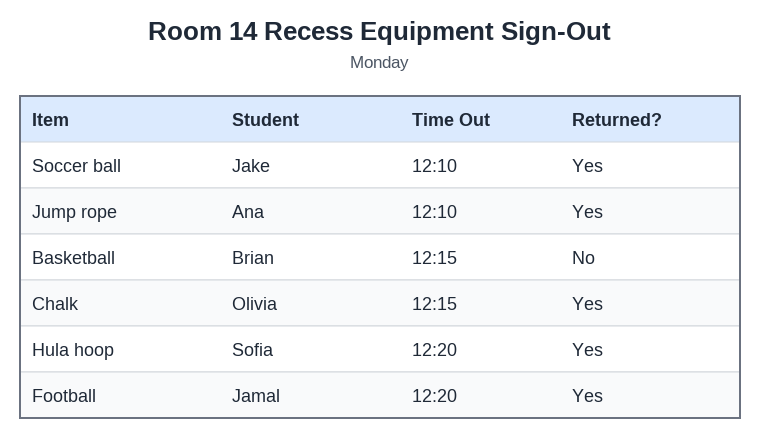
Room 14 Recess Equipment Sign-Out, Monday. Students write their name when they take an item outside, and they write Yes when they bring it back.
Soccer ball: Jake. Time out: 12:10. Returned: Yes.
Jump rope: Ana. Time out: 12:10. Returned: Yes.
Basketball: Brian. Time out: 12:15. Returned: No.
Chalk: Olivia. Time out: 12:15. Returned: Yes.
Hula hoop: Sofia. Time out: 12:20. Returned: Yes.
Football: Jamal. Time out: 12:20. Returned: Yes.
Question 1 of 12
Choose the best answer.
Who signed out the chalk?
Question 2 of 12
Choose the best answer.
What did Ana sign out?
Question 3 of 12
Choose the best answer.
Which item has not been brought back yet?
Read the story. Then answer the questions.
Language Arts: The Big Hill
It snowed all night. In the morning, Ji-woo looked out the window. The whole street was white.
Ji-woo and her little brother, Min, took their sled to the big hill behind the school. Min looked up at the top. "The hill is too tall," he said. He was scared.
Ji-woo had a plan. "Let's start halfway up," she said. They rode down the small part of the hill together. Min laughed the whole way.
After three rides, Min pointed to the top. "Now let's go from up there!" he said.
Question 4 of 12
Choose the best answer.
Where did Ji-woo and Min go sledding?
Question 5 of 12
Choose the best answer.
Why did Ji-woo want to start halfway up the hill?
Question 6 of 12
Choose the best answer.
How does Min change in the story?
Look at the bar graph. Then answer the questions.
Mathematics: Our Favorite Lunch
Read image description
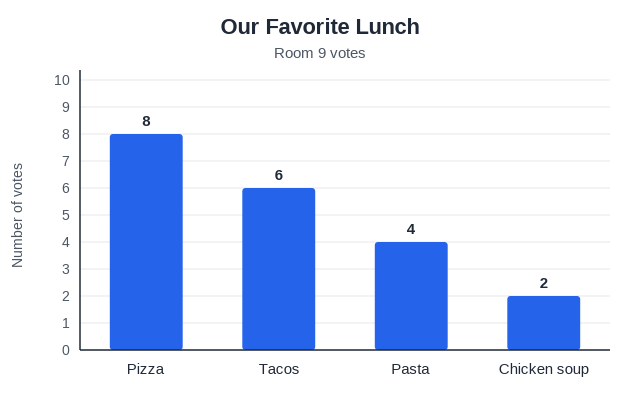
The students in Room 9 voted for their favorite school lunch. The bar graph shows the votes.
Pizza: 8 votes. Tacos: 6 votes. Pasta: 4 votes. Chicken soup: 2 votes.
Question 7 of 12
Choose the best answer.
Which lunch got the most votes?
Question 8 of 12
Choose the best answer.
How many students voted for tacos?
Question 9 of 12
Choose the best answer.
How many more students chose pizza than pasta?
Look at the timeline. Then answer the questions.
Social Studies: A Timeline of Riverton
Read image description
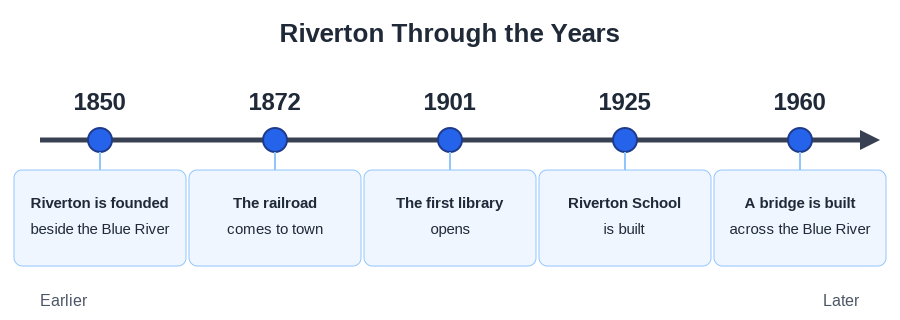
This timeline shows important events in the history of the town of Riverton. The earliest event is on the left, and the latest event is on the right.
1850: Riverton is founded beside the Blue River.
1872: The railroad comes to town.
1901: The first library opens.
1925: Riverton School is built.
1960: A bridge is built across the Blue River.
Question 10 of 12
Choose the best answer.
When did the railroad come to Riverton?
Question 11 of 12
Choose the best answer.
Which of these happened first?
Question 12 of 12
Choose the best answer.
What was built in 1960?
12 questions in this set are still unanswered. You can move on without answering them.
Ready for the whole thing? Take the reading practice test for Grades 4–5.
Answer key: every answer, explained
The correct answer to every question above, with why it is right and why each other choice is wrong. Open a question to see its answer.
Level A folders
1. Who signed out the chalk?
From “Social and Instructional: Recess Equipment Sign-Out”
- Brian
- Jake
- OliviaCorrect answer
- Jamal
Why “Olivia” is correct
This tests reading across a row of a chart. The Chalk row shows the name Olivia.
Why the other answers are wrong
- Brian — Brian signed out the basketball.
- Jake — Jake signed out the soccer ball.
- Jamal — Jamal signed out the football.
2. What did Ana sign out?
From “Social and Instructional: Recess Equipment Sign-Out”
- A jump ropeCorrect answer
- A basketball
- A soccer ball
- A hula hoop
Why “A jump rope” is correct
This tests finding a name in a chart and reading the item in that row. Ana's row is the jump rope.
Why the other answers are wrong
- A basketball — Brian signed out the basketball.
- A soccer ball — Jake signed out the soccer ball.
- A hula hoop — Sofia signed out the hula hoop.
3. Which item has not been brought back yet?
From “Social and Instructional: Recess Equipment Sign-Out”
- The soccer ball
- The chalk
- The hula hoop
- The basketballCorrect answer
Why “The basketball” is correct
This tests using a chart to solve a simple classroom problem. Only the basketball row says No in the Returned? column, so it is still outside.
Why the other answers are wrong
- The soccer ball — The soccer ball row says Yes.
- The chalk — The chalk row says Yes.
- The hula hoop — The hula hoop row says Yes.
4. Where did Ji-woo and Min go sledding?
From “Language Arts: The Big Hill”
- On the hill behind the schoolCorrect answer
- On the street by their house
- At a big park in the middle of town
- In their backyard
Why “On the hill behind the school” is correct
This tests a stated detail about setting. The story says they "took their sled to the big hill behind the school."
Why the other answers are wrong
- On the street by their house — They saw the snowy street from the window, but they sledded on the hill.
- At a big park in the middle of town — A park is not mentioned.
- In their backyard — A backyard is not mentioned.
5. Why did Ji-woo want to start halfway up the hill?
From “Language Arts: The Big Hill”
- The top of the hill was icy.
- Their sled was too small for two people.
- Min was scared of the tall hill.Correct answer
- She was too tired to climb.
Why “Min was scared of the tall hill.” is correct
This tests connecting a character's plan to a problem. Right before Ji-woo's plan, Min says, "The hill is too tall," and the story says, "He was scared." Starting lower is her way of helping him.
Why the other answers are wrong
- The top of the hill was icy. — The story does not say anything about ice.
- Their sled was too small for two people. — The size of the sled is not mentioned.
- She was too tired to climb. — Nothing in the story says she was tired.
6. How does Min change in the story?
From “Language Arts: The Big Hill”
- He is happy at first, but later he is scared.
- He wants to go home, but Ji-woo makes him stay.
- He never rides the sled at all.
- He is scared, then he wants to go from the top.Correct answer
Why “He is scared, then he wants to go from the top.” is correct
This tests tracking how a character changes from beginning to end. Min is scared in paragraph 2, laughs in paragraph 3, and asks to go from the top in paragraph 4.
Why the other answers are wrong
- He is happy at first, but later he is scared. — This is the opposite order of what happens.
- He wants to go home, but Ji-woo makes him stay. — Min never asks to go home.
- He never rides the sled at all. — He rides three times with Ji-woo.
7. Which lunch got the most votes?
From “Mathematics: Our Favorite Lunch”
- Tacos
- PizzaCorrect answer
- Pasta
- Chicken soup
Why “Pizza” is correct
This tests reading a bar graph: the tallest bar shows the most votes. The pizza bar reaches 8, higher than any other bar.
Why the other answers are wrong
- Tacos — Tacos got 6 votes, which is fewer than pizza.
- Pasta — Pasta got 4 votes.
- Chicken soup — Chicken soup got the fewest votes.
8. How many students voted for tacos?
From “Mathematics: Our Favorite Lunch”
- 2
- 4
- 6Correct answer
- 8
Why “6” is correct
This tests reading the value of one bar. The tacos bar stops at the line for 6.
Why the other answers are wrong
- 2 — Two is the number of votes for chicken soup.
- 4 — Four is the number of votes for pasta.
- 8 — Eight is the number of votes for pizza.
9. How many more students chose pizza than pasta?
From “Mathematics: Our Favorite Lunch”
- 2
- 4Correct answer
- 8
- 12
Why “4” is correct
This tests comparing two bars with subtraction. Pizza has 8 votes and pasta has 4, and 8 minus 4 is 4. "How many more" asks for a difference; students who add get 12.
Why the other answers are wrong
- 2 — Two would be the difference between tacos and pizza.
- 8 — Eight is the number of votes for pizza alone.
- 12 — Twelve is pizza and pasta added together, not the difference.
10. When did the railroad come to Riverton?
From “Social Studies: A Timeline of Riverton”
- 1850
- 1901
- 1925
- 1872Correct answer
Why “1872” is correct
This tests finding an event on a timeline and reading its date. The 1872 entry says, "The railroad comes to town."
Why the other answers are wrong
- 1850 — 1850 is when Riverton was founded.
- 1901 — 1901 is when the first library opened.
- 1925 — 1925 is when Riverton School was built.
11. Which of these happened first?
From “Social Studies: A Timeline of Riverton”
- The first library opened.
- The railroad came to town.Correct answer
- Riverton School was built.
- A bridge was built across the river.
Why “The railroad came to town.” is correct
This tests reading order on a timeline. Events go from earliest on the left to latest on the right, and of these four, the railroad in 1872 comes first.
Why the other answers are wrong
- The first library opened. — The library opened in 1901, after the railroad.
- Riverton School was built. — The school was built in 1925.
- A bridge was built across the river. — The bridge, in 1960, is the latest event on the timeline.
12. What was built in 1960?
From “Social Studies: A Timeline of Riverton”
- A bridge over the riverCorrect answer
- Riverton School
- The first library
- A train station
Why “A bridge over the river” is correct
This tests matching a date to its event. The last entry on the timeline, 1960, says a bridge was built across the Blue River.
Why the other answers are wrong
- Riverton School — Riverton School was built in 1925.
- The first library — The first library opened in 1901.
- A train station — A train station is not on the timeline; the railroad came in 1872.
Level B folders
13. When should students bring their projects to school?
From “Social and Instructional: A Letter About Science Night”
- On Thursday morningCorrect answer
- On Thursday at 6:00 p.m.
- On Wednesday afternoon
- On Friday morning
Why “On Thursday morning” is correct
This tests reading a detail that the writer sets against a likely mistake. The letter says projects come in "on Thursday morning, not in the evening," so teachers can help set up in the afternoon.
Why the other answers are wrong
- On Thursday at 6:00 p.m. — Six o'clock is when Science Night starts; the letter says "not in the evening."
- On Wednesday afternoon — Wednesday is not mentioned.
- On Friday morning — Science Night is on Thursday, so Friday would be too late.
14. Why should families park in the back lot?
From “Social and Instructional: A Letter About Science Night”
- The back lot is closer to the gym doors.
- The front lot will be closed for bus repairs.Correct answer
- The scientist needs the front lot for a truck.
- The telescope will be set up in the front lot.
Why “The front lot will be closed for bus repairs.” is correct
This tests finding a reason signaled by "because." The letter says, "Please park in the back lot, because the front lot will be closed for bus repairs."
Why the other answers are wrong
- The back lot is closer to the gym doors. — The letter does not say where the gym doors are.
- The scientist needs the front lot for a truck. — The scientist is mentioned, but not in connection with parking.
- The telescope will be set up in the front lot. — The letter does not say where the telescope will be.
15. What could stop families from using the telescope?
From “Social and Instructional: A Letter About Science Night”
- Too many pennies
- A late scientist
- Cloudy weatherCorrect answer
- A closed front lot
Why “Cloudy weather” is correct
This tests understanding a condition. The letter says families can use the telescope "if the weather is clear," so the telescope depends on the sky. Students have to infer that clouds are the opposite of "clear."
Why the other answers are wrong
- Too many pennies — Pennies are part of the paper bridge station.
- A late scientist — The scientist runs the water station, not the telescope.
- A closed front lot — The closed lot affects parking, not the telescope.
16. What does a beaver use to cut down small trees?
From “Science: How Beavers Build Dams”
- Its front teethCorrect answer
- Its flat tail
- Sharp stones
- Its front paws
Why “Its front teeth” is correct
This tests a stated detail in an informational text. Paragraph 2 says a beaver "cuts down small trees with its strong front teeth, which never stop growing."
Why the other answers are wrong
- Its flat tail — The passage does not say what the tail does.
- Sharp stones — Stones are used to fill spaces in the dam.
- Its front paws — The passage does not mention paws.
17. Why is the door to a beaver lodge underwater?
From “Science: How Beavers Build Dams”
- So mud does not fall inside
- So beavers can catch fish
- So enemies cannot get in easilyCorrect answer
- So the lodge stays warm in the winter
Why “So enemies cannot get in easily” is correct
This tests a reason signaled by "so." Paragraph 3 says the door is underwater "so wolves and coyotes cannot easily get inside." The student has to recognize wolves and coyotes as enemies.
Why the other answers are wrong
- So mud does not fall inside — Mud is part of the dam, not a reason for the door.
- So beavers can catch fish — Beavers are not described as eating fish.
- So the lodge stays warm in the winter — Warmth is not given as the reason.
18. Why do scientists call beavers "ecosystem engineers"?
From “Science: How Beavers Build Dams”
- Their teeth never stop growing.
- Their ponds help many other animals.Correct answer
- Their dams sometimes flood roads.
- They build bridges for people to walk across.
Why “Their ponds help many other animals.” is correct
This tests understanding a term from context. The sentence before the term explains that "ducks, frogs, fish, and turtles find food and shelter in the still water," and the words "for this reason" connect that idea to the name.
Why the other answers are wrong
- Their teeth never stop growing. — This is a true detail, but it is not the reason for the name.
- Their dams sometimes flood roads. — Flooding is a problem for people, not the reason for the name.
- They build bridges for people to walk across. — Beavers build dams and lodges, not bridges.
19. What mistake did Leo almost make?
From “Mathematics: A Rug for the Reading Corner”
- He almost added the sides instead of multiplying.Correct answer
- He almost measured the wrong corner.
- He almost ordered the bigger rug from the catalog.
- He almost multiplied 8 by 7.
Why “He almost added the sides instead of multiplying.” is correct
This tests understanding a problem in a math story. Leo "wanted to add the numbers together," and Mr. Bauer explains that adding gives the perimeter, while area needs multiplication.
Why the other answers are wrong
- He almost measured the wrong corner. — The passage does not say anything about the wrong corner.
- He almost ordered the bigger rug from the catalog. — Rebecca is the one who talks about the bigger rug.
- He almost multiplied 8 by 7. — Leo multiplied 8 by 6, the correct numbers.
20. What is the area of the reading corner?
From “Mathematics: A Rug for the Reading Corner”
- 14 square feet
- 28 square feet
- 35 square feet
- 48 square feetCorrect answer
Why “48 square feet” is correct
This tests finding a stated result and telling it apart from other numbers that could be computed. The passage says, "The reading corner had an area of 48 square feet," from 8 times 6.
Why the other answers are wrong
- 14 square feet — Fourteen is 8 plus 6, which is only two of the four sides added.
- 28 square feet — Twenty-eight feet is the perimeter, the distance around the corner.
- 35 square feet — Thirty-five square feet is the area of the first rug, not the corner.
21. Why was the second rug a poor choice?
From “Mathematics: A Rug for the Reading Corner”
- It had a smaller area than the first rug.
- It was longer than the corner.Correct answer
- It cost more money than the first rug.
- It left space for bookshelves.
Why “It was longer than the corner.” is correct
This tests using measurements to explain a decision. Rebecca says the second rug "was longer than the corner," and the numbers show why: the rug is 9 feet long, but the corner is only 8 feet long.
Why the other answers are wrong
- It had a smaller area than the first rug. — The second rug is bigger: 63 square feet compared with 35.
- It cost more money than the first rug. — The passage does not mention prices.
- It left space for bookshelves. — That is why the class liked the first rug.
Level C folders
22. The author says the lighthouse stood "like a tall, patient guard." What does this comparison suggest?
From “Language Arts: The Last Boat Home”
- The lighthouse was about to fall down.
- The lighthouse kept people away from the rocks.
- The lighthouse was waiting to be repaired.
- The lighthouse seemed to watch over the lake.Correct answer
Why “The lighthouse seemed to watch over the lake.” is correct
This tests interpreting a simile. A guard watches over and protects something, and "patient" suggests it does this steadily for a long time. The rest of the story, about watching boats come home, supports this reading.
Why the other answers are wrong
- The lighthouse was about to fall down. — Nothing in the comparison or the story suggests the tower is falling.
- The lighthouse kept people away from the rocks. — A guard can keep people out, but the story is about watching over boats, not blocking visitors.
- The lighthouse was waiting to be repaired. — "Patient" describes calm watching, not waiting for repairs.
23. Why does Nora think her grandmother might be sad?
From “Language Arts: The Last Boat Home”
- Her grandmother can no longer see the lake.
- Fishing boats no longer come into the harbor at night.
- A machine now runs the light that she used to keep.Correct answer
- Her grandmother has to move out of the house.
Why “A machine now runs the light that she used to keep.” is correct
This tests inferring a character's thinking from details. Paragraph 2 explains that "a machine turned the light on and off by itself," and Nora says, "The lighthouse doesn't need you anymore." The student has to link the two.
Why the other answers are wrong
- Her grandmother can no longer see the lake. — Grandma Elsie watches the lake every night.
- Fishing boats no longer come into the harbor at night. — A fishing boat comes in at the end of the story.
- Her grandmother has to move out of the house. — Moving is never mentioned.
24. Which sentence best states a theme of the story?
From “Language Arts: The Last Boat Home”
- Old lighthouses should always stay locked.
- Fishing on a lake at night is dangerous.
- Binoculars help people see things far away.
- A machine cannot replace caring for others.Correct answer
Why “A machine cannot replace caring for others.” is correct
This tests identifying a theme. Grandma Elsie says, "Caring about the people out there was the job. A machine can't do that part," and Nora's understanding at the end confirms it. The wrong choices are details or facts, not lessons.
Why the other answers are wrong
- Old lighthouses should always stay locked. — The locked door is a detail, not the story's message.
- Fishing on a lake at night is dangerous. — The story does not make a point about danger.
- Binoculars help people see things far away. — This is true, but it is not what the story is about.
25. Why are algae called producers?
From “Science: Energy in a Pond Food Chain”
- They are eaten by tadpoles.
- They are the smallest things in the pond.
- They use sunlight to make their own food.Correct answer
- They float near the top of the water.
Why “They use sunlight to make their own food.” is correct
This tests a content definition signaled by "because." Paragraph 2 says algae "use sunlight to make their own food. Because they make food, algae are called producers."
Why the other answers are wrong
- They are eaten by tadpoles. — Being eaten does not make something a producer; minnows are eaten too.
- They are the smallest things in the pond. — Size is not what makes a producer.
- They float near the top of the water. — Where algae float is not the reason for the name.
26. In the diagram, an arrow points from the minnow to the heron. What does this arrow show?
From “Science: Energy in a Pond Food Chain”
- The minnow eats the heron.
- The heron gives energy to the minnow.
- The minnow and the heron both eat algae.
- Energy moves to the heron when it eats a minnow.Correct answer
Why “Energy moves to the heron when it eats a minnow.” is correct
This tests reading a diagram using the rule the passage gives. Paragraph 4 says each arrow "points from the living thing that is eaten to the living thing that eats it" and "shows which way the energy goes." Many students read arrows the other way, which the first two wrong choices catch.
Why the other answers are wrong
- The minnow eats the heron. — The arrow points toward the eater, so the heron eats the minnow.
- The heron gives energy to the minnow. — Energy goes in the direction of the arrow, from minnow to heron.
- The minnow and the heron both eat algae. — Only tadpoles eat algae in this food chain.
27. According to the passage, what would most likely happen to the herons if most of the algae died?
From “Science: Energy in a Pond Food Chain”
- They would need to hunt for food in other ponds.Correct answer
- Nothing would change, because herons do not eat algae.
- They would start eating algae instead of minnows.
- They would catch more minnows than before.
Why “They would need to hunt for food in other ponds.” is correct
This tests following a chain of effects. Paragraph 5 traces the change step by step, from fewer algae to fewer tadpoles to hungry minnows, ending with herons that "would have to hunt in other ponds." The first wrong choice is the strongest distractor, because herons do not eat algae directly.
Why the other answers are wrong
- Nothing would change, because herons do not eat algae. — Herons depend on algae through the chain: algae feed tadpoles, which feed minnows.
- They would start eating algae instead of minnows. — The passage does not say herons can eat algae.
- They would catch more minnows than before. — There would be fewer minnows, because they would go hungry.
28. What problem did the Erie Canal help solve?
From “Social Studies: How the Erie Canal Changed New York”
- New York City had too many boats in its port.
- Getting goods past the mountains was hard.Correct answer
- Farmers in the Midwest had no crops to sell.
- There were not enough workers in New York.
Why “Getting goods past the mountains was hard.” is correct
This tests identifying the problem in a cause-and-effect text. Paragraph 1 says moving goods "was slow and expensive" because the Appalachian Mountains were in the way and wagons "could carry only small loads."
Why the other answers are wrong
- New York City had too many boats in its port. — The port grew busier after the canal; crowding was not the problem.
- Farmers in the Midwest had no crops to sell. — Farmers had crops; the problem was getting them east.
- There were not enough workers in New York. — Thousands of workers dug the canal.
29. Why did some people call the canal "Clinton's Ditch"?
From “Social Studies: How the Erie Canal Changed New York”
- Governor Clinton dug the whole canal himself.
- It was the official name chosen by the state.
- The canal started on a farm owned by Clinton.
- They thought the plan was silly.Correct answer
Why “They thought the plan was silly.” is correct
This tests inferring the purpose of a nickname. The passage says people "laughed at the plan and called it 'Clinton's Ditch.'" Calling a 363-mile canal a "ditch" was a way of saying it was a silly idea, and paragraph 3 says the critics "stopped laughing" once it worked.
Why the other answers are wrong
- Governor Clinton dug the whole canal himself. — Thousands of workers dug it.
- It was the official name chosen by the state. — The passage says people "laughed at the plan," so it was a joke name.
- The canal started on a farm owned by Clinton. — Nothing in the passage says where the canal started on Clinton's land.
30. Which sentence describes an effect of the Erie Canal?
From “Social Studies: How the Erie Canal Changed New York”
- The Appalachian Mountains became easier to climb.
- Towns along the canal grew quickly.Correct answer
- Wagons became the cheapest way to ship goods.
- Families stopped moving to Ohio and Michigan.
Why “Towns along the canal grew quickly.” is correct
This tests telling causes from effects. Paragraph 4 lists the canal's effects, including that "towns along the canal, such as Rochester and Syracuse, grew quickly." The wrong choices either describe things that did not change or reverse what happened.
Why the other answers are wrong
- The Appalachian Mountains became easier to climb. — The mountains did not change; the canal gave a way around them.
- Wagons became the cheapest way to ship goods. — Canal boats made shipping much cheaper than wagons.
- Families stopped moving to Ohio and Michigan. — The passage says families used the canal to move west.
More WIDA practice for 4th and 5th grade
- WIDA listening practice for 4th and 5th grade
- WIDA speaking practice for 4th and 5th grade
- WIDA writing practice for 4th and 5th grade
- WIDA listening practice test for 4th and 5th grade
- WIDA reading practice test for 4th and 5th grade
- WIDA listening practice test 2 for 4th and 5th grade
- WIDA reading practice test 2 for 4th and 5th grade
Read next
- WIDA Listening and Reading Test: Folders, Levels and Adaptivity: On WIDA ACCESS Online, listening and reading questions come in folders: one recording or text with a small group of questions about it. The test is adaptive, so after each folder it moves the student to easier or harder material. Listening and reading are taken first, and the results decide the tier of speaking and writing. Here is how they work.
- How to Prepare for WIDA ACCESS: A Practical Plan for Parents: WIDA ACCESS measures English that grows over months and years, so there is no shortcut to a higher level. What preparation can do is make the test familiar, so your child's real English shows on the day. The best plan is the official WIDA demos, a few weeks of short practice in each domain, and plenty of talk and reading at home, in any language.
- WIDA Scale Scores: How They Relate to Proficiency Levels: Every WIDA ACCESS score report gives two numbers for each domain and composite: a scale score and a proficiency level. The proficiency level (1.0 to 6.0) is the number schools and states usually act on. The scale score is what the level is worked out from, and it is the better number for tracking growth. In 2025–26, WIDA reset the scale, so scale scores from before 2026 cannot be compared with scale scores from 2026 on.
Unofficial practice. This site is not affiliated with, endorsed by, or connected to WIDA, the Wisconsin Center for Education Research, or the Board of Regents of the University of Wisconsin System. WIDA and WIDA ACCESS are trademarks of the Board of Regents of the University of Wisconsin System. Every question here is original practice material written to match the published test design.