According to the passage, what would most likely happen to the herons if most of the algae died?
Level C folders · WIDA Grades 4–5 reading. The correct answer, and the reasoning behind it.
Harder folders, aimed at levels 3 to 5: longer academic texts that ask about main ideas, evidence and word meaning.
Read the passage and look at the diagram. Then answer the questions.
Science: Energy in a Pond Food Chain
Read image description
Every living thing needs energy to grow, move, and stay alive. In a pond, energy passes from one living thing to another in a pattern called a food chain.
Most food chains begin with the sun. Algae, tiny plant-like living things that float in the water, use sunlight to make their own food. Because they make food, algae are called producers.
Tadpoles eat algae. Small fish called minnows eat tadpoles. A great blue heron, a tall wading bird, stands perfectly still in the shallow water and then snatches minnows with its sharp beak. Animals that get energy by eating other living things are called consumers.
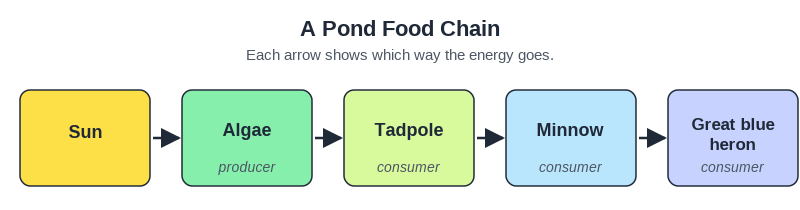
In a food chain diagram, each arrow points from the living thing that is eaten to the living thing that eats it. The arrow shows which way the energy goes.
A change to one link can affect the whole chain. Suppose a chemical washes into the pond and kills most of the algae. The tadpoles would have less to eat, so fewer of them would survive. Then the minnows would go hungry, and finally the herons would have to hunt in other ponds.
The diagram shows the chain: Sun, then algae, then tadpole, then minnow, then great blue heron, with an arrow between each one.
The question
Choose the best answer.
According to the passage, what would most likely happen to the herons if most of the algae died?
- They would need to hunt for food in other ponds.Correct answer
- Nothing would change, because herons do not eat algae.
- They would start eating algae instead of minnows.
- They would catch more minnows than before.
Why “They would need to hunt for food in other ponds.” is correct
This tests following a chain of effects. Paragraph 5 traces the change step by step, from fewer algae to fewer tadpoles to hungry minnows, ending with herons that "would have to hunt in other ponds." The first wrong choice is the strongest distractor, because herons do not eat algae directly.
Why the other answers are wrong
- Nothing would change, because herons do not eat algae. — Herons depend on algae through the chain: algae feed tadpoles, which feed minnows.
- They would start eating algae instead of minnows. — The passage does not say herons can eat algae.
- They would catch more minnows than before. — There would be fewer minnows, because they would go hungry.
Practice more of this
More reading practice for Grades 4–5, or see the WIDA practice test for 4th and 5th grade.
Unofficial practice. This site is not affiliated with, endorsed by, or connected to WIDA, the Wisconsin Center for Education Research, or the Board of Regents of the University of Wisconsin System. WIDA and WIDA ACCESS are trademarks of the Board of Regents of the University of Wisconsin System. Every question here is original practice material written to match the published test design.