WIDA reading practice questions for 1st grade
Passages, charts and pictures with questions in groups of three, from social and classroom language to language arts, math, science and social studies.
Teaching this in class? It is all free online, and the Grade 1 printable pack ($8.99) has a booklet for every student, the answer key, rubrics and audio.
These 24 questions are grouped by task type, one group at a time. Answer a question to see whether it was right and why. Nothing is timed and nothing is recorded. Printable version with the answer key.
Set 1 of 3. 0 of 24 questions answered.
Level A folders
Easier folders, aimed at proficiency levels 1 to 3: short texts with pictures, labels and simple sentences.
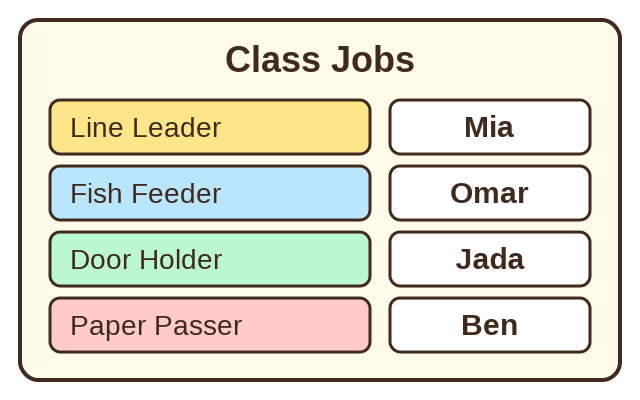
Look at the job chart. Then answer the questions.
Social and Instructional: Our Class Jobs
Read image description
Class Jobs
Line Leader: Mia
Fish Feeder: Omar
Door Holder: Jada
Paper Passer: Ben
Question 1 of 9
Choose the best answer.
Who is the line leader?
Question 2 of 9
Choose the best answer.
What is Omar’s job?
Question 3 of 9
Choose the best answer.
Jada holds the ___.
Read the note. Then answer the questions.
Social and Instructional: A Note from Ms. Rogers
Dear Class,
Tomorrow is Pajama Day!
You can wear your pajamas to school.
Bring a book to read on the rug.
Love, Ms. Rogers
Question 4 of 9
Choose the best answer.
What is tomorrow?
Question 5 of 9
Choose the best answer.
What can children wear to school tomorrow?
Question 6 of 9
Choose the best answer.
What should children bring?
Read the story. Then answer the questions.
Language Arts: Ben’s Rocket
Read image description
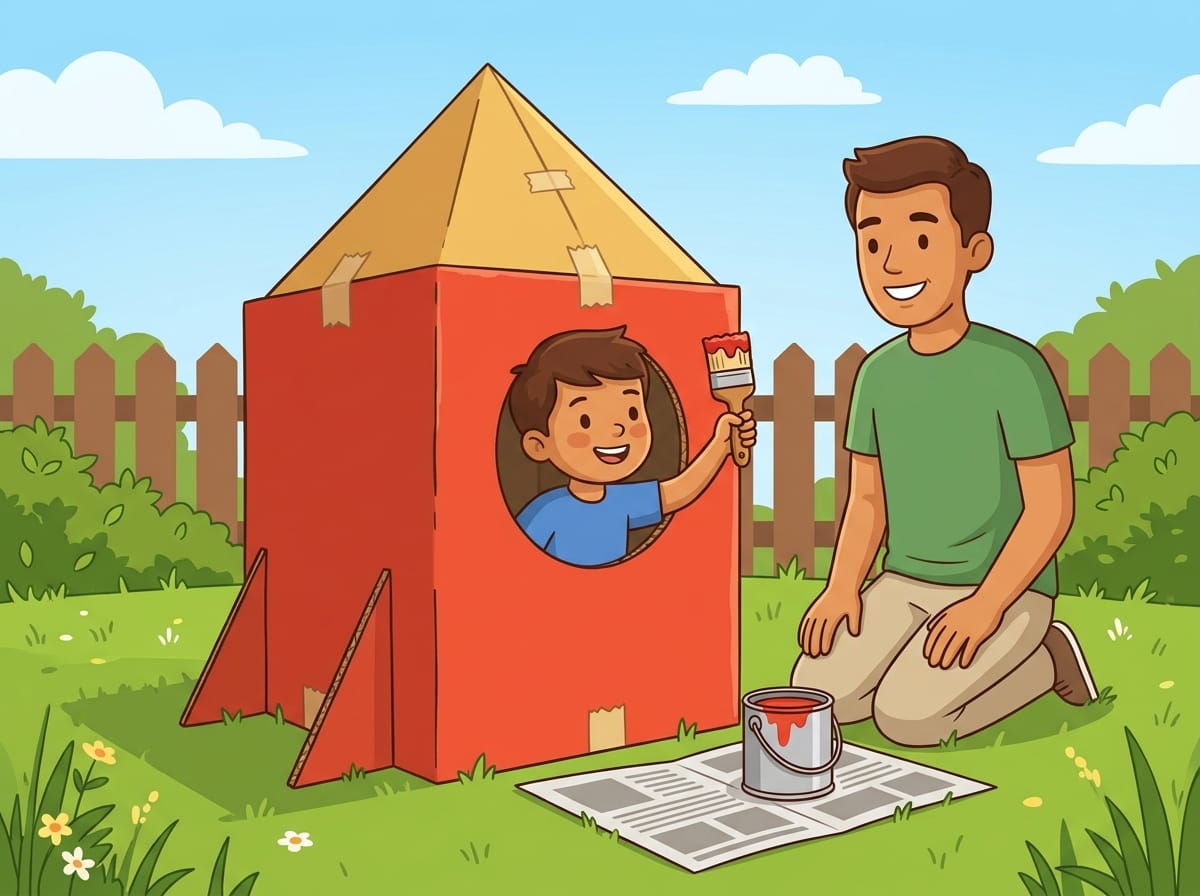
Ben gets a big box.
Dad cuts a round window in the box.
Ben paints the box red.
Now the box is a rocket!
Ben sits in the rocket. 3, 2, 1, go!
Question 7 of 9
Choose the best answer.
Who cuts the window?
Question 8 of 9
Choose the best answer.
What does the box become?
Question 9 of 9
Choose the best answer.
What does Ben do after he paints the box?
9 questions in this set are still unanswered. You can move on without answering them.
Ready for the whole thing? Take the reading practice test for Grade 1.
Answer key: every answer, explained
The correct answer to every question above, with why it is right and why each other choice is wrong. Open a question to see its answer.
Level A folders
1. Who is the line leader?
From “Social and Instructional: Our Class Jobs”
- MiaCorrect answer
- Omar
- Ben
Why “Mia” is correct
A job chart is read across: find the job, then read the name next to it. All the choices are names on the chart, so the child has to find the right row. Running a finger along the row is a good habit to practice.
Why the other answers are wrong
- Omar — Omar is on the chart, but his job is Fish Feeder.
- Ben — Ben is on the chart, but his job is Paper Passer.
2. What is Omar’s job?
From “Social and Instructional: Our Class Jobs”
- Door Holder
- Paper Passer
- Fish FeederCorrect answer
Why “Fish Feeder” is correct
This time the child starts from the name and reads back to the job, the reverse of the first question. Reading a chart both ways is the skill. If the child is stuck, point to Omar’s name and ask what word is next to it.
Why the other answers are wrong
- Door Holder — Door Holder is Jada’s job.
- Paper Passer — Paper Passer is Ben’s job.
3. Jada holds the ___.
From “Social and Instructional: Our Class Jobs”
- fish
- doorCorrect answer
- paper
Why “door” is correct
Jada is the Door Holder, so she holds the door. The child has to turn a job name into what the job means. Each wrong choice comes from another job on the chart.
Why the other answers are wrong
- fish — Fish comes from Omar’s job, Fish Feeder.
- paper — Paper comes from Ben’s job, Paper Passer.
4. What is tomorrow?
From “Social and Instructional: A Note from Ms. Rogers”
- Hat Day
- Pajama DayCorrect answer
- Book Fair Day
Why “Pajama Day” is correct
The second line says it. A note like this has a pattern: who it is to, the news, what to do, and who wrote it. The word "book" appears later, which makes "Book Fair Day" tempting for a child who skims.
Why the other answers are wrong
- Hat Day — Hats are not in the note.
- Book Fair Day — The note mentions a book, but tomorrow is Pajama Day, not a book fair.
5. What can children wear to school tomorrow?
From “Social and Instructional: A Note from Ms. Rogers”
- PajamasCorrect answer
- Swimsuits
- Rain boots
Why “Pajamas” is correct
The third line says "You can wear your pajamas to school." The question uses "wear", the same word as the note, so the child can find the matching line.
Why the other answers are wrong
- Swimsuits — Swimsuits are not in the note.
- Rain boots — Rain boots are not in the note.
6. What should children bring?
From “Social and Instructional: A Note from Ms. Rogers”
- A pillow
- A snack
- A bookCorrect answer
Why “A book” is correct
"Bring a book to read on the rug." A pillow fits a pajama day, so a child who guesses from the idea instead of reading may choose it.
Why the other answers are wrong
- A pillow — A pillow goes with pajamas, but the note asks for a book.
- A snack — A snack is not in the note.
7. Who cuts the window?
From “Language Arts: Ben’s Rocket”
- Ben
- Mom
- DadCorrect answer
Why “Dad” is correct
The picture shows both Ben and Dad, so it cannot answer this. The child has to read the second sentence. Ben is the main character, which makes his name the easy wrong guess.
Why the other answers are wrong
- Ben — Ben paints the box, but Dad cuts the window.
- Mom — Mom is not in the story.
8. What does the box become?
From “Language Arts: Ben’s Rocket”
- A rocketCorrect answer
- A doghouse
- A car
Why “A rocket” is correct
"Now the box is a rocket!" A big box could be many things in pretend play, which is why the other choices are believable. The word "now" signals the change.
Why the other answers are wrong
- A doghouse — A box can be a doghouse, but in this story it is a rocket.
- A car — A box can be a car, but Ben makes a rocket.
9. What does Ben do after he paints the box?
From “Language Arts: Ben’s Rocket”
- He paints it again
- He sits in itCorrect answer
- He gives it to Dad
Why “He sits in it” is correct
The question asks about order. Painting comes in sentence three, and the last sentence says Ben sits in the rocket. Ask the child to point to the painting sentence and then read on.
Why the other answers are wrong
- He paints it again — He paints it only once.
- He gives it to Dad — He keeps the rocket and sits in it himself.
Level B folders
10. Which fruit got the most votes?
From “Math: Our Favorite Fruit”
- Apples
- Grapes
- Oranges
- BananasCorrect answer
Why “Bananas” is correct
The child compares the rows and finds the longest one. Apples (5) and bananas (6) are close, so a quick look is not enough; the child has to count. "Most" is the key word.
Why the other answers are wrong
- Apples — Apples have 5, one less than bananas.
- Grapes — Grapes have the fewest votes, not the most.
- Oranges — Oranges have 3 votes, fewer than apples or bananas.
11. How many children chose grapes?
From “Math: Our Favorite Fruit”
- 2Correct answer
- 3
- 5
- 6
Why “2” is correct
Find the grapes row and count the circles: 2. The wrong numbers all come from other rows, so a child who reads the wrong row will still find their answer among the choices.
Why the other answers are wrong
- 3 — 3 is the number for oranges.
- 5 — 5 is the number for apples.
- 6 — 6 is the number for bananas.
12. How many more children chose apples than grapes?
From “Math: Our Favorite Fruit”
- 2
- 5
- 3Correct answer
- 7
Why “3” is correct
Apples have 5 and grapes have 2, and the difference is 3. "How many more" questions are a grade 1 math language demand: the words tell the child to compare, not to add. A child who adds gets 7.
Why the other answers are wrong
- 2 — 2 is how many chose grapes, not the difference.
- 5 — 5 is how many chose apples, not the difference.
- 7 — 7 is apples and grapes added together. "How many more" asks for the difference.
13. Which one keeps us warm?
From “Science: The Sky in the Day and at Night”
 The moon
- Correct answer
 The sun
 Stars
 A cloud
Why “The sun” is correct
The first paragraph says the sun "keeps us warm." The child reads the word and matches it to a picture. The moon and stars are named in the text too, so the child has to find the right sentence, not just a familiar word.
Why the other answers are wrong
- The moon — The moon is in the text, but it does not make heat or even its own light.
- Stars — The text says the sun is a star too, but the stars in this picture are the far-away night stars. The text says it is the sun that keeps us warm.
- A cloud — Clouds are not in the text.
14. Why does the moon shine?
From “Science: The Sky in the Day and at Night”
- It makes its very own light
- It is on fire
- The stars light it up
- The sun’s light hits itCorrect answer
Why “The sun’s light hits it” is correct
The third paragraph says the moon "does not make its own light" and then gives the real reason. The first choice repeats words from the text but drops the word "not", so a child who reads carefully will catch it.
Why the other answers are wrong
- It makes its very own light — The text says the moon does not make its own light.
- It is on fire — The text says nothing about fire.
- The stars light it up — Stars are mentioned, but the text says the light comes from the sun.
15. What does the text say about the sun?
From “Science: The Sky in the Day and at Night”
- It is a starCorrect answer
- It is smaller than the moon
- It comes out at night
- It is cold
Why “It is a star” is correct
The last sentence says "The sun is a star, too!" Many children are surprised by this, which makes it a good check that they read to the end. The other choices go against what the text says.
Why the other answers are wrong
- It is smaller than the moon — The text does not compare the sizes of the sun and the moon.
- It comes out at night — The text says we see the sun in the day. The moon and stars come at night.
- It is cold — The text says the sun keeps us warm.
16. What were many toys made of long ago?
From “Social Studies: Toys Long Ago and Today”
- Plastic and metal
- Glass and paper
- Wood and clothCorrect answer
- Rubber and plastic
Why “Wood and cloth” is correct
The first sentence answers it directly. "Long ago" and "today" are the key time words in this text; plastic belongs to today, so choices with plastic are the trap for a child who mixes up the two parts.
Why the other answers are wrong
- Plastic and metal — Plastic is how toys are made today, not long ago.
- Glass and paper — Glass and paper are not in the text.
- Rubber and plastic — Plastic is how toys are made today.
17. Which toy is most like a toy from today?
From “Social Studies: Toys Long Ago and Today”
- A cloth doll
- A toy with batteriesCorrect answer
- A hoop you roll with a stick
- A doll made at home
Why “A toy with batteries” is correct
The third paragraph says some toys today use batteries. The other three choices each come from the long-ago part. Sorting things into then and now is a grade 1 social studies skill.
Why the other answers are wrong
- A cloth doll — A cloth doll is a toy from long ago.
- A hoop you roll with a stick — A wooden hoop is a toy from long ago.
- A doll made at home — Families made toys at home long ago.
18. What is the same long ago and today?
From “Social Studies: Toys Long Ago and Today”
- Toys use batteries
- Toys are made of plastic
- Families make all their toys at home
- Children like to play ballCorrect answer
Why “Children like to play ball” is correct
"Some things have not changed" tells the reader that a sameness is coming. The other choices are each true for only one time. Ask the child: was it true long ago? Is it true today?
Why the other answers are wrong
- Toys use batteries — Batteries are only in toys from today.
- Toys are made of plastic — Plastic is only how toys are made today.
- Families make all their toys at home — This was true long ago, and the text does not say it is true today.
Level C folders
19. What made Nora’s tooth fall out?
From “Language Arts: Nora’s Loose Tooth”
- She bit into an appleCorrect answer
- Her brother pulled it
- She fell on the floor
- She brushed it hard
Why “She bit into an apple” is correct
The story never says "the apple made it fall out". The child reads that she bit the apple and then something fell, and puts the two together. The brother comes in only after school, after the tooth is already out.
Why the other answers are wrong
- Her brother pulled it — Her brother sees the gap after school. The tooth was already out.
- She fell on the floor — Nora does not fall in the story. Her tooth falls onto the tray.
- She brushed it hard — Brushing is not in the story.
20. Read this sentence from the story: “Now there was a gap in her smile.” What does gap mean?
From “Language Arts: Nora’s Loose Tooth”
- A crunchy food
- A big laugh
- An empty spaceCorrect answer
- A loose tooth
Why “An empty space” is correct
The child works out a new word from the story: the tooth fell out, so there is now an empty space where it was. "A loose tooth" is close to the topic, which makes it the strongest wrong answer; the tooth is gone, and the gap is where it used to be.
Why the other answers are wrong
- A crunchy food — The apple is crunchy. The gap is in Nora’s smile.
- A big laugh — Her brother laughs later, but a gap is not a laugh.
- A loose tooth — The loose tooth has fallen out. The gap is the space it left.
21. How did Nora feel when her tooth came out?
From “Language Arts: Nora’s Loose Tooth”
- Scared
- HappyCorrect answer
- Angry
- Sleepy
Why “Happy” is correct
"Grinned from ear to ear" means a very big smile, but the story does not say "happy". The child reads the clue and names the feeling. Showing her brother right away is a second clue.
Why the other answers are wrong
- Scared — A child might feel scared about a tooth, but Nora grins.
- Angry — Nothing in the story shows Nora is angry.
- Sleepy — It happens at lunch, and Nora is excited, not tired.
22. Opening a drawer is a ___.
From “Science: Push and Pull”
- push
- pullCorrect answer
- kick
- roll
Why “pull” is correct
The second paragraph gives this exact example. The child has to keep the two words apart: push is away from you, pull is toward you. Acting it out with a real drawer makes the difference stick.
Why the other answers are wrong
- push — A push moves something away. A drawer comes toward you.
- kick — Kicking is the text’s example of a push.
- roll — Rolling is what the balls do. It is not a push or a pull.
23. Whose ball most likely rolled farther?
From “Science: Push and Pull”
- Nick’s ballCorrect answer
- Kim’s ball
- They rolled the same
- Neither ball moved
Why “Nick’s ball” is correct
The text does not say whose ball went farther. The child uses the rule in the third paragraph (a hard push makes a thing move far) and applies it to Nick. Using a rule from one part of a text to answer about another part is a level C skill.
Why the other answers are wrong
- Kim’s ball — Kim gave a soft push, and a soft push makes a ball move only a little.
- They rolled the same — The pushes were different, so the balls would not roll the same.
- Neither ball moved — Both children pushed their balls, so both balls moved.
24. What is this text mostly about?
From “Science: Push and Pull”
- Balls are fun to roll on the floor
- Drawers open and close
- Nick is faster than Kim
- Pushes and pulls move thingsCorrect answer
Why “Pushes and pulls move things” is correct
A main idea question asks what the whole text is about, not one part. Balls, drawers and Nick are all details. The child can check by asking which choice every paragraph talks about.
Why the other answers are wrong
- Balls are fun to roll on the floor — Balls are one example. The text is about how things move.
- Drawers open and close — A drawer is one example of a pull.
- Nick is faster than Kim — The text says nothing about how fast Nick and Kim are. It is about their pushes.
More WIDA practice for 1st grade
Read next
- WIDA Listening and Reading Test: Folders, Levels and Adaptivity: On WIDA ACCESS Online, listening and reading questions come in folders: one recording or text with a small group of questions about it. The test is adaptive, so after each folder it moves the student to easier or harder material. Listening and reading are taken first, and the results decide the tier of speaking and writing. Here is how they work.
- How to Prepare for WIDA ACCESS: A Practical Plan for Parents: WIDA ACCESS measures English that grows over months and years, so there is no shortcut to a higher level. What preparation can do is make the test familiar, so your child's real English shows on the day. The best plan is the official WIDA demos, a few weeks of short practice in each domain, and plenty of talk and reading at home, in any language.
- WIDA Scale Scores: How They Relate to Proficiency Levels: Every WIDA ACCESS score report gives two numbers for each domain and composite: a scale score and a proficiency level. The proficiency level (1.0 to 6.0) is the number schools and states usually act on. The scale score is what the level is worked out from, and it is the better number for tracking growth. In 2025–26, WIDA reset the scale, so scale scores from before 2026 cannot be compared with scale scores from 2026 on.
Unofficial practice. This site is not affiliated with, endorsed by, or connected to WIDA, the Wisconsin Center for Education Research, or the Board of Regents of the University of Wisconsin System. WIDA and WIDA ACCESS are trademarks of the Board of Regents of the University of Wisconsin System. Every question here is original practice material written to match the published test design.