What were many toys made of long ago?
Level B folders · WIDA Grade 1 reading. The correct answer, and the reasoning behind it.
Middle folders, aimed at levels 2 to 4: paragraphs, charts and short articles with content vocabulary.
Look at the picture and read. Then answer the questions.
Social Studies: Toys Long Ago and Today
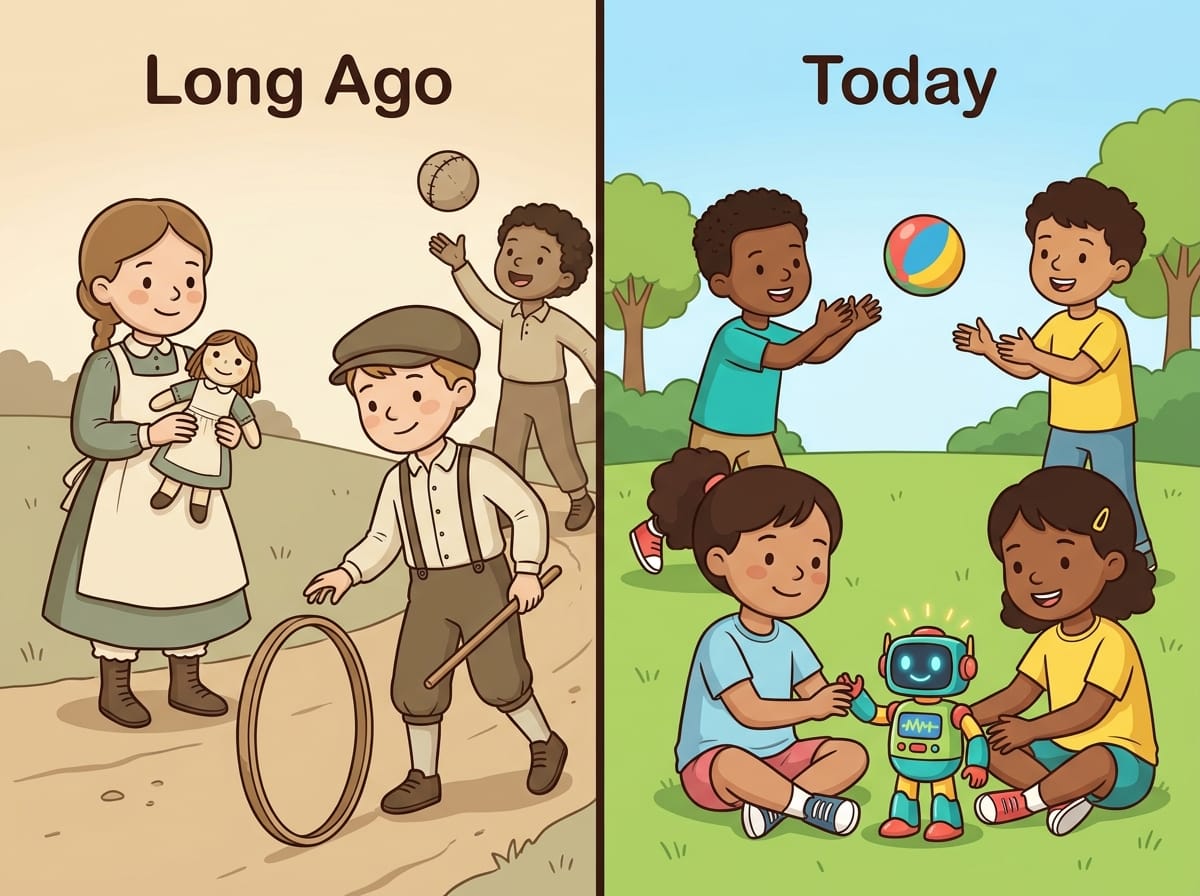
Read image description
Long ago, many toys were made of wood and cloth. A girl might have a cloth doll. A boy might roll a wooden hoop with a stick.
Long ago, families made many of their toys at home.
Today, many toys are made of plastic. Some toys use batteries. They can light up or make sounds.
Some things have not changed. Long ago and today, children like to play ball.
The question
Choose the best answer.
What were many toys made of long ago?
- Plastic and metal
- Glass and paper
- Wood and clothCorrect answer
- Rubber and plastic
Why “Wood and cloth” is correct
The first sentence answers it directly. "Long ago" and "today" are the key time words in this text; plastic belongs to today, so choices with plastic are the trap for a child who mixes up the two parts.
Why the other answers are wrong
- Plastic and metal — Plastic is how toys are made today, not long ago.
- Glass and paper — Glass and paper are not in the text.
- Rubber and plastic — Plastic is how toys are made today.
Practice more of this
More reading practice for Grade 1, or see the WIDA practice test for 1st grade.
Unofficial practice. This site is not affiliated with, endorsed by, or connected to WIDA, the Wisconsin Center for Education Research, or the Board of Regents of the University of Wisconsin System. WIDA and WIDA ACCESS are trademarks of the Board of Regents of the University of Wisconsin System. Every question here is original practice material written to match the published test design.