WIDA writing prompts and practice for 1st grade screener
Writing tasks at each tier with the rubric and a sample answer. Not scored here, but you can ask for AI practice feedback on what you write.
Write your response in the editor. You can see your word count, use the optional timer, save a draft in this browser, ask for AI practice feedback, and compare your writing with the rubric and sample response. It is not scored here — on the real test, writing is scored against a rubric.
Printable version with every prompt, rubric and sample response.
Prompt 1 of 2 — Tier A tasks — suggested time about 8 minutes
Look at the picture of the classroom.
Our Classroom
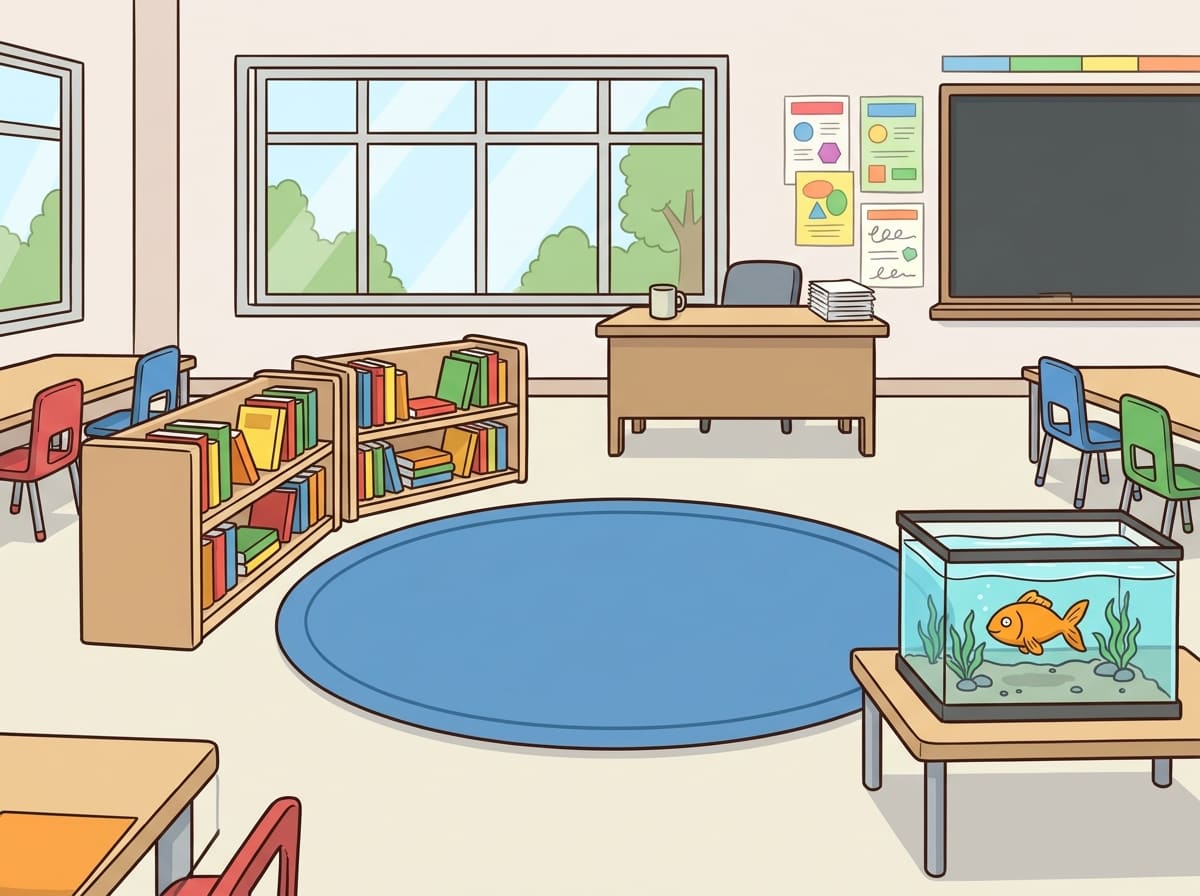
Read image description
A first-grade classroom. There is a round blue rug in the middle. Shelves of books stand by the rug.
A fish tank with one orange fish sits on a table. The teacher's desk is in front of a big window.
Word bank: rug, books, fish, desk, window
Look at the picture. Use words from the word bank. Write on paper, the way grade 1 students write in a booklet.
This is a classroom at a new school. Write about what you see in the classroom. Write two or three sentences.
View the practice scoring rubric
| Level | What it looks like |
|---|---|
| 7 — Fully developed |
|
| 6 — Well developed |
|
| 5 — Developed |
|
| 4 — Expanding |
|
| 3 — Emerging |
|
| 2 — Beginning |
|
| 1 — Starting |
|
Show a strong sample response
I see a big rug. The books is on the shelf. A fish is in the tank. it is orange. I like the rug.
This sits around level 3 to 4. The child writes several short, related sentences with words from the word bank, adds one detail (orange), and has small errors ("books is," a lowercase "it") that don't block meaning.
What to look for
- Read the word bank aloud first if the child can't yet read it alone.
- Invented spelling is fine at grade 1; look for sentences that tell about the picture.
- On the real Screener, writing is scored locally by a trained educator using WIDA's own scale; this rubric is a practice guide, not that scale. A blank, copied, off-topic or non-English response doesn't get a level here; note it and try again.
All 2 writing prompts for 1st grade screener
- Tier A tasks (Our Classroom): This is a classroom at a new school. Write about what you see in the classroom. Write two or three sentences.
- Tier B/C tasks (Books We Like Best): Write about the graph. Which kind of book do most children in this class like? What kind of book do you like best, and why?
More WIDA practice for 1st grade screener
Read next
- WIDA Writing Test: Tasks, Tiers, Scoring and Sample Answers: The WIDA ACCESS writing test asks students to write extended answers to a few tasks, each set up with a short scenario that gives them a reason to write. Grades 1–3 handwrite in a booklet and grades 4–12 type. Tasks come in two tiers, A and B/C, and trained raters score each answer on a 0–7 rubric. Here is how it works, with an original sample answer, and how to practise.
- How to Prepare for WIDA ACCESS: A Practical Plan for Parents: WIDA ACCESS measures English that grows over months and years, so there is no shortcut to a higher level. What preparation can do is make the test familiar, so your child's real English shows on the day. The best plan is the official WIDA demos, a few weeks of short practice in each domain, and plenty of talk and reading at home, in any language.
- WIDA Scale Scores: How They Relate to Proficiency Levels: Every WIDA ACCESS score report gives two numbers for each domain and composite: a scale score and a proficiency level. The proficiency level (1.0 to 6.0) is the number schools and states usually act on. The scale score is what the level is worked out from, and it is the better number for tracking growth. In 2025–26, WIDA reset the scale, so scale scores from before 2026 cannot be compared with scale scores from 2026 on.
Unofficial practice. This site is not affiliated with, endorsed by, or connected to WIDA, the Wisconsin Center for Education Research, or the Board of Regents of the University of Wisconsin System. WIDA and WIDA ACCESS are trademarks of the Board of Regents of the University of Wisconsin System. Every question here is original practice material written to match the published test design.