WIDA reading practice questions for 1st grade screener
Passages, charts and pictures with questions in groups of three, from social and classroom language to language arts, math, science and social studies.
These 12 questions are grouped by task type, one group at a time. Answer a question to see whether it was right and why. Nothing is timed and nothing is recorded. Printable version with the answer key.
Set 1 of 3. 0 of 12 questions answered.
Level A folders
Easier folders, aimed at proficiency levels 1 to 3: short texts with pictures, labels and simple sentences.
Read the note. Then answer the questions.
Social and Instructional: A Party Note
Dear Ana,
Come to my party!
I will be seven.
The party is on Saturday.
We will play games and eat cake.
From, Carlos
Question 1 of 6
Choose the best answer.
How old will Carlos be?
Question 2 of 6
Choose the best answer.
When is the party?
Question 3 of 6
Choose the best answer.
Who is the note for?
Look at the class schedule. Then answer the questions.
Social and Instructional: Our Day
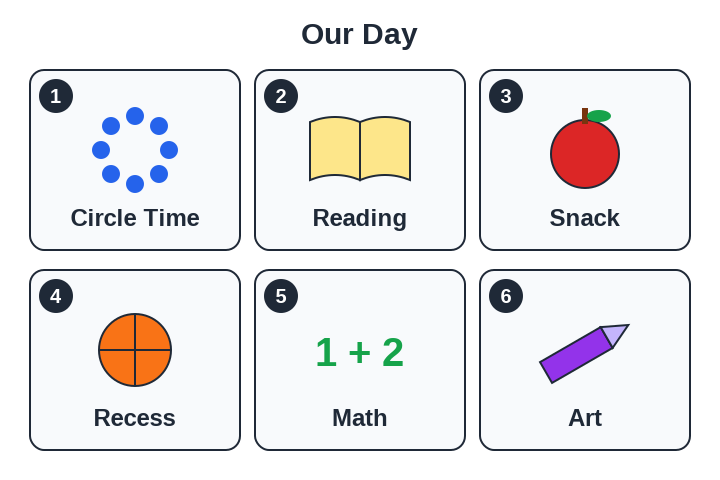
Read image description
Our Day
1. Circle Time
2. Reading
3. Snack
4. Recess
5. Math
6. Art
Question 4 of 6
Choose the best answer.
What comes after Reading?
Question 5 of 6
Choose the best answer.
What is the last thing on the schedule?
Question 6 of 6
Choose the best answer.
The class goes outside to play. What is it time for?
6 questions in this set are still unanswered. You can move on without answering them.
Ready for the whole thing? Take the reading practice test for Screener: Grade 1.
Answer key: every answer, explained
The correct answer to every question above, with why it is right and why each other choice is wrong. Open a question to see its answer.
Level A folders
1. How old will Carlos be?
From “Social and Instructional: A Party Note”
- sevenCorrect answer
- six
- eight
Why “seven” is correct
The note says "I will be seven." Number words are early sight words in grade 1.
Why the other answers are wrong
- six — The note says "I will be seven."
- eight — The note says "I will be seven."
2. When is the party?
From “Social and Instructional: A Party Note”
- on Friday
- on Sunday
- on SaturdayCorrect answer
Why “on Saturday” is correct
The note says "The party is on Saturday." Days of the week are everyday school words at this level.
Why the other answers are wrong
- on Friday — Friday is not in the note.
- on Sunday — Sunday is not in the note.
3. Who is the note for?
From “Social and Instructional: A Party Note”
- Carlos
- AnaCorrect answer
- Mom
Why “Ana” is correct
The note begins "Dear Ana." The name after "Dear" tells who the note is for, and the name after "From" tells who wrote it.
Why the other answers are wrong
- Carlos — Carlos wrote the note; his name comes after "From."
- Mom — No mom is named in the note.
4. What comes after Reading?
From “Social and Instructional: Our Day”
- SnackCorrect answer
- Math
- Circle Time
Why “Snack” is correct
Reading is number 2 and Snack is number 3. The numbers show the order of the day.
Why the other answers are wrong
- Math — Math is number 5; it comes later.
- Circle Time — Circle Time comes before Reading.
5. What is the last thing on the schedule?
From “Social and Instructional: Our Day”
- Recess
- ArtCorrect answer
- Circle Time
Why “Art” is correct
Art is number 6, the highest number, so it comes last.
Why the other answers are wrong
- Recess — Recess is number 4, in the middle of the day.
- Circle Time — Circle Time is the first thing, not the last.
6. The class goes outside to play. What is it time for?
From “Social and Instructional: Our Day”
- Snack
- Math
- RecessCorrect answer
Why “Recess” is correct
The child has to know that recess means outdoor play time. School routine words like this are part of Social and Instructional language.
Why the other answers are wrong
- Snack — Snack is time to eat.
- Math — Math is a lesson in the classroom.
Level B folders
7. How many students like animal books best?
From “Mathematics: Books We Like Best”
- 6
- 5
- 8Correct answer
Why “8” is correct
The Animals row has 8 circles, and each circle is one student. The child counts one row and ignores the others.
Why the other answers are wrong
- 6 — Six is the number for Space.
- 5 — Five is the number for Trucks.
8. Which kind of book do the fewest students like best?
From “Mathematics: Books We Like Best”
- trucks
- jokesCorrect answer
- space
Why “jokes” is correct
Jokes has only 2 circles, the shortest row. "Fewest" is a comparison word that grade 1 math uses a lot.
Why the other answers are wrong
- trucks — Five students chose trucks, which is more than the 2 who chose jokes.
- space — Six students chose space.
9. How many more students like animal books than truck books?
From “Mathematics: Books We Like Best”
- 3Correct answer
- 13
- 2
Why “3” is correct
Eight chose animals and 5 chose trucks, and 8 minus 5 is 3. "How many more" asks for a difference, not a total.
Why the other answers are wrong
- 13 — This adds 8 and 5 instead of finding the difference.
- 2 — Two is the number of students who chose jokes.
Level C folders
10. Why did Danny not want to go up the slide?
From “Language Arts: Danny and the Big Slide”
- It was time to go inside.
- Mia was on it.
- It was very tall.Correct answer
Why “It was very tall.” is correct
The story says the new slide "was very tall" and the old one "was small." The child has to connect the comparison to Danny's feeling.
Why the other answers are wrong
- It was time to go inside. — Nothing in the story says recess was over.
- Mia was on it. — Mia offers to go with him; she is not in his way.
11. Who helped Danny?
From “Language Arts: Danny and the Big Slide”
- his teacher
- MiaCorrect answer
- his mom
Why “Mia” is correct
Mia says, "We can go together." The child has to see that going together is a way of helping.
Why the other answers are wrong
- his teacher — No teacher is in the story.
- his mom — Danny's mom is not in the story.
12. How did Danny feel at the end?
From “Language Arts: Danny and the Big Slide”
- happyCorrect answer
- scared
- sleepy
Why “happy” is correct
The story never says "happy." It says Danny laughed and said "Again!", and the child infers the feeling from what he does.
Why the other answers are wrong
- scared — He was scared at first, but at the end he laughs.
- sleepy — Nothing in the story points to being tired.
More WIDA practice for 1st grade screener
Read next
- WIDA Listening and Reading Test: Folders, Levels and Adaptivity: On WIDA ACCESS Online, listening and reading questions come in folders: one recording or text with a small group of questions about it. The test is adaptive, so after each folder it moves the student to easier or harder material. Listening and reading are taken first, and the results decide the tier of speaking and writing. Here is how they work.
- How to Prepare for WIDA ACCESS: A Practical Plan for Parents: WIDA ACCESS measures English that grows over months and years, so there is no shortcut to a higher level. What preparation can do is make the test familiar, so your child's real English shows on the day. The best plan is the official WIDA demos, a few weeks of short practice in each domain, and plenty of talk and reading at home, in any language.
- WIDA Scale Scores: How They Relate to Proficiency Levels: Every WIDA ACCESS score report gives two numbers for each domain and composite: a scale score and a proficiency level. The proficiency level (1.0 to 6.0) is the number schools and states usually act on. The scale score is what the level is worked out from, and it is the better number for tracking growth. In 2025–26, WIDA reset the scale, so scale scores from before 2026 cannot be compared with scale scores from 2026 on.
Unofficial practice. This site is not affiliated with, endorsed by, or connected to WIDA, the Wisconsin Center for Education Research, or the Board of Regents of the University of Wisconsin System. WIDA and WIDA ACCESS are trademarks of the Board of Regents of the University of Wisconsin System. Every question here is original practice material written to match the published test design.