How many more seniors plan to attend a four-year college than plan to work full time?
Level B folders · WIDA Grades 9–12 reading. The correct answer, and the reasoning behind it.
Middle folders, aimed at levels 2 to 4: paragraphs, charts and short articles with content vocabulary.
Read the text and look at the bar graph. Then answer the questions.
Math: Plans After Graduation
Read image description
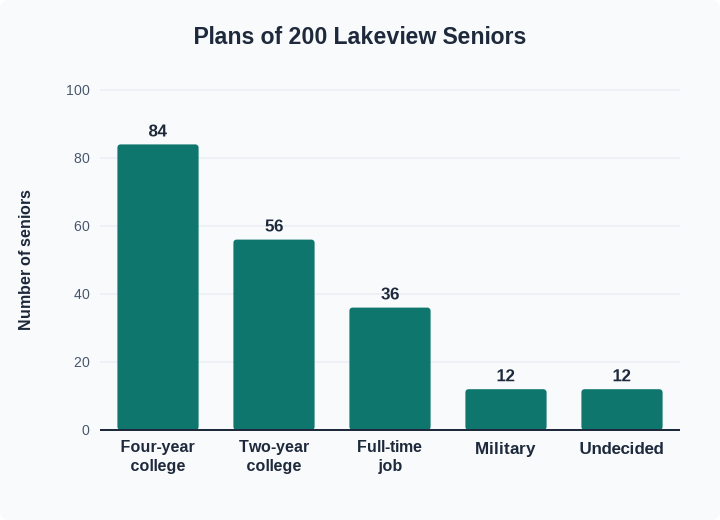
The counseling office at Lakeview High School asked 200 seniors what they plan to do after graduation. The bar graph shows the results.
84 seniors plan to attend a four-year college. 56 plan to attend a two-year college. 36 plan to work full time, 12 plan to join the military, and 12 are undecided.
The counselors plan to use the results to schedule more college visits and a spring career fair.
The question
Choose the best answer.
How many more seniors plan to attend a four-year college than plan to work full time?
- 48Correct answer
- 36
- 28
- 120
Why “48” is correct
Subtract: 84 four-year college students minus 36 who plan to work is 48. Choice d adds the two numbers instead of finding the difference, a common error with 'how many more' questions.
Why the other answers are wrong
- 36 — 36 is the number who plan to work, not the difference.
- 28 — 28 is the difference between the four-year and two-year college groups.
- 120 — 120 is the sum of the two groups, not the difference.
Practice more of this
More reading practice for Grades 9–12, or see the WIDA practice test for high school (grades 9–12).
Unofficial practice. This site is not affiliated with, endorsed by, or connected to WIDA, the Wisconsin Center for Education Research, or the Board of Regents of the University of Wisconsin System. WIDA and WIDA ACCESS are trademarks of the Board of Regents of the University of Wisconsin System. Every question here is original practice material written to match the published test design.