WIDA Practice
Practice TestsDomainsToolsGuidesPrintablesAbout
  • Practice Tests
  • Domains
  • Tools
  • Guides
  • Printables
  • About
Home / Practice tests / Screener: Grades 9–12 / Writing / Printable version

WIDA writing practice for high school screener

Printable version. Original practice written to match the published WIDA format, not questions from the official test.

Back to the interactive version

Writing prompts

On the real test these are scored by a trained person against a rubric. The rubric and a sample response follow each prompt.

Prompt 1: Tier A tasks

Suggested time: about 12 minutes

Type your answer. Use the model email to help you.

Write an email to your school counselor. Ask to join a club or team at your new school, and explain why you want to join. Include a greeting, at least three sentences and a closing. Model: "Dear Ms. Lee, I am writing to ask about ___. I want to join because ___. At my old school, I ___. Thank you, ___"

Scoring rubric

LevelWhat it looks like
7: Fully developed
  • Organized, cohesive response that fully carries out the task's purpose (narrate, inform, explain or argue) with the features that purpose needs
  • Varied, complex sentences used with control
  • Precise, wide-ranging vocabulary, including the content area's technical words
6: Well developed
  • Clearly organized response that carries out the purpose, with linking words that join ideas across the text
  • A range of sentence types, with occasional errors that don't affect meaning
  • Specific and some technical vocabulary used appropriately
5: Developed
  • Connected ideas that carry out the purpose, with some organization beyond a list
  • Compound and some complex sentences; errors sometimes affect meaning
  • Some content-area vocabulary alongside everyday words
4: Expanding
  • Several related sentences on the task, with simple connections between ideas
  • Simple and compound sentences; repeated patterns and errors
  • Mostly general vocabulary, some specific words
3: Emerging
  • A few sentences or phrases about the task; little connection between them
  • Short simple sentences or formulas, often with errors
  • Everyday words, repeated; relies on words given in the task
2: Beginning
  • Words, phrases or one simple sentence related to the task
  • Memorized chunks or patterns
  • A few familiar words, some copied from the prompt
1: Starting
  • Single words, labels or drawings related to the task
  • No sentence structure yet
  • Words may be copied, or partly in another language

A strong sample response

Dear Mr. Delgado,

I am writing to ask about the soccer team. I want to join because I play soccer for many years in my country. At my old school I was the goalkeeper. I think it is a good way to make friends. When is the practice? Do I need special shoes?

Thank you,

Vanessa

This sits around level 3 to 4. It follows the model to make a complete email, gives reasons and a detail from her past, and adds two questions of her own. Sentences are simple, with a tense error ("I play soccer for many years") that doesn't block meaning.

What to look for

  • Check the parts of an email: greeting, purpose, reason and closing.
  • Using the model is expected at Tier A; credit any sentences the student adds on their own.
  • On the real Screener, writing is scored locally by a trained educator using WIDA's own scale; this rubric is a practice guide, not that scale. A blank, copied, off-topic or non-English response doesn't get a level here; note it and try again.

Prompt 2: Tier B/C tasks

Suggested time: about 20 minutes

Look at the graph.

Hours of Daylight: Minneapolis and Quito
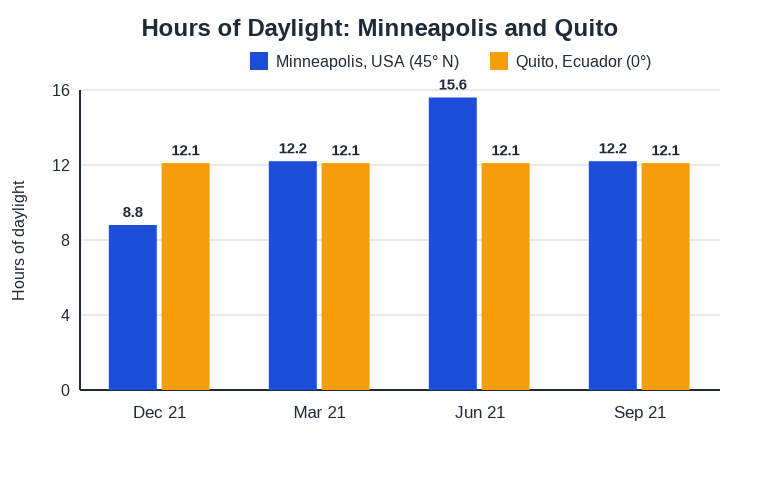
A bar graph comparing hours of daylight on four dates. Minneapolis, USA, at 45 degrees north: December 21, 8.8 hours; March 21, 12.2; June 21, 15.6; September 21, 12.2. Quito, Ecuador, at the equator: 12.1 hours on all four dates.

Picture description

The graph compares hours of daylight on four dates in two cities: Minneapolis, in the United States (about 45° north of the equator), and Quito, Ecuador (on the equator).

Minneapolis: December 21, 8.8 hours. March 21, 12.2 hours. June 21, 15.6 hours. September 21, 12.2 hours.

Quito: 12.1 hours on all four dates.

Type your answer. Plan before you write.

A student who moved from Quito to Minneapolis says, "In December it gets dark before I even get home from school!" Write an explanation for your school's newcomer guide. Use the data to compare daylight in the two cities, and explain the science that causes the difference. End with advice for new students arriving in winter.

Scoring rubric

LevelWhat it looks like
7: Fully developed
  • Organized, cohesive response that fully carries out the task's purpose (narrate, inform, explain or argue) with the features that purpose needs
  • Varied, complex sentences used with control
  • Precise, wide-ranging vocabulary, including the content area's technical words
6: Well developed
  • Clearly organized response that carries out the purpose, with linking words that join ideas across the text
  • A range of sentence types, with occasional errors that don't affect meaning
  • Specific and some technical vocabulary used appropriately
5: Developed
  • Connected ideas that carry out the purpose, with some organization beyond a list
  • Compound and some complex sentences; errors sometimes affect meaning
  • Some content-area vocabulary alongside everyday words
4: Expanding
  • Several related sentences on the task, with simple connections between ideas
  • Simple and compound sentences; repeated patterns and errors
  • Mostly general vocabulary, some specific words
3: Emerging
  • A few sentences or phrases about the task; little connection between them
  • Short simple sentences or formulas, often with errors
  • Everyday words, repeated; relies on words given in the task
2: Beginning
  • Words, phrases or one simple sentence related to the task
  • Memorized chunks or patterns
  • A few familiar words, some copied from the prompt
1: Starting
  • Single words, labels or drawings related to the task
  • No sentence structure yet
  • Words may be copied, or partly in another language

A strong sample response

Many newcomers to Minneapolis are surprised by how short winter days are, and the data explains why. In Quito, which sits on the equator, there are about 12.1 hours of daylight on every date shown, so the length of the day barely changes during the year. In Minneapolis, however, daylight ranges from only 8.8 hours on December 21 to 15.6 hours on June 21, a difference of almost seven hours. On the equinoxes in March and September, the two cities are nearly equal, at about 12 hours each.

The reason is that Earth's axis is tilted about 23.5 degrees. In December, the Northern Hemisphere is tilted away from the sun, so places far north of the equator, like Minneapolis, spend less of each day in sunlight. In June, the opposite happens, and the days are long. Because Quito is on the equator, the tilt has very little effect on its day length.

If you are arriving in winter, expect it to be dark by about 4:30 in the afternoon. Try to go outside during the middle of the day, keep a regular sleep schedule, and remember that by June you will have more daylight than you ever had in Quito.

This sits around level 6 to 7. It reads and compares the data precisely, including a calculated difference (math), explains the cause with accurate science (axial tilt, hemisphere, equinox), and is organized into data, explanation and advice, with cohesive transitions ("however," "The reason is," "Because").

What to look for

  • Check that the comparisons match the graph and that the science explanation names Earth's tilt, not distance from the sun.
  • A strong response integrates both areas: it uses the numbers as evidence for the science explanation.
  • On the real Screener, writing is scored locally by a trained educator using WIDA's own scale; this rubric is a practice guide, not that scale. A blank, copied, off-topic or non-English response doesn't get a level here; note it and try again.

Unofficial practice. This site is not affiliated with, endorsed by, or connected to WIDA, the Wisconsin Center for Education Research, or the Board of Regents of the University of Wisconsin System. WIDA and WIDA ACCESS are trademarks of the Board of Regents of the University of Wisconsin System. Every question here is original practice material written to match the published test design.

WIDA Practice

Unofficial practice. Not affiliated with WIDA. Free, independent practice tests and guides written to match the published test design.

No sign-up or ads. Your practice is saved only in this browser. Privacy policy · Refund policy

Practice for other English learner tests

  • TELPAS practice test (Texas)
  • Free TELPAS practice tests for grades 2–12
  • ELPAC practice test (California)

Practice

  • All practice tests
  • Choose a grade band
  • Listening, speaking, reading, and writing
  • Practice tools
  • Printable practice packs

By grade

  • WIDA practice test for kindergarten
  • WIDA practice test for 1st grade
  • WIDA practice test for 2nd and 3rd grade
  • WIDA practice test for 4th and 5th grade
  • WIDA practice test for 6th, 7th and 8th grade
  • WIDA practice test for high school (grades 9–12)
  • WIDA practice test for kindergarten screener
  • WIDA practice test for 1st grade screener
  • WIDA practice test for 2nd and 3rd grade screener
  • WIDA practice test for 4th and 5th grade screener
  • WIDA practice test for middle school screener
  • WIDA practice test for high school screener

Learn

  • Preparation guides
  • What Is the WIDA Test? A Parent's Guide to WIDA ACCESS
  • WIDA Scale Scores: How They Relate to Proficiency Levels
  • ELPAC vs WIDA ACCESS: How California's Test Compares
  • How Long Is the WIDA Test? Timing by Domain and Grade
  • How to Prepare for WIDA ACCESS: A Practical Plan for Parents
  • New York WIDA ACCESS: The Switch from NYSESLAT in 2026–27
  • Official WIDA Sample Items, Test Demo and Practice: Where to Find Them
  • TELPAS vs WIDA ACCESS: How Texas's Test Compares
  • WIDA ACCESS 2025–26 Changes: What Parents Need to Know
  • WIDA ACCESS in Middle and High School: What It Means for Grades 6–12
  • How WIDA ACCESS Is Administered: A Guide for School Staff
  • WIDA Exit Criteria by State: ACCESS Scores to Exit EL Services
  • WIDA Kindergarten Test: What to Expect and How to Prepare
  • WIDA Listening and Reading Test: Folders, Levels and Adaptivity
  • WIDA Proficiency Levels 1–6 Explained, With Examples by Grade
  • WIDA Score Release Dates: When 2027 ACCESS Scores Come Out
  • WIDA Scores Explained: How to Read the WIDA Score Report
  • WIDA Screener: What It Is, How Long It Takes and How It Is Scored
  • WIDA Speaking Test: Tiers, the Model Student and How to Practice
  • Which States Use WIDA? Every State for 2026–27
  • WIDA Testing Window 2026–27: ACCESS Test Dates by State
  • WIDA Writing Test: Tasks, Tiers, Scoring and Sample Answers
  • About this site
AboutContactPrivacyTerms of use

Unofficial practice. This site is not affiliated with, endorsed by, or connected to WIDA, the Wisconsin Center for Education Research, or the Board of Regents of the University of Wisconsin System. WIDA and WIDA ACCESS are trademarks of the Board of Regents of the University of Wisconsin System. Every question here is original practice material written to match the published test design.