WIDA speaking practice for high school screener
Printable version. Original practice written to match the published WIDA format, not questions from the official test.
Speaking prompts
On the real test these are scored by a trained person against a rubric. The rubric and a sample response follow each prompt.
Prompt 1: Tier A tasks
Suggested time: about 1 minutes
Model answer: read this aloud first
Listen to the model student answer a similar question first.
Model answer
Transcript for the adult to read aloud. The student listens and does not read it.
Dr. Kaminski: Look at the chart. How many science credits does a student need?
Kevin: Three. Three credits.
The student's own task
Look at the chart.
Credits to Graduate
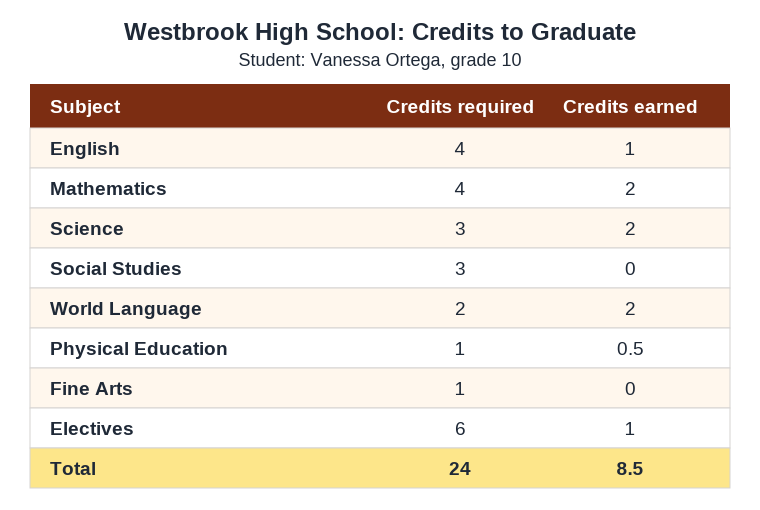
Picture description
Westbrook High School: Credits to Graduate
Student: Vanessa Ortega, grade 10
English: 4 required, 1 earned
Mathematics: 4 required, 2 earned
Science: 3 required, 2 earned
Social Studies: 3 required, 0 earned
World Language: 2 required, 2 earned
Physical Education: 1 required, 0.5 earned
Fine Arts: 1 required, 0 earned
Electives: 6 required, 1 earned
Total: 24 required, 8.5 earned
Look at the chart. Listen to the model student first. Then answer.
Look at the chart. How many English credits does a student need to graduate?
Scoring rubric
| Level | What it looks like |
|---|---|
| 4: Exemplary |
|
| 3: Strong |
|
| 2: Adequate |
|
| 1: Attempted |
|
A strong sample response
Four credits. Four.
This is a level 1 task: the right number with the word "credits" is a full answer, like the model.
What to look for
- The answer is in the "Credits required" column, not the "Credits earned" column.
- A short phrase is all this task asks for.
- On the real Screener, speaking is scored locally by a trained test administrator using WIDA's own scale; this rubric is a practice guide, not that scale.
Prompt 2: Tier A tasks
Suggested time: about 2 minutes
Model answer: read this aloud first
Listen to the model student answer a similar question first.
Model answer
Transcript for the adult to read aloud. The student listens and does not read it.
Dr. Kaminski: Describe a place in your neighborhood that you like to go. What do you do there?
Kevin: I like to go to the basketball court near my apartment. It is outside, next to a big parking lot. I go there after school with my cousin. We play two against two with other guys. Sometimes we stay until it is dark.
The student's own task
Listen to the model student first. Then answer.
Describe a class or subject you studied at your last school. What did you learn or do in that class?
Scoring rubric
| Level | What it looks like |
|---|---|
| 4: Exemplary |
|
| 3: Strong |
|
| 2: Adequate |
|
| 1: Attempted |
|
A strong sample response
At my last school I studied geography. We learned about rivers and mountains in different countries. The teacher gave us maps and we colored them. I liked it because I want to travel. We had a test every month.
This is a level 3 task. The answer describes the class in several simple connected sentences, gives details and a reason, and uses past tense, as the model does with present tense.
What to look for
- Any subject is fine. Listen for details about what the student did, not only the name of the class.
- Past tense is natural here; mixed tenses at this level are expected.
- On the real Screener, speaking is scored locally by a trained test administrator using WIDA's own scale; this rubric is a practice guide, not that scale.
Prompt 3: Tier B/C tasks
Suggested time: about 2 minutes
Model answer: read this aloud first
Listen to the model student answer a similar question first.
Model answer
Transcript for the adult to read aloud. The student listens and does not read it.
Dr. Kaminski: During a storm, why do we see lightning before we hear the thunder?
Kevin: Lightning and thunder happen at the same time, but light travels much faster than sound. The light reaches our eyes almost right away, but the sound takes longer to travel through the air. So if the storm is far away, you see the flash and then you count a few seconds before you hear it.
The student's own task
Listen to the model student first. Then answer.
When you shout in an empty gym, you often hear an echo. Explain why this happens, and why you hear less echo when the gym is full of people.
Scoring rubric
| Level | What it looks like |
|---|---|
| 4: Exemplary |
|
| 3: Strong |
|
| 2: Adequate |
|
| 1: Attempted |
|
A strong sample response
An echo happens because sound is a wave that travels through the air. When you shout, the sound waves move out and hit the hard walls and floor of the gym. Hard, flat surfaces reflect the sound, so it bounces back to your ears a moment later, and that is the echo. When the gym is full, the people and their clothes are soft, so they absorb a lot of the sound instead of reflecting it. That means less sound comes back, and the echo is weaker.
This is the level 3 to 5 range of a Tier B/C task, done at the top. It explains a cause-and-effect chain with science vocabulary (wave, reflect, absorb), answers both parts of the question, and links ideas with "because," "so" and "that means," like the model.
What to look for
- Check that the student answers both parts: why the echo happens and why it changes with people in the gym.
- Listen for cause-and-effect language, not only a description of the echo.
- On the real Screener, speaking is scored locally by a trained test administrator using WIDA's own scale; this rubric is a practice guide, not that scale.
Prompt 4: Tier B/C tasks
Suggested time: about 2 minutes
Model answer: read this aloud first
Listen to the model student answer a similar question first.
Model answer
Transcript for the adult to read aloud. The student listens and does not read it.
Dr. Kaminski: Should high school students be allowed to use their phones during lunch? Give your opinion and reasons.
Kevin: I think students should be allowed to use their phones at lunch, with some limits. Lunch is our only break, and many students need to check messages from family or a job. Also, banning phones completely is hard to enforce, so teachers spend time fighting about it. Some people worry that students won't talk to each other, and that's a fair point, so maybe the school could have one phone-free table for people who want it. But overall, a free break should be free.
The student's own task
Listen to the model student first. Then answer.
Should every high school student have to pass a personal finance course, about budgets, saving and credit, in order to graduate? Give your opinion and reasons.
Scoring rubric
| Level | What it looks like |
|---|---|
| 4: Exemplary |
|
| 3: Strong |
|
| 2: Adequate |
|
| 1: Attempted |
|
A strong sample response
In my opinion, a personal finance course should be required. First, every adult has to manage money, but a lot of people never learn how. If students understand budgets and credit cards before they leave school, they are less likely to fall into debt. Second, families who are new to this country may not know how credit scores work here, so the school can teach things parents can't. Some people say the schedule is already full, and that's true, but the course could replace one elective, because this knowledge is useful for every career. That is why I think it should be a requirement.
This is a level 5 task. The answer takes a clear position, develops two reasons with explanation, acknowledges and answers a counterargument, and concludes, using varied connectors ("In my opinion," "First," "Second," "Some people say," "That is why").
What to look for
- Either position is fine; look for developed reasons and a response to the other side.
- Precise words such as debt, credit score and requirement show academic vocabulary at this level.
- On the real Screener, speaking is scored locally by a trained test administrator using WIDA's own scale; this rubric is a practice guide, not that scale.
Unofficial practice. This site is not affiliated with, endorsed by, or connected to WIDA, the Wisconsin Center for Education Research, or the Board of Regents of the University of Wisconsin System. WIDA and WIDA ACCESS are trademarks of the Board of Regents of the University of Wisconsin System. Every question here is original practice material written to match the published test design.