WIDA reading practice for high school screener
Printable version. Original practice written to match the published WIDA format, not questions from the official test. The answer key, with an explanation for every answer, is at the end.
Questions
Level A folders
Read the email. Then answer the questions.
Social and Instructional: An Email from the Counselor
From: Mr. Delgado
To: Vanessa Ortega
Subject: Your first week
Hi Vanessa,
Welcome again to Westbrook High School! Here are a few reminders for your first week.
Your schedule is posted on the student portal. On Mondays, classes begin at 8:15 instead of 7:45 because teachers have meetings.
Your English language development class meets in Room B12, on the lower level of Building B.
The club fair is Thursday during lunch in the gym. It's a great way to meet people.
Please bring your immunization records to the nurse by next Friday.
Let me know if you have any questions. My door is always open.
Mr. Delgado, Counseling Office
Choose the best answer.
1. Why do classes start later on Mondays?
- A The buses run late.
- B The club fair is held.
- C Students take tests.
- D Teachers have meetings.
Choose the best answer.
2. Where is the club fair?
- A in Room B12
- B in the gym
- C in the counseling office
- D in the cafeteria
Choose the best answer.
3. What does Mr. Delgado mean by "My door is always open"?
- A She can come to him anytime.
- B His office has no door.
- C The office never closes at night.
- D She must knock before entering.
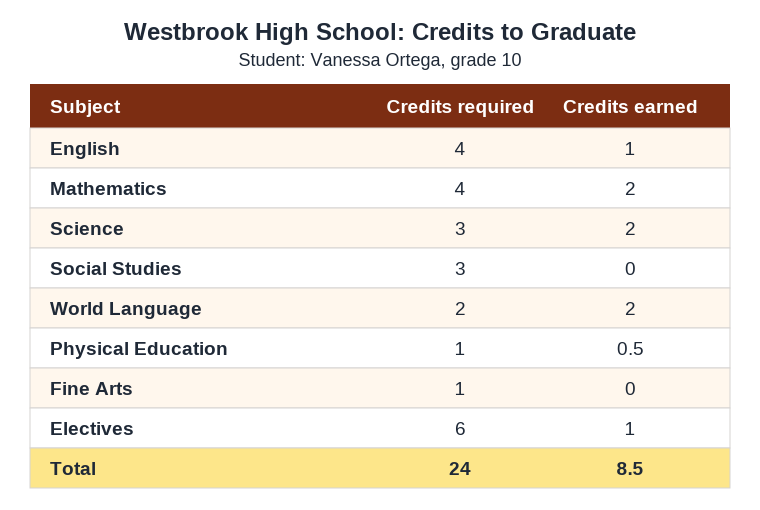
Read the chart. Then answer the questions.
Social and Instructional: Credits to Graduate
Picture description
Westbrook High School: Credits to Graduate
Student: Vanessa Ortega, grade 10
English: 4 required, 1 earned
Mathematics: 4 required, 2 earned
Science: 3 required, 2 earned
Social Studies: 3 required, 0 earned
World Language: 2 required, 2 earned
Physical Education: 1 required, 0.5 earned
Fine Arts: 1 required, 0 earned
Electives: 6 required, 1 earned
Total: 24 required, 8.5 earned
Choose the best answer.
4. In which subject has Vanessa already earned all the credits she needs?
- A Science
- B Mathematics
- C World Language
- D Fine Arts
Choose the best answer.
5. How many more Mathematics credits does Vanessa need?
- A 4
- B 6
- C 1
- D 2
Choose the best answer.
6. How many credits does a student need to graduate?
- A 24
- B 8.5
- C 15.5
- D 6
Level B folders
Read the article. Then answer the questions.
Science: How a Microwave Oven Heats Food
A microwave oven doesn't heat food with a flame or a hot coil. Instead, it uses microwaves, a type of electromagnetic wave. Like radio waves and visible light, microwaves carry energy, but you can't see them.
Most foods contain water. Each water molecule has a slightly positive end and a slightly negative end, so it tries to line up with the electric field of the microwave. Because the field flips direction billions of times per second, the water molecules twist back and forth very rapidly.
As the molecules twist, they bump into the molecules around them. This motion produces heat, which then spreads through the food by conduction.
This explains some common microwave problems. Foods with very little water, like crackers, don't heat much. Thick foods can stay cold in the center, because microwaves reach only a few centimeters into the food, and the inside must heat slowly by conduction. That is why many instructions say to stir the food or let it stand for a minute.
The metal walls of the oven reflect the microwaves and keep them inside, and a turntable rotates the food so it heats more evenly.
Choose the best answer.
7. What do microwaves cause water molecules to do?
- A freeze into ice crystals
- B twist back and forth rapidly
- C break apart into smaller pieces
- D glow like a light bulb
Choose the best answer.
8. Why can the center of a thick food stay cold?
- A The center has more water than the edges.
- B The turntable spins too slowly.
- C Microwaves don't reach that deep.
- D The metal walls block the microwaves.
Choose the best answer.
9. Why do many instructions say to stir microwaved food?
- A to let more air into the food
- B so the microwaves can reach the walls
- C to spread heat to cold spots
- D to stop the turntable
Level C folders
Read the personal essay. Then answer the questions.
Language Arts: Close Enough to Be Mine
On my first day at Westbrook, the attendance list turned my name into a question. "Th-ow?" the teacher tried, and twenty-eight heads turned toward me. I said "Here" before she could try again.
My name is Thảo. The little hook over the a tells you how the voice should dip and then rise, the way a melody does. Without the mark, the word is only a shape. With it, it is something my grandmother chose for me in a town I barely remember.
By the end of the week, I had a plan. I would become "Tia." It was short, easy and impossible to misspell. I practiced it in the bathroom mirror, trying to make it sound as if it belonged to me.
On Monday, I wrote TIA in large, confident letters on my chemistry worksheet. Ms. Bryant handed it back at the end of class. In the margin she had written, in small, careful print: Is this what you'd like me to call you? I'm happy to. But I've been practicing Thảo. Did I get it right this time?
Under her note was my name, spelled correctly, hook and all.
I did not answer right away. I folded the paper into my notebook and carried it around for two days, as if it were a letter I had to think about before I could reply. On Wednesday, I stayed after class and said my name for her slowly, twice. She repeated it. It was not perfect. But it was close enough to be mine.
Choose the best answer.
10. Why does the narrator say "Here" before the teacher can try again?
- A She did not hear the teacher clearly.
- B She wanted to be first in line.
- C She thought the teacher said Tia.
- D She was embarrassed by the stares.
Choose the best answer.
11. What does Ms. Bryant's note suggest about her?
- A She has been trying to learn the real name.
- B She is annoyed that the worksheet has the wrong name.
- C She does not allow nicknames in her chemistry class.
- D She thinks Tia is easier to spell than Thảo.
Choose the best answer.
12. Which theme does the essay develop?
- A Fitting in is easiest when you choose a simpler name.
- B A name can hold a person's identity and history.
- C Teachers should never use nicknames.
- D Learning chemistry requires careful practice.
Answer key
Level A folders
1. Why do classes start later on Mondays?
From “Social and Instructional: An Email from the Counselor”
- The buses run late.
- The club fair is held.
- Students take tests.
- Teachers have meetings.Correct answer
Why “Teachers have meetings.” is correct
The email says classes begin at 8:15 on Mondays "because teachers have meetings." The word "because" marks the reason.
Why the other answers are wrong
- The buses run late. — Buses are not mentioned.
- The club fair is held. — The club fair is on Thursday.
- Students take tests. — Tests are not mentioned.
2. Where is the club fair?
From “Social and Instructional: An Email from the Counselor”
- in Room B12
- in the gymCorrect answer
- in the counseling office
- in the cafeteria
Why “in the gym” is correct
The email says "The club fair is Thursday during lunch in the gym." The mention of lunch is a trap for the cafeteria choice.
Why the other answers are wrong
- in Room B12 — Room B12 is her English language development class.
- in the counseling office — The counseling office is where the email comes from.
- in the cafeteria — It happens during lunch, but in the gym.
3. What does Mr. Delgado mean by "My door is always open"?
From “Social and Instructional: An Email from the Counselor”
- She can come to him anytime.Correct answer
- His office has no door.
- The office never closes at night.
- She must knock before entering.
Why “She can come to him anytime.” is correct
"My door is always open" is an idiom meaning someone is willing to help at any time. It follows "Let me know if you have any questions."
Why the other answers are wrong
- His office has no door. — This reads the idiom literally.
- The office never closes at night. — He means he is available, not that the building is open all night.
- She must knock before entering. — This is the opposite of the message.
4. In which subject has Vanessa already earned all the credits she needs?
From “Social and Instructional: Credits to Graduate”
- Science
- Mathematics
- World LanguageCorrect answer
- Fine Arts
Why “World Language” is correct
World Language requires 2 credits, and Vanessa has earned 2. The student compares the two numbers in each row.
Why the other answers are wrong
- Science — She has 2 of the 3 science credits she needs.
- Mathematics — She has 2 of the 4 math credits she needs.
- Fine Arts — She has 0 of the 1 fine arts credit she needs.
5. How many more Mathematics credits does Vanessa need?
From “Social and Instructional: Credits to Graduate”
- 4
- 6
- 1
- 2Correct answer
Why “2” is correct
Mathematics requires 4 and she has earned 2, so she needs 4 − 2 = 2 more.
Why the other answers are wrong
- 4 — Four is the number required, not the number still needed.
- 6 — This adds the earned credits to the required ones.
- 1 — One is not the difference between 4 and 2.
6. How many credits does a student need to graduate?
From “Social and Instructional: Credits to Graduate”
- 24Correct answer
- 8.5
- 15.5
- 6
Why “24” is correct
The Total row shows 24 credits required. The student has to read the right column of the total row.
Why the other answers are wrong
- 8.5 — This is the number Vanessa has earned so far.
- 15.5 — This is how many Vanessa still needs (24 − 8.5).
- 6 — Six is the number of elective credits required.
Level B folders
7. What do microwaves cause water molecules to do?
From “Science: How a Microwave Oven Heats Food”
- freeze into ice crystals
- twist back and forth rapidlyCorrect answer
- break apart into smaller pieces
- glow like a light bulb
Why “twist back and forth rapidly” is correct
Paragraph 2 says the molecules "twist back and forth very rapidly" as the field flips. Paragraph 3 explains how that motion becomes heat.
Why the other answers are wrong
- freeze into ice crystals — Microwaves add energy; they don't freeze anything.
- break apart into smaller pieces — The molecules move, but the article doesn't say they break apart.
- glow like a light bulb — Microwaves are invisible, and nothing glows.
8. Why can the center of a thick food stay cold?
From “Science: How a Microwave Oven Heats Food”
- The center has more water than the edges.
- The turntable spins too slowly.
- Microwaves don't reach that deep.Correct answer
- The metal walls block the microwaves.
Why “Microwaves don't reach that deep.” is correct
The article says microwaves "reach only a few centimeters into the food," so the inside must heat slowly by conduction.
Why the other answers are wrong
- The center has more water than the edges. — More water would heat more, not less.
- The turntable spins too slowly. — The turntable helps the food heat evenly.
- The metal walls block the microwaves. — The walls keep microwaves inside the oven, not out of the food.
9. Why do many instructions say to stir microwaved food?
From “Science: How a Microwave Oven Heats Food”
- to let more air into the food
- so the microwaves can reach the walls
- to spread heat to cold spotsCorrect answer
- to stop the turntable
Why “to spread heat to cold spots” is correct
Stirring moves hot food from the edges into the cold center. The student has to connect the instruction to the cause given just before it.
Why the other answers are wrong
- to let more air into the food — Air is not part of the explanation.
- so the microwaves can reach the walls — The walls reflect microwaves whether or not food is stirred.
- to stop the turntable — Stirring has nothing to do with the turntable.
Level C folders
10. Why does the narrator say "Here" before the teacher can try again?
From “Language Arts: Close Enough to Be Mine”
- She did not hear the teacher clearly.
- She wanted to be first in line.
- She thought the teacher said Tia.
- She was embarrassed by the stares.Correct answer
Why “She was embarrassed by the stares.” is correct
Twenty-eight heads turn toward her, and she answers quickly to end the moment. The student must infer the feeling from the action; it is never stated.
Why the other answers are wrong
- She did not hear the teacher clearly. — She heard the attempt well enough to quote it.
- She wanted to be first in line. — There is no line; this is attendance.
- She thought the teacher said Tia. — She hasn't chosen the name Tia yet.
11. What does Ms. Bryant's note suggest about her?
From “Language Arts: Close Enough to Be Mine”
- She has been trying to learn the real name.Correct answer
- She is annoyed that the worksheet has the wrong name.
- She does not allow nicknames in her chemistry class.
- She thinks Tia is easier to spell than Thảo.
Why “She has been trying to learn the real name.” is correct
The note says "I've been practicing Thảo" and spells it "hook and all." She respects the choice but shows she has made an effort, which is why the narrator takes two days to reply.
Why the other answers are wrong
- She is annoyed that the worksheet has the wrong name. — Her tone is gentle, and she offers to use Tia.
- She does not allow nicknames in her chemistry class. — She says "I'm happy to" call her Tia.
- She thinks Tia is easier to spell than Thảo. — She spells Thảo correctly and asks about pronunciation.
12. Which theme does the essay develop?
From “Language Arts: Close Enough to Be Mine”
- Fitting in is easiest when you choose a simpler name.
- A name can hold a person's identity and history.Correct answer
- Teachers should never use nicknames.
- Learning chemistry requires careful practice.
Why “A name can hold a person's identity and history.” is correct
Paragraph 2 links the name to her grandmother and her first home, and the ending ("close enough to be mine") shows her claiming it. A theme is the idea the whole text develops, not a detail.
Why the other answers are wrong
- Fitting in is easiest when you choose a simpler name. — The narrator chooses to keep her name, so the essay moves away from this idea.
- Teachers should never use nicknames. — The teacher is willing to use the nickname.
- Learning chemistry requires careful practice. — Chemistry is only the setting of the worksheet.
Unofficial practice. This site is not affiliated with, endorsed by, or connected to WIDA, the Wisconsin Center for Education Research, or the Board of Regents of the University of Wisconsin System. WIDA and WIDA ACCESS are trademarks of the Board of Regents of the University of Wisconsin System. Every question here is original practice material written to match the published test design.