WIDA writing practice for middle school screener
Printable version. Original practice written to match the published WIDA format, not questions from the official test.
Writing prompts
On the real test these are scored by a trained person against a rubric. The rubric and a sample response follow each prompt.
Prompt 1: Tier A tasks
Suggested time: about 15 minutes
Type your answer. You can use the sentence starters.
Language Arts: Write a short story about a day with a big surprise. It can be true or made up. Tell what happened at the beginning, in the middle and at the end. Sentence starters: At first, ___. Then ___. After that, ___. In the end, ___.
Scoring rubric
| Level | What it looks like |
|---|---|
| 7: Fully developed |
|
| 6: Well developed |
|
| 5: Developed |
|
| 4: Expanding |
|
| 3: Emerging |
|
| 2: Beginning |
|
| 1: Starting |
|
A strong sample response
At first, it was a normal Saturday. I was bored and my mom said go to the store with her. Then we drive to my aunt house, not the store. I didnt understand. After that, I open the door and all my family was there. They yell "Surprise!" because it was my birthday. My cousin from Texas come too. I was so happy I almost cry. In the end, we eat cake and dance until night. It was the best surprise.
This sits around level 3 to 4. The story follows the sentence starters to give a beginning, middle and end, adds details and a feeling, and connects events in order. Sentences are simple, with errors in past tense ("drive," "open," "come") and a missing apostrophe that don't block meaning.
What to look for
- Check for a clear order of events and some detail about feelings or people.
- Using the starters is expected at this tier; credit any sentences that go beyond them.
- On the real Screener, writing is scored locally by a trained educator using WIDA's own scale; this rubric is a practice guide, not that scale. A blank, copied, off-topic or non-English response doesn't get a level here; note it and try again.
Prompt 2: Tier B/C tasks
Suggested time: about 20 minutes
Look at the graph.
Mathematics and Science: Cafeteria Food Waste
Picture description
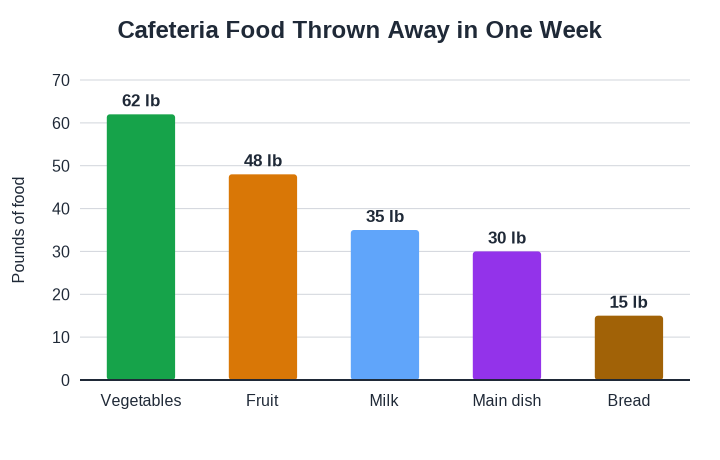
For one school week, the student council weighed the food students threw away at lunch. The bar graph shows the results in pounds.
Vegetables: 62 pounds. Fruit: 48 pounds. Milk: 35 pounds. Main dish: 30 pounds. Bread: 15 pounds. Total: 190 pounds.
Right now, the school's food waste goes to a landfill. In a landfill, food is buried under layers of trash with almost no air. It breaks down very slowly and gives off methane, a gas that traps heat in the atmosphere.
In a compost bin, food is mixed with air and water. Bacteria, fungi and worms break it down in a few months into rich soil that helps plants grow.
Type your answer. Plan before you write.
Your student council wants to cut down on food waste in the cafeteria. Write a letter to the council. Explain what the data shows, and explain what happens to food waste in a landfill compared with a compost bin. Then argue for one change the school should make, using evidence from the graph.
Scoring rubric
| Level | What it looks like |
|---|---|
| 7: Fully developed |
|
| 6: Well developed |
|
| 5: Developed |
|
| 4: Expanding |
|
| 3: Emerging |
|
| 2: Beginning |
|
| 1: Starting |
|
A strong sample response
Dear Student Council,
Your survey shows that our cafeteria throws away a lot of food: 190 pounds in just one week. Vegetables are the biggest problem, at 62 pounds, which is about one third of all the waste. Fruit is next with 48 pounds, so fruits and vegetables together make up 110 pounds, more than half of the total. In contrast, bread is only 15 pounds.
Right now, all of this food goes to a landfill. Because it is buried with almost no air, it breaks down slowly and releases methane, a gas that traps heat in the atmosphere. In a compost bin, however, air, water, bacteria and worms turn food scraps into healthy soil in a few months.
Therefore, I believe the school should start a compost program for fruit and vegetable scraps. Since those two groups are more than half of our waste, composting them would keep over 100 pounds a week out of the landfill. The finished compost could even be spread around the trees in front of the school. Some people might say we should just serve fewer vegetables, but students need them to stay healthy. Although composting takes some work, student volunteers could empty the bins each day.
Sincerely,
Daniela
This sits around level 6 to 7. It reports data with calculated totals and fractions (math), explains the difference between a landfill and compost with science vocabulary (methane, atmosphere, bacteria), argues a position with evidence, answers an alternative, and is organized into clear paragraphs with transitions such as "In contrast," "Therefore" and "Although."
What to look for
- Check the numbers and any differences the student calculates against the graph.
- A strong letter explains why, not only what, and uses the data as evidence for the recommendation.
- On the real Screener, writing is scored locally by a trained educator using WIDA's own scale; this rubric is a practice guide, not that scale. A blank, copied, off-topic or non-English response doesn't get a level here; note it and try again.
Unofficial practice. This site is not affiliated with, endorsed by, or connected to WIDA, the Wisconsin Center for Education Research, or the Board of Regents of the University of Wisconsin System. WIDA and WIDA ACCESS are trademarks of the Board of Regents of the University of Wisconsin System. Every question here is original practice material written to match the published test design.