WIDA speaking practice for middle school screener
Printable version. Original practice written to match the published WIDA format, not questions from the official test.
Speaking prompts
On the real test these are scored by a trained person against a rubric. The rubric and a sample response follow each prompt.
Prompt 1: Tier A tasks
Suggested time: about 1 minutes
Model answer: read this aloud first
Listen to the model student answer a similar question first.
Model answer
Transcript for the adult to read aloud. The student listens and does not read it.
Mr. Mitchell: Look at the schedule. What time does school start?
Maria: Eight o'clock. At eight.
The student's own task
Look at the bell schedule.
The Bell Schedule
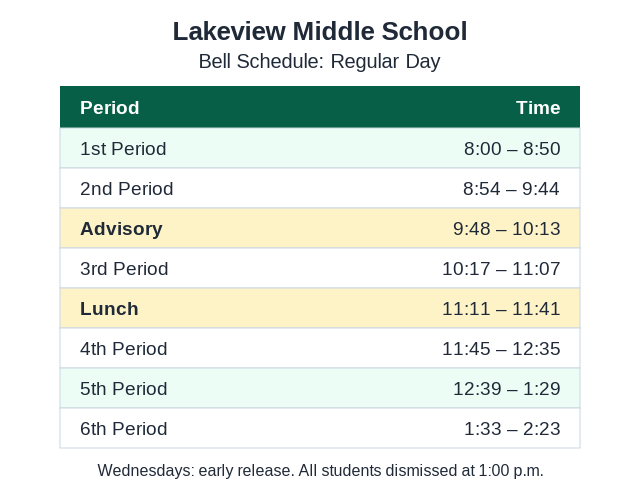
Picture description
Lakeview Middle School Bell Schedule: Regular Day
1st Period: 8:00 to 8:50
2nd Period: 8:54 to 9:44
Advisory: 9:48 to 10:13
3rd Period: 10:17 to 11:07
Lunch: 11:11 to 11:41
4th Period: 11:45 to 12:35
5th Period: 12:39 to 1:29
6th Period: 1:33 to 2:23
Wednesdays: early release. All students dismissed at 1:00 p.m.
Look at the schedule. Listen to the model student first. Then answer.
Look at the schedule. What time do students go home on Wednesdays?
Scoring rubric
| Level | What it looks like |
|---|---|
| 4: Exemplary |
|
| 3: Strong |
|
| 2: Adequate |
|
| 1: Attempted |
|
A strong sample response
One o'clock. At one on Wednesday.
This is a level 1 task: the correct time in a short phrase is a full answer, like the model.
What to look for
- The answer is in the note at the bottom of the schedule; let the student look for it.
- A short phrase with the right time is all this task asks for.
- On the real Screener, speaking is scored locally by a trained test administrator using WIDA's own scale; this rubric is a practice guide, not that scale.
Prompt 2: Tier A tasks
Suggested time: about 2 minutes
Model answer: read this aloud first
Listen to the model student answer a similar question first.
Model answer
Transcript for the adult to read aloud. The student listens and does not read it.
Mr. Mitchell: Tell me what you usually do after school.
Maria: After school I take the bus home. First I eat a snack. Then I do my homework at the kitchen table. At night I help my mom make dinner, and I talk to my cousins on the phone.
The student's own task
Listen to the model student first. Then answer.
Tell me what you usually do in the morning before school.
Scoring rubric
| Level | What it looks like |
|---|---|
| 4: Exemplary |
|
| 3: Strong |
|
| 2: Adequate |
|
| 1: Attempted |
|
A strong sample response
In the morning I wake up at six thirty. I take a shower and get dressed. Then I eat breakfast with my little brother. I walk to the bus stop at seven fifteen. Sometimes I am late and I run.
This is a level 3 task. The answer tells a routine in order with time words (then, at seven fifteen, sometimes) in simple connected sentences, as the model does.
What to look for
- Listen for order: first, then, after that, and times of day.
- Simple present tense ("I wake up") is expected for routines; note it if the student mixes in past tense, but don't stop them.
- On the real Screener, speaking is scored locally by a trained test administrator using WIDA's own scale; this rubric is a practice guide, not that scale.
Prompt 3: Tier B/C tasks
Suggested time: about 2 minutes
Model answer: read this aloud first
Listen to the model student answer a similar question first.
Model answer
Transcript for the adult to read aloud. The student listens and does not read it.
Mr. Mitchell: Tell me about a book or movie you like. Who is in it and what happens?
Maria: I like a movie about a girl who wants to be a cook. She lives in a small town with her grandmother. At first, nobody wants to eat her food because it's different. Then she enters a cooking contest, and she makes her grandmother's soup. She wins, and the whole town comes to her restaurant.
The student's own task
Listen to the model student first. Then answer.
In English class, you are studying stories from different cultures. Retell a story you know from your family or from where you grew up. Tell who is in it, where it happens and what happens.
Scoring rubric
| Level | What it looks like |
|---|---|
| 4: Exemplary |
|
| 3: Strong |
|
| 2: Adequate |
|
| 1: Attempted |
|
A strong sample response
My grandfather told me a story about a turtle and an eagle. The eagle was very proud, and he always laughed at the turtle because she was slow. One day, the eagle said they should race to the top of a mountain. The turtle agreed, but she was smart. She asked her friends, the other turtles, to wait at different places on the mountain. When the eagle flew up, he always saw a turtle in front of him. At the end, the eagle was tired and the turtle won. My grandfather says the story means you should not laugh at people who are different.
This is the level 3 to 5 range of a Tier B/C task, done at the top. It narrates with characters, a setting, events in order and an ending, uses past tense with control, and adds the story's message, like the model.
What to look for
- Any story is fine, including a family story or a folktale; the language matters, not the source.
- Listen for sequence (one day, when, at the end) and for past-tense verbs.
- On the real Screener, speaking is scored locally by a trained test administrator using WIDA's own scale; this rubric is a practice guide, not that scale.
Prompt 4: Tier B/C tasks
Suggested time: about 2 minutes
Model answer: read this aloud first
Listen to the model student answer a similar question first.
Model answer
Transcript for the adult to read aloud. The student listens and does not read it.
Mr. Mitchell: Should middle school students have to do community service? Tell me your opinion and give reasons.
Maria: I think middle school students should do some community service, but not too many hours. First, helping at a food bank or a library teaches you about your own community. Second, you meet people you would never meet at school. Some people say students already have too much homework, and that's true, so I think ten hours a year is fair. That's enough to learn something without making school harder.
The student's own task
Listen to the model student first. Then answer.
Should all middle school students have to learn a second language? Tell me your opinion and give reasons.
Scoring rubric
| Level | What it looks like |
|---|---|
| 4: Exemplary |
|
| 3: Strong |
|
| 2: Adequate |
|
| 1: Attempted |
|
A strong sample response
I think every middle school student should learn a second language. First, it helps you talk to more people. In our school there are students from many countries, and if you know a little Spanish or Arabic, you can make a new student feel welcome. Second, scientists say learning a language makes your brain stronger and helps you in other subjects. Some people argue that students should spend that time on math, but you can use a language your whole life, at work and when you travel. So I think it should be required, maybe for two years.
This is a level 5 task. The answer takes a position, gives two developed reasons with examples, answers a counterargument, and closes with a clear conclusion, matching the model.
What to look for
- Either side is fine. Look for reasons, examples, and a response to the other side.
- Linking words such as first, second, some people argue and so show organization.
- On the real Screener, speaking is scored locally by a trained test administrator using WIDA's own scale; this rubric is a practice guide, not that scale.
Unofficial practice. This site is not affiliated with, endorsed by, or connected to WIDA, the Wisconsin Center for Education Research, or the Board of Regents of the University of Wisconsin System. WIDA and WIDA ACCESS are trademarks of the Board of Regents of the University of Wisconsin System. Every question here is original practice material written to match the published test design.