WIDA reading practice questions for middle school screener
Passages, charts and pictures with questions in groups of three, from social and classroom language to language arts, math, science and social studies.
These 12 questions are grouped by task type, one group at a time. Answer a question to see whether it was right and why. Nothing is timed and nothing is recorded. Printable version with the answer key.
Set 1 of 3. 0 of 12 questions answered.
Level A folders
Easier folders, aimed at proficiency levels 1 to 3: short texts with pictures, labels and simple sentences.
Read the notice. Then answer the questions.
Social and Instructional: How to Pay for Lunch
How to Pay for Lunch at Lakeview
Every student has a lunch account. Your account number is the same as your student ID number.
At the register, type your ID number on the keypad. The cost of your meal is taken from your account.
Families can add money online, or send cash or a check to the cafeteria office. Write the student's name and ID number on the envelope.
Some families qualify for free or reduced-price meals. Ask for an application in the main office. Applications are available in several languages and are kept private.
Breakfast is served from 7:30 to 7:55 a.m.
Question 1 of 6
Choose the best answer.
What is a student's lunch account number?
Question 2 of 6
Choose the best answer.
Where can a family get an application for free meals?
Question 3 of 6
Choose the best answer.
In the notice, what does "kept private" mean?
Look at the bell schedule. Then answer the questions.
Social and Instructional: The Bell Schedule
Read image description
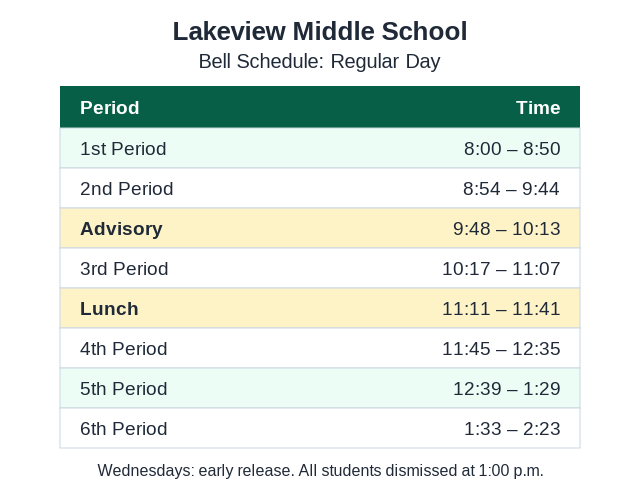
Lakeview Middle School Bell Schedule: Regular Day
1st Period: 8:00 to 8:50
2nd Period: 8:54 to 9:44
Advisory: 9:48 to 10:13
3rd Period: 10:17 to 11:07
Lunch: 11:11 to 11:41
4th Period: 11:45 to 12:35
5th Period: 12:39 to 1:29
6th Period: 1:33 to 2:23
Wednesdays: early release. All students dismissed at 1:00 p.m.
Question 4 of 6
Choose the best answer.
What time does lunch start?
Question 5 of 6
Choose the best answer.
What comes right after Advisory?
Question 6 of 6
Choose the best answer.
How long is each class period?
6 questions in this set are still unanswered. You can move on without answering them.
Ready for the whole thing? Take the reading practice test for Screener: Grades 6–8.
Answer key: every answer, explained
The correct answer to every question above, with why it is right and why each other choice is wrong. Open a question to see its answer.
Level A folders
1. What is a student's lunch account number?
From “Social and Instructional: How to Pay for Lunch”
- a new number every week
- printed on the lunch menu
- the same as the student IDCorrect answer
- the student's locker number
Why “the same as the student ID” is correct
The notice says, "Your account number is the same as your student ID number." The answer is in the second sentence.
Why the other answers are wrong
- a new number every week — The number does not change.
- printed on the lunch menu — The menu is not mentioned.
- the student's locker number — Lockers are not mentioned.
2. Where can a family get an application for free meals?
From “Social and Instructional: How to Pay for Lunch”
- the cafeteria register
- the main officeCorrect answer
- online only
- the library
Why “the main office” is correct
The notice says, "Ask for an application in the main office." The cafeteria office is mentioned too, so the student must read carefully.
Why the other answers are wrong
- the cafeteria register — Students pay at the register; applications are in the main office.
- online only — Money can be added online, but applications come from the main office.
- the library — The library is not mentioned.
3. In the notice, what does "kept private" mean?
From “Social and Instructional: How to Pay for Lunch”
- kept in a locker
- sent home by mail
- written in English
- not shared with othersCorrect answer
Why “not shared with others” is correct
Private means not shared. The school is telling families that their application information is safe, which matters to newcomer families.
Why the other answers are wrong
- kept in a locker — This takes "kept" literally.
- sent home by mail — Mail is not mentioned.
- written in English — The applications come in several languages.
4. What time does lunch start?
From “Social and Instructional: The Bell Schedule”
- 11:11Correct answer
- 11:41
- 11:07
- 11:45
Why “11:11” is correct
The Lunch row reads 11:11 to 11:41, and the first time is the start. Every distractor is a nearby time on the schedule.
Why the other answers are wrong
- 11:41 — This is when lunch ends.
- 11:07 — This is when 3rd Period ends.
- 11:45 — This is when 4th Period starts.
5. What comes right after Advisory?
From “Social and Instructional: The Bell Schedule”
- 2nd Period
- Lunch
- 4th Period
- 3rd PeriodCorrect answer
Why “3rd Period” is correct
Advisory ends at 10:13, and 3rd Period starts at 10:17. The student reads the order of rows.
Why the other answers are wrong
- 2nd Period — 2nd Period comes before Advisory.
- Lunch — Lunch comes after 3rd Period.
- 4th Period — 4th Period comes after Lunch.
6. How long is each class period?
From “Social and Instructional: The Bell Schedule”
- 4 minutes
- 25 minutes
- 50 minutesCorrect answer
- 30 minutes
Why “50 minutes” is correct
Each period runs 50 minutes, for example 8:00 to 8:50. This asks the student to calculate from the table, not just find a number.
Why the other answers are wrong
- 4 minutes — Four minutes is the time between periods.
- 25 minutes — Twenty-five minutes is the length of Advisory.
- 30 minutes — Thirty minutes is the length of Lunch.
Level B folders
7. What is the unit rate for Route 12?
From “Mathematics: Comparing Bus Routes”
- 5 minutes per mileCorrect answer
- 4 minutes per mile
- 25 miles per minute
- 20 minutes per mile
Why “5 minutes per mile” is correct
Route 12 takes 25 minutes for 5 miles, and 25 ÷ 5 = 5 minutes per mile. The text shows the method for Route 7, and the student applies it.
Why the other answers are wrong
- 4 minutes per mile — This is the unit rate for Route 7.
- 25 miles per minute — This mixes up the units and skips the division.
- 20 minutes per mile — This subtracts 5 from 25 instead of dividing.
8. Why does Daniela say she has to "count the walk too"?
From “Mathematics: Comparing Bus Routes”
- Walking is safer than the bus.
- It adds time to Route 7.Correct answer
- Route 12 has a longer walk.
- The bus does not run on weekends.
Why “It adds time to Route 7.” is correct
Route 7's stop is an 8-minute walk away, so the total trip is longer than the ride alone. The student sees why a unit rate is not the whole answer.
Why the other answers are wrong
- Walking is safer than the bus. — Safety is not discussed.
- Route 12 has a longer walk. — Route 12 stops right in front of her building.
- The bus does not run on weekends. — The schedule on weekends is not mentioned.
9. From her door, which route gets Daniela to school sooner, and by how much?
From “Mathematics: Comparing Bus Routes”
- Route 7, by 1 minute
- Route 12, by 7 minutesCorrect answer
- Route 12, by 1 minute
- Route 7, by 8 minutes
Why “Route 12, by 7 minutes” is correct
With the walk, Route 7 takes 32 minutes and Route 12 takes 25, so Route 12 is 7 minutes sooner. Each wrong answer matches a common slip.
Why the other answers are wrong
- Route 7, by 1 minute — This compares the rides only (24 and 25) and leaves out the walk.
- Route 12, by 1 minute — The difference is 32 − 25, which is 7.
- Route 7, by 8 minutes — Eight minutes is the length of the walk, and it makes Route 7 slower.
Level C folders
10. According to the article, why did immigrants form mutual aid societies?
From “Social Studies: Newcomers Helping Newcomers”
- City laws required every new immigrant to join one.
- They wanted to return to their homelands.
- Banks paid them to collect money.
- There was little government help in emergencies.Correct answer
Why “There was little government help in emergencies.” is correct
Paragraph 1 says "There was almost no government help ... So immigrants built their own safety net." The word "So" signals the cause and effect.
Why the other answers are wrong
- City laws required every new immigrant to join one. — Joining was a choice; no law is mentioned.
- They wanted to return to their homelands. — The societies helped people live in their new cities.
- Banks paid them to collect money. — Banks are not mentioned.
11. What does "safety net" mean as it is used in paragraph 1?
From “Social Studies: Newcomers Helping Newcomers”
- a net used by workers on tall buildings
- a rule for keeping money in a bank
- protection when trouble comesCorrect answer
- a fence around a crowded neighborhood
Why “protection when trouble comes” is correct
The phrase is figurative: like a net that catches someone who falls, the societies caught members who lost work or got sick. Paragraph 2 explains how.
Why the other answers are wrong
- a net used by workers on tall buildings — This is the literal meaning, not the meaning here.
- a rule for keeping money in a bank — Banks are not part of the article.
- a fence around a crowded neighborhood — Nothing physical is being described.
12. Which statement best expresses the central idea of the article?
From “Social Studies: Newcomers Helping Newcomers”
- Immigrants built groups that offered both money and community.Correct answer
- Mutual aid societies disappeared once the government created Social Security.
- Immigrants trusted only people from their own village, so cities stayed divided.
- Lending circles today work exactly the same way banks did in the 1800s.
Why “Immigrants built groups that offered both money and community.” is correct
The article explains the financial help (paragraph 2) and the community (paragraph 4) and traces the idea to today. The central idea covers both parts; each distractor overstates or narrows one detail.
Why the other answers are wrong
- Mutual aid societies disappeared once the government created Social Security. — The article says many shrank but "the idea never fully disappeared."
- Immigrants trusted only people from their own village, so cities stayed divided. — Shared homelands made trust easier; the article doesn't claim cities stayed divided.
- Lending circles today work exactly the same way banks did in the 1800s. — Lending circles are a modern example, not the central idea.
More WIDA practice for middle school screener
Read next
- WIDA Listening and Reading Test: Folders, Levels and Adaptivity: On WIDA ACCESS Online, listening and reading questions come in folders: one recording or text with a small group of questions about it. The test is adaptive, so after each folder it moves the student to easier or harder material. Listening and reading are taken first, and the results decide the tier of speaking and writing. Here is how they work.
- How to Prepare for WIDA ACCESS: A Practical Plan for Parents: WIDA ACCESS measures English that grows over months and years, so there is no shortcut to a higher level. What preparation can do is make the test familiar, so your child's real English shows on the day. The best plan is the official WIDA demos, a few weeks of short practice in each domain, and plenty of talk and reading at home, in any language.
- WIDA Scale Scores: How They Relate to Proficiency Levels: Every WIDA ACCESS score report gives two numbers for each domain and composite: a scale score and a proficiency level. The proficiency level (1.0 to 6.0) is the number schools and states usually act on. The scale score is what the level is worked out from, and it is the better number for tracking growth. In 2025–26, WIDA reset the scale, so scale scores from before 2026 cannot be compared with scale scores from 2026 on.
Unofficial practice. This site is not affiliated with, endorsed by, or connected to WIDA, the Wisconsin Center for Education Research, or the Board of Regents of the University of Wisconsin System. WIDA and WIDA ACCESS are trademarks of the Board of Regents of the University of Wisconsin System. Every question here is original practice material written to match the published test design.