WIDA speaking practice for 4th and 5th grade screener
Printable version. Original practice written to match the published WIDA format, not questions from the official test.
Speaking prompts
On the real test these are scored by a trained person against a rubric. The rubric and a sample response follow each prompt.
Prompt 1: Tier A tasks
Suggested time: about 1 minutes
Model answer: read this aloud first
Listen to the model student answer a similar question first.
Model answer
Transcript for the adult to read aloud. The student listens and does not read it.
Ms. Whitfield: Look at the schedule. What day is Art?
Mateo: Monday. On Monday.
The student's own task
Look at the schedule.
The Specials Schedule
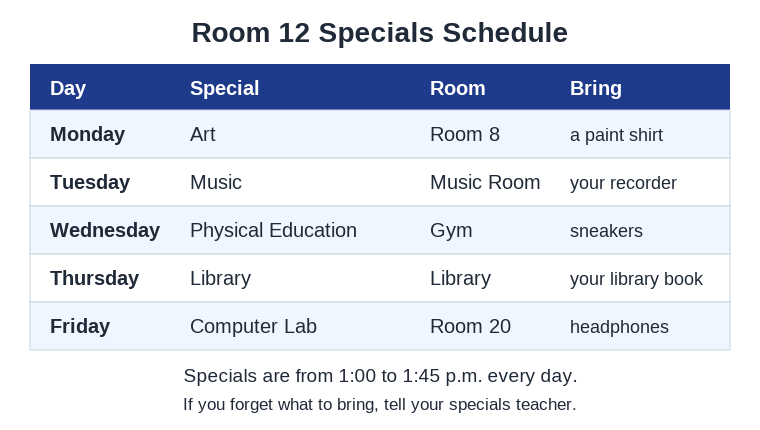
Picture description
Room 12 Specials Schedule
Monday: Art, Room 8. Bring a paint shirt.
Tuesday: Music, Music Room. Bring your recorder.
Wednesday: Physical Education, Gym. Bring sneakers.
Thursday: Library, Library. Bring your library book.
Friday: Computer Lab, Room 20. Bring headphones.
Specials are from 1:00 to 1:45 p.m. every day.
If you forget what to bring, tell your specials teacher.
Look at the schedule. Listen to the model student first. Then answer.
Look at the schedule. Where is Physical Education?
Scoring rubric
| Level | What it looks like |
|---|---|
| 4: Exemplary |
|
| 3: Strong |
|
| 2: Adequate |
|
| 1: Attempted |
|
A strong sample response
The gym. In the gym.
This is a level 1 task: a short phrase with the right place is a full answer, like the model.
What to look for
- Let the student look at the schedule as long as needed before answering.
- One or two correct English words is enough here.
- On the real Screener, speaking is scored locally by a trained test administrator using WIDA's own scale; this rubric is a practice guide, not that scale.
Prompt 2: Tier A tasks
Suggested time: about 2 minutes
Model answer: read this aloud first
Listen to the model student answer a similar question first.
Model answer
Transcript for the adult to read aloud. The student listens and does not read it.
Ms. Whitfield: Tell me about a team, club or class you went to before. What did you do there?
Mateo: At my old school I was on a soccer team. We practiced on Saturdays. I played defense. I liked it because my friends were on the team.
The student's own task
Look at the schedule.
The Specials Schedule
Picture description
Room 12 Specials Schedule
Monday: Art, Room 8. Bring a paint shirt.
Tuesday: Music, Music Room. Bring your recorder.
Wednesday: Physical Education, Gym. Bring sneakers.
Thursday: Library, Library. Bring your library book.
Friday: Computer Lab, Room 20. Bring headphones.
Specials are from 1:00 to 1:45 p.m. every day.
If you forget what to bring, tell your specials teacher.
Listen to the model student first. Then answer.
Look at the schedule again. Which special do you like best? Tell me what day it is, what you bring, and why you like it.
Scoring rubric
| Level | What it looks like |
|---|---|
| 4: Exemplary |
|
| 3: Strong |
|
| 2: Adequate |
|
| 1: Attempted |
|
A strong sample response
I like Music best. It is on Tuesday and I bring my recorder. At my old school we sing a lot. I like music because I can play songs for my grandma.
This is a level 3 task. The answer chooses a special, reads two details from the schedule and gives a reason in simple connected sentences, as the model does.
What to look for
- Check that the day and what to bring match the schedule.
- A reason with "because" or "I like" moves the answer from naming to explaining.
- On the real Screener, speaking is scored locally by a trained test administrator using WIDA's own scale; this rubric is a practice guide, not that scale.
Prompt 3: Tier B/C tasks
Suggested time: about 2 minutes
Model answer: read this aloud first
Listen to the model student answer a similar question first.
Model answer
Transcript for the adult to read aloud. The student listens and does not read it.
Ms. Whitfield: On a cold morning, you can see your breath. Explain why.
Mateo: You can see your breath because the air inside your body is warm and it has water vapor in it. When it goes out into the cold air, it cools down fast. The water vapor turns into really tiny drops of water, like a little cloud. On a warm day it doesn't get cold enough, so you can't see it.
The student's own task
Listen to the model student first. Then answer.
On a hot day, you take a cold can of juice out of the refrigerator. Soon the outside of the can is wet. Explain why.
Scoring rubric
| Level | What it looks like |
|---|---|
| 4: Exemplary |
|
| 3: Strong |
|
| 2: Adequate |
|
| 1: Attempted |
|
A strong sample response
The can gets wet because the air has water vapor in it, even if you can't see it. When the warm air touches the cold can, the air cools down. Cold air can't hold as much water vapor, so the vapor turns into little drops of water on the can. That's called condensation. It's not juice coming out, because the can is closed.
This is the level 3 to 5 range of a Tier B/C task, done at the top. It uses the science words water vapor and condensation, explains the cause with "because" and "so," and rules out a wrong idea, going a step beyond the model.
What to look for
- Listen for a cause ("because the air has water vapor ...") and not only a description ("the can is wet").
- Science vocabulary is a plus, but a clear everyday explanation of water from the air turning into drops also shows the idea.
- On the real Screener, speaking is scored locally by a trained test administrator using WIDA's own scale; this rubric is a practice guide, not that scale.
Prompt 4: Tier B/C tasks
Suggested time: about 2 minutes
Model answer: read this aloud first
Listen to the model student answer a similar question first.
Model answer
Transcript for the adult to read aloud. The student listens and does not read it.
Ms. Whitfield: Our school can make recess longer or make lunch longer. Which is better? Give reasons.
Mateo: I think a longer recess is better. First, kids need to move after sitting all morning, and moving helps us focus in the afternoon. Also, lunch is already long enough to finish eating, but recess goes by really fast. Some people say a long lunch lets you talk to friends, but you can talk at recess too, and you can play at the same time.
The student's own task
Listen to the model student first. Then answer.
Your school wants new students to feel welcome. It can have a welcome party once a month, or it can give every new student a classmate guide for the first week. Which is better? Give reasons.
Scoring rubric
| Level | What it looks like |
|---|---|
| 4: Exemplary |
|
| 3: Strong |
|
| 2: Adequate |
|
| 1: Attempted |
|
A strong sample response
I think the classmate guide is better. A party is fun, but it only happens once a month, and new students need help on the very first day. A guide can show you where everything is and sit with you at lunch, so you're not alone. Also, at a party there are a lot of people, and a shy kid might not talk to anybody. With one guide, you get to know one person really well, and then they introduce you to their friends.
This is a level 5 task. The answer states a position, gives several reasons, responds to the other option ("A party is fun, but ..."), and links ideas with "so," "also" and "then," matching the model.
What to look for
- Either choice is fine. Look for reasons and for an answer to the other side.
- If the student stops after one reason, ask "What else?" once.
- On the real Screener, speaking is scored locally by a trained test administrator using WIDA's own scale; this rubric is a practice guide, not that scale.
Unofficial practice. This site is not affiliated with, endorsed by, or connected to WIDA, the Wisconsin Center for Education Research, or the Board of Regents of the University of Wisconsin System. WIDA and WIDA ACCESS are trademarks of the Board of Regents of the University of Wisconsin System. Every question here is original practice material written to match the published test design.