WIDA reading practice for 4th and 5th grade screener
Printable version. Original practice written to match the published WIDA format, not questions from the official test. The answer key, with an explanation for every answer, is at the end.
Questions
Level A folders
Read the letter. Then answer the questions.
Social and Instructional: A Letter to New Families
Dear New Families,
Welcome to Oak Hill Elementary! We are excited to meet your child. Please use this checklist during the first week.
1. Return the health form to the nurse by Wednesday.
2. Write your child's name inside his or her jacket and lunch box.
3. Check the Tuesday Folder every week. Teachers send home news and graded work in it.
4. Sign up for the free breakfast program at the front office, if you would like.
If you have questions, call the office. We have staff who speak Spanish, Arabic and French.
Sincerely,
Ms. Howard, Principal
Choose the best answer.
1. When is the health form due?
- A by Tuesday
- B by Wednesday
- C by Friday
- D on the first day
Choose the best answer.
2. What do teachers send home in the Tuesday Folder?
- A the health form
- B breakfast sign-up forms
- C news and graded work
- D lunch money
Choose the best answer.
3. Why does the letter name Spanish, Arabic and French?
- A The school teaches them.
- B Families must learn them.
- C Forms are written in them.
- D Office staff speak them.
Read the schedule. Then answer the questions.
Social and Instructional: The Specials Schedule
Picture description
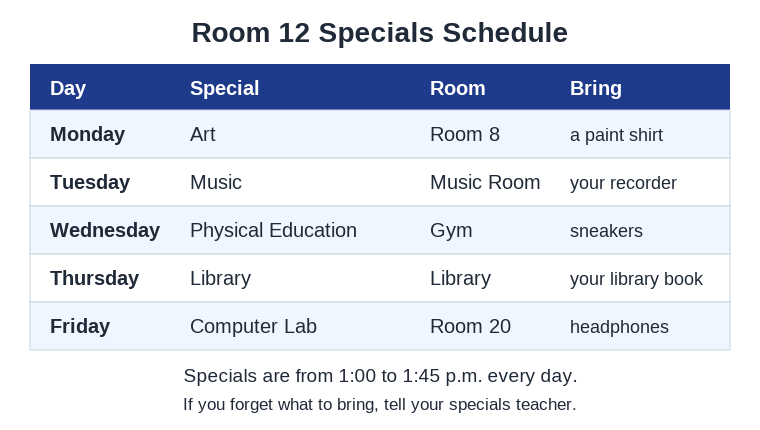
Room 12 Specials Schedule
Monday: Art, Room 8. Bring a paint shirt.
Tuesday: Music, Music Room. Bring your recorder.
Wednesday: Physical Education, Gym. Bring sneakers.
Thursday: Library, Library. Bring your library book.
Friday: Computer Lab, Room 20. Bring headphones.
Specials are from 1:00 to 1:45 p.m. every day.
If you forget what to bring, tell your specials teacher.
Choose the best answer.
4. Which special does Room 12 have on Tuesday?
- A Music
- B Art
- C Library
- D Computer Lab
Choose the best answer.
5. On which day should Brandon wear sneakers?
- A Monday
- B Wednesday
- C Thursday
- D Friday
Choose the best answer.
6. Brandon forgot his headphones. What should he do?
- A tell his specials teacher
- B go to the Music Room
- C skip Computer Lab
- D call home at 1:00
Level B folders
Read the text and look at the graph. Then answer the questions.
Mathematics: Languages in Our Class
Picture description
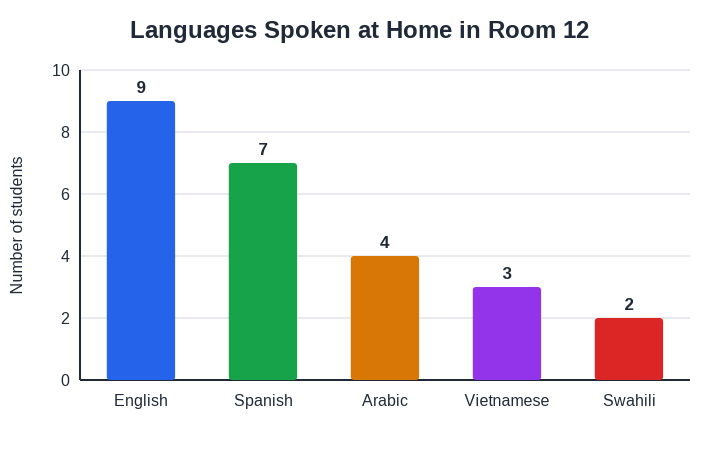
Ms. Carter's class in Room 12 did a survey. Each student named the main language spoken at home. Each student gave only one answer.
The class showed the results in a bar graph. English: 9 students. Spanish: 7 students. Arabic: 4 students. Vietnamese: 3 students. Swahili: 2 students.
The class found that more than half of the students speak a language other than English at home. "That means our class can say hello in five languages," said Brandon.
Choose the best answer.
7. How many students speak Spanish at home?
- A 9
- B 4
- C 2
- D 7
Choose the best answer.
8. How many students took part in the survey?
- A 24
- B 9
- C 25
- D 5
Choose the best answer.
9. Which statement is true about the graph?
- A More students speak Swahili than Arabic.
- B Arabic plus Vietnamese equals Spanish.
- C Spanish is the most common language.
- D Half the class speaks English.
Level C folders
Read the story. Then answer the questions.
Language Arts: Caleb's Notebook
Caleb kept a small green notebook in his back pocket. On the first page he had written, in careful letters, NEW WORDS.
Every time he heard an English word he didn't know, he wrote it down the way it sounded. By the end of his first week at Oak Hill, the notebook said things like "reses," "kafeteerya" and "fyeld trip."
On Friday, his teacher, Ms. Carter, noticed the notebook on his desk. Caleb felt his stomach drop. He was sure she would laugh at his spelling.
Instead, she pulled up a chair. "May I?" she asked. She turned the pages slowly. "You've collected forty-two words in five days," she said. "That's more than most people learn in a month."
Then she took a red pen out of her pocket, and Caleb held his breath. But she didn't cross anything out. Next to each word, she wrote the spelling in small letters, so both versions stood side by side.
"Your way shows how the word sounds," she said. "My way shows how it looks. You need both."
That night, Caleb started a new page. At the top he wrote, in careful letters, WORDS I KNOW.
Choose the best answer.
10. Why did Caleb feel his "stomach drop"?
- A He felt sick after eating lunch.
- B He thought she would take his notebook and keep it.
- C He was afraid she would laugh at his spelling.
- D He had forgotten to do his homework.
Choose the best answer.
11. What does Ms. Carter do with the red pen?
- A adds the spelling beside each word
- B crosses out the misspelled words
- C draws a big star on the cover page
- D writes a note home to his family
Choose the best answer.
12. What does the new page, WORDS I KNOW, show about Caleb at the end?
- A He no longer needs any help from his teacher.
- B He wants to stop writing new words.
- C He has filled the whole notebook.
- D He is proud of what he has learned.
Answer key
Level A folders
1. When is the health form due?
From “Social and Instructional: A Letter to New Families”
- by Tuesday
- by WednesdayCorrect answer
- by Friday
- on the first day
Why “by Wednesday” is correct
Item 1 says to return the health form "by Wednesday." The student scans a list for one detail.
Why the other answers are wrong
- by Tuesday — Tuesday is the day for the weekly folder.
- by Friday — Friday is not mentioned in this letter.
- on the first day — The letter gives a day of the week.
2. What do teachers send home in the Tuesday Folder?
From “Social and Instructional: A Letter to New Families”
- the health form
- breakfast sign-up forms
- news and graded workCorrect answer
- lunch money
Why “news and graded work” is correct
Item 3 says "Teachers send home news and graded work in it." The word "it" refers back to the Tuesday Folder.
Why the other answers are wrong
- the health form — The health form goes to the nurse.
- breakfast sign-up forms — Breakfast sign-up is at the front office.
- lunch money — Money is not mentioned.
3. Why does the letter name Spanish, Arabic and French?
From “Social and Instructional: A Letter to New Families”
- The school teaches them.
- Families must learn them.
- Forms are written in them.
- Office staff speak them.Correct answer
Why “Office staff speak them.” is correct
The letter says "We have staff who speak Spanish, Arabic and French." The languages are named so families know they can get help.
Why the other answers are wrong
- The school teaches them. — The letter doesn't mention language classes.
- Families must learn them. — Nothing asks families to learn a language.
- Forms are written in them. — The letter doesn't say what language the forms are in.
4. Which special does Room 12 have on Tuesday?
From “Social and Instructional: The Specials Schedule”
- MusicCorrect answer
- Art
- Library
- Computer Lab
Why “Music” is correct
The Tuesday row lists Music. Reading across one row of a table is the skill.
Why the other answers are wrong
- Art — Art is on Monday.
- Library — Library is on Thursday.
- Computer Lab — Computer Lab is on Friday.
5. On which day should Brandon wear sneakers?
From “Social and Instructional: The Specials Schedule”
- Monday
- WednesdayCorrect answer
- Thursday
- Friday
Why “Wednesday” is correct
Sneakers are in the Bring column on the Physical Education row, which is Wednesday. The student reads from the right column back to the day.
Why the other answers are wrong
- Monday — On Monday he brings a paint shirt for Art.
- Thursday — On Thursday he brings his library book.
- Friday — On Friday he brings headphones.
6. Brandon forgot his headphones. What should he do?
From “Social and Instructional: The Specials Schedule”
- tell his specials teacherCorrect answer
- go to the Music Room
- skip Computer Lab
- call home at 1:00
Why “tell his specials teacher” is correct
The note at the bottom says "If you forget what to bring, tell your specials teacher." The student has to look beyond the table to the note.
Why the other answers are wrong
- go to the Music Room — Music is on Tuesday; headphones are for the Computer Lab.
- skip Computer Lab — The schedule says to tell the teacher, not to miss the class.
- call home at 1:00 — The schedule gives a time for specials, not for calling home.
Level B folders
7. How many students speak Spanish at home?
From “Mathematics: Languages in Our Class”
- 9
- 4
- 2
- 7Correct answer
Why “7” is correct
The Spanish bar shows 7. The student reads one bar on the graph.
Why the other answers are wrong
- 9 — Nine is the number for English.
- 4 — Four is the number for Arabic.
- 2 — Two is the number for Swahili.
8. How many students took part in the survey?
From “Mathematics: Languages in Our Class”
- 24
- 9
- 25Correct answer
- 5
Why “25” is correct
Each student gave one answer, so the total of all the bars, 9 + 7 + 4 + 3 + 2 = 25, is the number of students.
Why the other answers are wrong
- 24 — This is an adding error; 9 + 7 + 4 + 3 + 2 is 25.
- 9 — Nine is the tallest bar, not the total.
- 5 — Five is the number of languages, not students.
9. Which statement is true about the graph?
From “Mathematics: Languages in Our Class”
- More students speak Swahili than Arabic.
- Arabic plus Vietnamese equals Spanish.Correct answer
- Spanish is the most common language.
- Half the class speaks English.
Why “Arabic plus Vietnamese equals Spanish.” is correct
Arabic (4) plus Vietnamese (3) is 7, the same as Spanish. Each choice tests a different comparison, so the student must check them one by one.
Why the other answers are wrong
- More students speak Swahili than Arabic. — Swahili has 2 and Arabic has 4.
- Spanish is the most common language. — English, with 9, is the most common.
- Half the class speaks English. — Nine out of 25 is less than half.
Level C folders
10. Why did Caleb feel his "stomach drop"?
From “Language Arts: Caleb's Notebook”
- He felt sick after eating lunch.
- He thought she would take his notebook and keep it.
- He was afraid she would laugh at his spelling.Correct answer
- He had forgotten to do his homework.
Why “He was afraid she would laugh at his spelling.” is correct
The next sentence explains: "He was sure she would laugh at his spelling." "Stomach drop" is figurative language for sudden worry.
Why the other answers are wrong
- He felt sick after eating lunch. — The phrase describes worry, not illness.
- He thought she would take his notebook and keep it. — The story says what he feared, and it was being laughed at.
- He had forgotten to do his homework. — Homework is not mentioned.
11. What does Ms. Carter do with the red pen?
From “Language Arts: Caleb's Notebook”
- adds the spelling beside each wordCorrect answer
- crosses out the misspelled words
- draws a big star on the cover page
- writes a note home to his family
Why “adds the spelling beside each word” is correct
She writes the spelling "next to each word" so both versions stand side by side. Caleb, and the reader, expect a red pen to mean corrections, so the story plays against that expectation.
Why the other answers are wrong
- crosses out the misspelled words — The story says she "didn't cross anything out."
- draws a big star on the cover page — The story does not mention a star.
- writes a note home to his family — No note home is mentioned.
12. What does the new page, WORDS I KNOW, show about Caleb at the end?
From “Language Arts: Caleb's Notebook”
- He no longer needs any help from his teacher.
- He wants to stop writing new words.
- He has filled the whole notebook.
- He is proud of what he has learned.Correct answer
Why “He is proud of what he has learned.” is correct
The first page said NEW WORDS; the new one says WORDS I KNOW, written "in careful letters" like the first. The change in title shows his new confidence, which the reader must infer.
Why the other answers are wrong
- He no longer needs any help from his teacher. — Nothing suggests he is done learning.
- He wants to stop writing new words. — He starts a new page, so he keeps writing.
- He has filled the whole notebook. — The story doesn't say the notebook is full.
Unofficial practice. This site is not affiliated with, endorsed by, or connected to WIDA, the Wisconsin Center for Education Research, or the Board of Regents of the University of Wisconsin System. WIDA and WIDA ACCESS are trademarks of the Board of Regents of the University of Wisconsin System. Every question here is original practice material written to match the published test design.