WIDA writing practice for 2nd and 3rd grade screener
Printable version. Original practice written to match the published WIDA format, not questions from the official test.
Writing prompts
On the real test these are scored by a trained person against a rubric. The rubric and a sample response follow each prompt.
Prompt 1: Tier A tasks
Suggested time: about 10 minutes
Write on paper, the way grades 2 and 3 write in a booklet. You can use the sentence starters.
Write a letter to a new friend at your school. Tell your friend about you: your name, where you are from, and what you like to do. Sentence starters: My name is ___. I am from ___. I like to ___. My favorite ___ is ___. Word bank: family, play, soccer, draw, read, food, color
Scoring rubric
| Level | What it looks like |
|---|---|
| 7: Fully developed |
|
| 6: Well developed |
|
| 5: Developed |
|
| 4: Expanding |
|
| 3: Emerging |
|
| 2: Beginning |
|
| 1: Starting |
|
A strong sample response
Dear Lucy,
My name is Ana. I am from Guatemala. I like to play soccer with my brother. I like to draw too. My favorite food is pupusas. My favorite color is green. Do you like soccer?
Your friend, Ana
This sits around level 3 to 4. It uses the sentence starters to write several related sentences, adds details (her brother, a food) and ends with a question, but most sentences follow the same pattern.
What to look for
- This task is Language Arts: writing a friendly letter. Check for a greeting and a closing.
- Using the starters is expected at this tier. Credit any extra detail the child adds on their own.
- On the real Screener, writing is scored locally by a trained educator using WIDA's own scale; this rubric is a practice guide, not that scale. A blank, copied, off-topic or non-English response doesn't get a level here; note it and try again.
Prompt 2: Tier B/C tasks
Suggested time: about 15 minutes
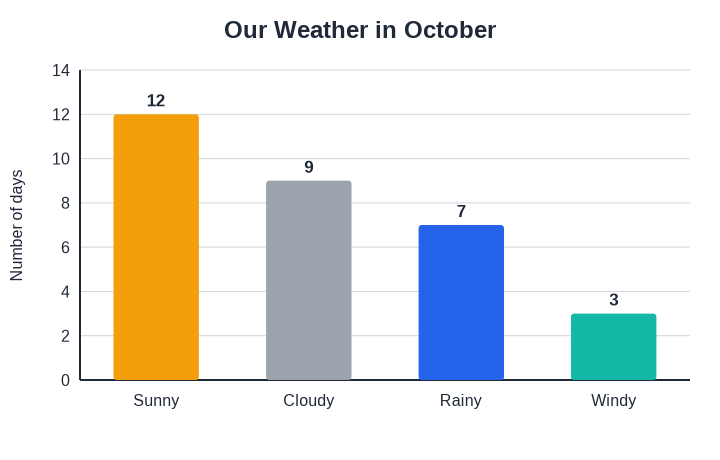
Look at the bar graph.
Our Weather in October
Picture description
A class kept a weather chart for the month of October. Every day they wrote down the weather.
The bar graph shows the number of days: Sunny 12, Cloudy 9, Rainy 7, Windy 3.
Look at the graph. Write on paper, the way grades 2 and 3 write in a booklet.
Write a short report about the weather in October. Tell what the graph shows. Use numbers to compare the kinds of weather. Then tell how this weather is the same as or different from the weather in a place you know.
Scoring rubric
| Level | What it looks like |
|---|---|
| 7: Fully developed |
|
| 6: Well developed |
|
| 5: Developed |
|
| 4: Expanding |
|
| 3: Emerging |
|
| 2: Beginning |
|
| 1: Starting |
|
A strong sample response
In October, our class wrote down the weather every day. The graph shows that sunny weather happened the most, with 12 days. There were 9 cloudy days and 7 rainy days. Only 3 days were windy, so windy was the least. That means there were 9 more sunny days than windy days.
Where my grandma lives, it is hot almost every day, and in some months it rains every afternoon. Here it is colder, and the rain does not come at the same time. I like the sunny days best because we can go outside for recess.
This sits around level 6 to 7. It reads the graph accurately (math: most, least, 9 more), describes weather (science), organizes the report into two parts, and uses linking words such as "so," "that means" and "because."
What to look for
- Check the math first: the numbers and comparisons should match the graph.
- A strong report has a beginning that says what the graph is about, then comparisons, then the child's own connection.
- On the real Screener, writing is scored locally by a trained educator using WIDA's own scale; this rubric is a practice guide, not that scale. A blank, copied, off-topic or non-English response doesn't get a level here; note it and try again.
Unofficial practice. This site is not affiliated with, endorsed by, or connected to WIDA, the Wisconsin Center for Education Research, or the Board of Regents of the University of Wisconsin System. WIDA and WIDA ACCESS are trademarks of the Board of Regents of the University of Wisconsin System. Every question here is original practice material written to match the published test design.