WIDA speaking practice for 2nd and 3rd grade screener
Printable version. Original practice written to match the published WIDA format, not questions from the official test.
Speaking prompts
On the real test these are scored by a trained person against a rubric. The rubric and a sample response follow each prompt.
Prompt 1: Tier A tasks
Suggested time: about 1 minutes
Model answer: read this aloud first
Listen to the model student answer a similar question first.
Model answer
Transcript for the adult to read aloud. The student listens and does not read it.
Mr. Castillo: Look at the map. Where do students play basketball?
Megan: The gym. In the gym.
The student's own task
Look at the map of the school.
A School Map
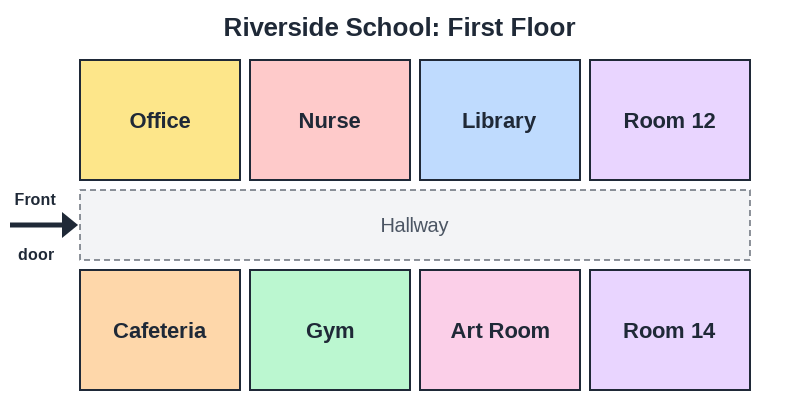
Picture description
This is a map of the first floor of Riverside School. The front door opens into a long hallway.
On one side of the hallway, starting at the front door, are the Office, the Nurse, the Library and Room 12.
On the other side, starting at the front door, are the Cafeteria, the Gym, the Art Room and Room 14.
Each room is across the hallway from the room in the same place on the other side. The Office is across from the Cafeteria.
Look at the map. Listen to the model student first. Then answer.
Look at the map. Where do students eat lunch?
Scoring rubric
| Level | What it looks like |
|---|---|
| 4: Exemplary |
|
| 3: Strong |
|
| 2: Adequate |
|
| 1: Attempted |
|
A strong sample response
The cafeteria. We eat in cafeteria.
This is a level 1 task: naming the right room in a word or phrase is a full answer, like the model.
What to look for
- If the child doesn't know the word, it is fine to point to the room on the map, then ask them to say it.
- One correct English word is enough for this task.
- On the real Screener, speaking is scored locally by a trained test administrator using WIDA's own scale; this rubric is a practice guide, not that scale.
Prompt 2: Tier A tasks
Suggested time: about 2 minutes
Model answer: read this aloud first
Listen to the model student answer a similar question first.
Model answer
Transcript for the adult to read aloud. The student listens and does not read it.
Mr. Castillo: You are in the Office. Tell me how to get to the Gym.
Megan: Go out of the office to the hallway. Walk past the cafeteria. The gym is next. It is across from the nurse.
The student's own task
Look at the map of the school.
A School Map
Picture description
This is a map of the first floor of Riverside School. The front door opens into a long hallway.
On one side of the hallway, starting at the front door, are the Office, the Nurse, the Library and Room 12.
On the other side, starting at the front door, are the Cafeteria, the Gym, the Art Room and Room 14.
Each room is across the hallway from the room in the same place on the other side. The Office is across from the Cafeteria.
Look at the same map. Listen to the model student first. Then answer.
A new student is at the Office. Tell her how to get to the Library.
Scoring rubric
| Level | What it looks like |
|---|---|
| 4: Exemplary |
|
| 3: Strong |
|
| 2: Adequate |
|
| 1: Attempted |
|
A strong sample response
Go out the office door to the hall. Walk past the nurse. The library is next. It is across from the art room.
This is a level 3 task. The answer gives the steps in order in short sentences and uses place words (past, next, across from), the way the model does.
What to look for
- Listen for direction words: past, next to, across from, left, right.
- Short sentences in the right order are what this level asks for.
- On the real Screener, speaking is scored locally by a trained test administrator using WIDA's own scale; this rubric is a practice guide, not that scale.
Prompt 3: Tier B/C tasks
Suggested time: about 2 minutes
Model answer: read this aloud first
Listen to the model student answer a similar question first.
Model answer
Transcript for the adult to read aloud. The student listens and does not read it.
Mr. Castillo: Our class has a hamster. Explain how to take care of it.
Megan: First, you have to give the hamster food every day, like seeds. It also needs fresh water in its bottle. Once a week you clean the cage, because it gets dirty. And you put it in a quiet place, because hamsters sleep in the day.
The student's own task
Listen to the model student first. Then answer.
In science we learn what animals need to live. Your class has a pet fish. Explain how to take care of it.
Scoring rubric
| Level | What it looks like |
|---|---|
| 4: Exemplary |
|
| 3: Strong |
|
| 2: Adequate |
|
| 1: Attempted |
|
A strong sample response
A fish needs clean water to live, so you have to change some of the water every week. You give it a little food every day, but not too much, because the water gets dirty. The fish tank needs light, but not too hot. Also, you can't tap on the glass, because it scares the fish.
This is a level 3 task in a Tier B/C pair, done here at the top. The answer names what the fish needs (water, food, light) and gives reasons with "because" and "so," like the model.
What to look for
- A strong answer explains why, not only what: "because the water gets dirty."
- Science words such as need, live, clean and tank show content language.
- On the real Screener, speaking is scored locally by a trained test administrator using WIDA's own scale; this rubric is a practice guide, not that scale.
Prompt 4: Tier B/C tasks
Suggested time: about 2 minutes
Model answer: read this aloud first
Listen to the model student answer a similar question first.
Model answer
Transcript for the adult to read aloud. The student listens and does not read it.
Mr. Castillo: Should students choose their own seats in class? Tell me what you think and why.
Megan: I think teachers should pick the seats. If kids choose, they always sit with their best friends and talk a lot, so it's hard to learn. Also, when the teacher picks, you meet new kids. Some kids might feel bad if nobody wants to sit with them, so it's fairer when the teacher does it.
The student's own task
Listen to the model student first. Then answer.
Should every new student at your school get a buddy for the first week? Tell me what you think and why.
Scoring rubric
| Level | What it looks like |
|---|---|
| 4: Exemplary |
|
| 3: Strong |
|
| 2: Adequate |
|
| 1: Attempted |
|
A strong sample response
Yes, I think every new student should get a buddy. When you are new, you don't know where the bathroom or the cafeteria is, so a buddy can show you. Also, a buddy can sit with you at lunch, so you are not alone. Some kids are shy and won't ask for help. If they have a buddy, they don't have to ask.
This is a level 5 task. The answer takes a clear side, gives three connected reasons, and uses "when," "so," "also" and "if" to link ideas, matching the model.
What to look for
- Either side is fine; listen for reasons and the words that join them.
- Ask "Why?" once if the child gives only an opinion.
- On the real Screener, speaking is scored locally by a trained test administrator using WIDA's own scale; this rubric is a practice guide, not that scale.
Unofficial practice. This site is not affiliated with, endorsed by, or connected to WIDA, the Wisconsin Center for Education Research, or the Board of Regents of the University of Wisconsin System. WIDA and WIDA ACCESS are trademarks of the Board of Regents of the University of Wisconsin System. Every question here is original practice material written to match the published test design.