WIDA reading practice questions for 2nd and 3rd grade screener
Passages, charts and pictures with questions in groups of three, from social and classroom language to language arts, math, science and social studies.
These 12 questions are grouped by task type, one group at a time. Answer a question to see whether it was right and why. Nothing is timed and nothing is recorded. Printable version with the answer key.
Set 1 of 3. 0 of 12 questions answered.
Level A folders
Easier folders, aimed at proficiency levels 1 to 3: short texts with pictures, labels and simple sentences.
Read the card. Then answer the questions.
Social and Instructional: A Welcome Card
Dear Anthony,
Welcome to Room 14! We are happy you are here.
Here are some things to know. We eat lunch at 11:30. We have gym on Tuesday and Thursday, so wear sneakers on those days.
You can borrow books from our class library. Just write your name on a card.
If you need help, ask your buddy, Keisha. She sits next to you.
Your friends,
Mr. Gordon's Class
Question 1 of 6
Choose the best answer.
Who wrote the card?
Question 2 of 6
Choose the best answer.
Why should Anthony wear sneakers on Tuesday?
Question 3 of 6
Choose the best answer.
What should Anthony do to borrow a book?
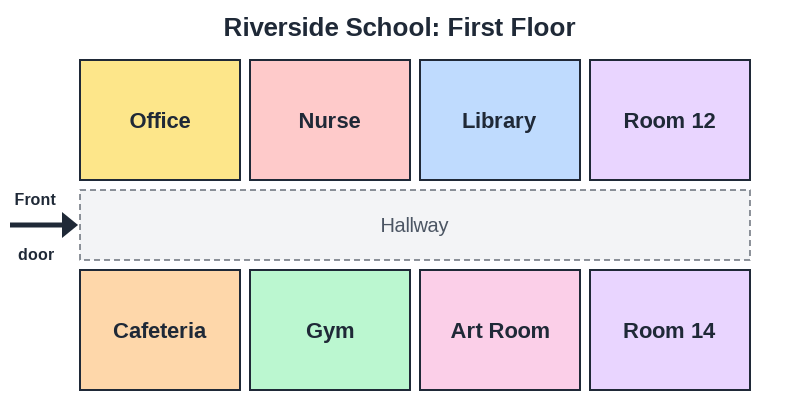
Look at the map of the school. Then answer the questions.
Social and Instructional: A School Map
Read image description
This is a map of the first floor of Riverside School. The front door opens into a long hallway.
On one side of the hallway, starting at the front door, are the Office, the Nurse, the Library and Room 12.
On the other side, starting at the front door, are the Cafeteria, the Gym, the Art Room and Room 14.
Each room is across the hallway from the room in the same place on the other side. The Office is across from the Cafeteria.
Question 4 of 6
Choose the best answer.
Which room is next to the Cafeteria?
Question 5 of 6
Choose the best answer.
Which room is across the hall from the Library?
Question 6 of 6
Choose the best answer.
Anthony feels sick. Which room should he go to?
6 questions in this set are still unanswered. You can move on without answering them.
Ready for the whole thing? Take the reading practice test for Screener: Grades 2–3.
Answer key: every answer, explained
The correct answer to every question above, with why it is right and why each other choice is wrong. Open a question to see its answer.
Level A folders
1. Who wrote the card?
From “Social and Instructional: A Welcome Card”
- Keisha
- Anthony's dad
- the principal
- Mr. Gordon's classCorrect answer
Why “Mr. Gordon's class” is correct
The card ends "Your friends, Mr. Gordon's Class." The signature at the end of a letter tells who wrote it.
Why the other answers are wrong
- Keisha — Keisha is named in the card as the buddy, but the whole class signed it.
- Anthony's dad — The card is to Anthony, not from his family.
- the principal — No principal is mentioned.
2. Why should Anthony wear sneakers on Tuesday?
From “Social and Instructional: A Welcome Card”
- It is library day.
- The class walks to lunch.
- He has gym that day.Correct answer
- It will rain.
Why “He has gym that day.” is correct
The card says "We have gym on Tuesday and Thursday, so wear sneakers." The word "so" links the reason to the advice.
Why the other answers are wrong
- It is library day. — The card does not give a library day.
- The class walks to lunch. — Lunch has a time, not a reason for sneakers.
- It will rain. — Weather is not mentioned.
3. What should Anthony do to borrow a book?
From “Social and Instructional: A Welcome Card”
- write his name on a cardCorrect answer
- ask the principal
- bring a note from his dad
- wait until Thursday
Why “write his name on a card” is correct
The card says "Just write your name on a card." The student finds one direction in a list of several.
Why the other answers are wrong
- ask the principal — No principal is mentioned.
- bring a note from his dad — A note from home is not needed.
- wait until Thursday — Thursday is a gym day, not a book day.
4. Which room is next to the Cafeteria?
From “Social and Instructional: A School Map”
- the Office
- the GymCorrect answer
- Room 14
- the Nurse
Why “the Gym” is correct
On the map, the Gym is right beside the Cafeteria on the same side of the hall. "Next to" and "across from" are both tested in this folder.
Why the other answers are wrong
- the Office — The Office is across the hall from the Cafeteria, not next to it.
- Room 14 — Room 14 is at the far end of the hall.
- the Nurse — The Nurse is on the other side of the hallway.
5. Which room is across the hall from the Library?
From “Social and Instructional: A School Map”
- Room 12
- the Art RoomCorrect answer
- the Gym
- the Office
Why “the Art Room” is correct
The Library is third from the front door on one side, and the Art Room is third on the other side. The student reads position on a simple map.
Why the other answers are wrong
- Room 12 — Room 12 is next to the Library, on the same side.
- the Gym — The Gym is across from the Nurse.
- the Office — The Office is on the same side as the Library.
6. Anthony feels sick. Which room should he go to?
From “Social and Instructional: A School Map”
- the Cafeteria
- the Gym
- the NurseCorrect answer
- the Library
Why “the Nurse” is correct
A school nurse helps students who feel sick or get hurt. The student needs the word "nurse" and must find it among the rooms.
Why the other answers are wrong
- the Cafeteria — The Cafeteria is for eating lunch.
- the Gym — The Gym is for exercise and games.
- the Library — The Library is for books.
Level B folders
7. What is this text mostly about?
From “Social Studies: Why Families Move”
- reasons families moveCorrect answer
- how to pack a moving truck
- jobs in a big city
- how floods start
Why “reasons families move” is correct
The first paragraph says families "move for many different reasons," and the next three paragraphs each give one. A main-idea question asks what all the parts share.
Why the other answers are wrong
- how to pack a moving truck — Packing is not in the text.
- jobs in a big city — Jobs are one reason, but only one detail.
- how floods start — Floods are an example, not the topic.
8. Which reason for moving is in the text?
From “Social Studies: Why Families Move”
- A family wants a bigger house.
- Children want to change schools.
- A town builds a new park.
- A parent finds work.Correct answer
Why “A parent finds work.” is correct
The second paragraph says "A parent may find work in a new city." The correct answer restates the text in different words.
Why the other answers are wrong
- A family wants a bigger house. — Houses are not mentioned.
- Children want to change schools. — Changing schools is not given as a reason.
- A town builds a new park. — Parks are not mentioned.
9. Which word from the text means "people who are new to a place"?
From “Social Studies: Why Families Move”
- neighbors
- newcomersCorrect answer
- classmates
- grandparents
Why “newcomers” is correct
The text says "many people help newcomers," and the word is made of "new" and "comers." Breaking a word into parts is a useful strategy to model.
Why the other answers are wrong
- neighbors — Neighbors are people who live near you.
- classmates — Classmates are students in your class.
- grandparents — Grandparents are your parents' parents.
Level C folders
10. Why did Ashley stand by the fence?
From “Language Arts: The Clapping Game”
- She was not allowed to play.
- She wanted to be alone.
- She had hurt her foot.
- She didn't know the song.Correct answer
Why “She didn't know the song.” is correct
The first paragraph says Ashley didn't know the words, "so she stood by the fence." She repeats the reason to Lucy.
Why the other answers are wrong
- She was not allowed to play. — Lucy invites her, so she is allowed.
- She wanted to be alone. — The story gives a different reason.
- She had hurt her foot. — No injury is mentioned.
11. The story says "Her cheeks felt hot." This shows that Ashley felt
From “Language Arts: The Clapping Game”
- embarrassedCorrect answer
- sick from the sun
- angry at Lucy
- excited to jump
Why “embarrassed” is correct
Hot cheeks are a common sign of embarrassment, and it comes right after she refuses a turn. The student infers a feeling from a physical detail.
Why the other answers are wrong
- sick from the sun — The story is about feelings, not the weather.
- angry at Lucy — Lucy is being kind; nothing shows anger.
- excited to jump — She says no to a turn, so she is not excited.
12. What lesson does the story teach?
From “Language Arts: The Clapping Game”
- Jump rope is harder than clapping.
- It is best to play alone at recess.
- Sharing a game can build a friendship.Correct answer
- New students should only watch others play.
Why “Sharing a game can build a friendship.” is correct
The girls trade games: Ashley teaches clapping and Lucy teaches the rhyme, and they become friends. The lesson comes from the whole story, not one sentence.
Why the other answers are wrong
- Jump rope is harder than clapping. — Ashley learns jump rope quickly, so this is not the point.
- It is best to play alone at recess. — The girls end up playing together.
- New students should only watch others play. — Ashley joins in once she shares her own game.
More WIDA practice for 2nd and 3rd grade screener
Read next
- WIDA Listening and Reading Test: Folders, Levels and Adaptivity: On WIDA ACCESS Online, listening and reading questions come in folders: one recording or text with a small group of questions about it. The test is adaptive, so after each folder it moves the student to easier or harder material. Listening and reading are taken first, and the results decide the tier of speaking and writing. Here is how they work.
- How to Prepare for WIDA ACCESS: A Practical Plan for Parents: WIDA ACCESS measures English that grows over months and years, so there is no shortcut to a higher level. What preparation can do is make the test familiar, so your child's real English shows on the day. The best plan is the official WIDA demos, a few weeks of short practice in each domain, and plenty of talk and reading at home, in any language.
- WIDA Scale Scores: How They Relate to Proficiency Levels: Every WIDA ACCESS score report gives two numbers for each domain and composite: a scale score and a proficiency level. The proficiency level (1.0 to 6.0) is the number schools and states usually act on. The scale score is what the level is worked out from, and it is the better number for tracking growth. In 2025–26, WIDA reset the scale, so scale scores from before 2026 cannot be compared with scale scores from 2026 on.
Unofficial practice. This site is not affiliated with, endorsed by, or connected to WIDA, the Wisconsin Center for Education Research, or the Board of Regents of the University of Wisconsin System. WIDA and WIDA ACCESS are trademarks of the Board of Regents of the University of Wisconsin System. Every question here is original practice material written to match the published test design.