WIDA speaking practice for 1st grade screener
Printable version. Original practice written to match the published WIDA format, not questions from the official test.
Speaking prompts
On the real test these are scored by a trained person against a rubric. The rubric and a sample response follow each prompt.
Prompt 1: Tier A tasks
Suggested time: about 1 minutes
Model answer: read this aloud first
Listen to the model student answer a similar question first.
Model answer
Transcript for the adult to read aloud. The student listens and does not read it.
Mrs. Brandt: Look at the picture. What is on the wall?
Jason: A clock. A big clock.
The student's own task
Look at the picture.
The School Office
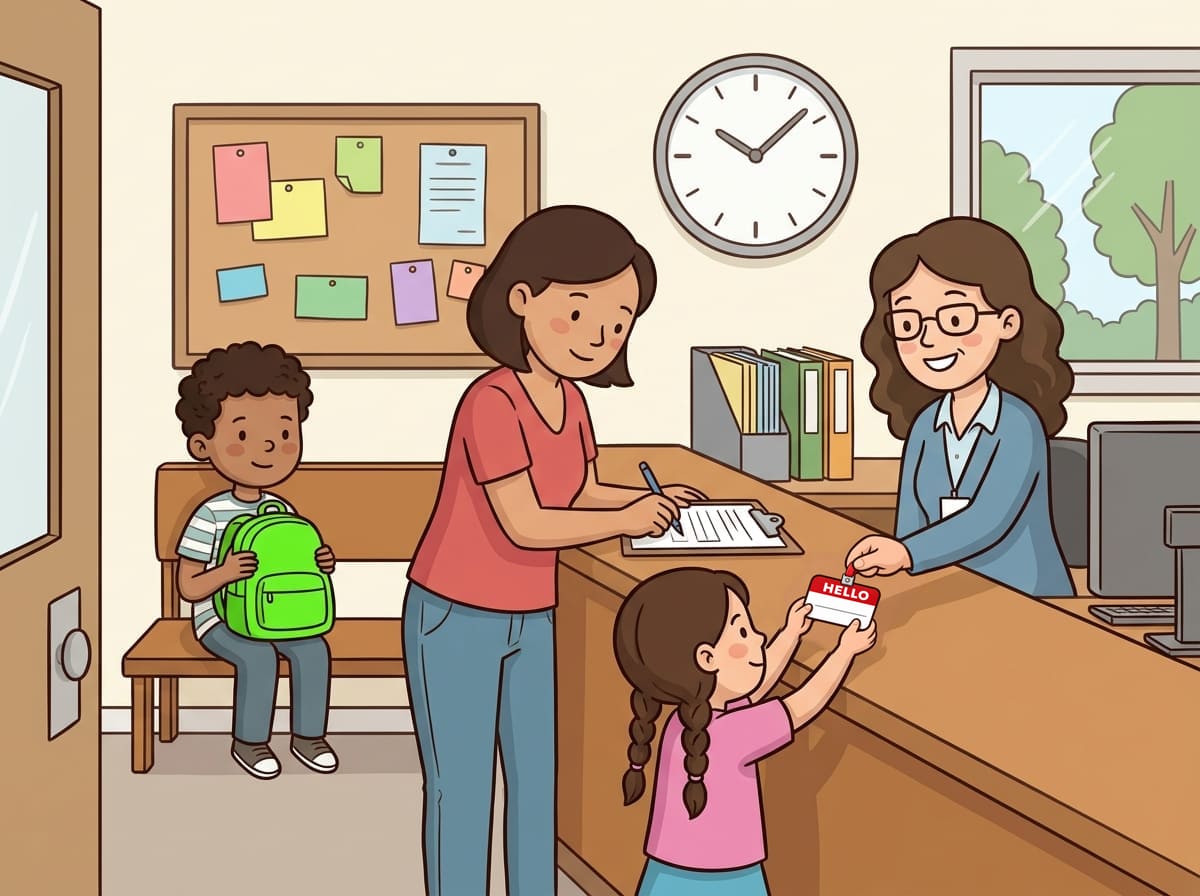
Picture description
A school office. A woman at the front desk hands a name tag to a girl. The girl's mother writes on a paper form.
A boy with a green backpack sits on a bench by the wall and waits. A big round clock hangs on the wall.
Look at the picture of the school office. Listen to the model student first. Then answer.
Look at the girl at the desk. What is the woman giving her?
Scoring rubric
| Level | What it looks like |
|---|---|
| 4: Exemplary |
|
| 3: Strong |
|
| 2: Adequate |
|
| 1: Attempted |
|
A strong sample response
A name tag. Name tag for her.
This is a level 1 task, so a word or short phrase that names the right thing is a full answer. It matches the model, which also answers in a short phrase.
What to look for
- Point to the girl if the child is unsure where to look, but do not say the answer.
- A one- or two-word English answer ("name tag," "a sticker") is what this task asks for.
- On the real Screener, speaking is scored locally by a trained test administrator using WIDA's own scale; this rubric is a practice guide, not that scale.
Prompt 2: Tier A tasks
Suggested time: about 1 minutes
Model answer: read this aloud first
Listen to the model student answer a similar question first.
Model answer
Transcript for the adult to read aloud. The student listens and does not read it.
Mrs. Brandt: Tell me about the boy on the bench.
Jason: The boy is sitting on the bench. He has a green backpack. He is waiting.
The student's own task
Look at the picture.
The School Office
Picture description
A school office. A woman at the front desk hands a name tag to a girl. The girl's mother writes on a paper form.
A boy with a green backpack sits on a bench by the wall and waits. A big round clock hangs on the wall.
Look at the same picture. Listen to the model student first. Then answer.
Tell me what the girl and her mom are doing in the school office.
Scoring rubric
| Level | What it looks like |
|---|---|
| 4: Exemplary |
|
| 3: Strong |
|
| 2: Adequate |
|
| 1: Attempted |
|
A strong sample response
The girl is getting a name tag. Her mom is writing on the paper. They are new at the school.
This is a level 3 task. The answer uses three short sentences with action words (getting, writing) and adds a reason, like the model.
What to look for
- Listen for whole sentences with "is" plus an action word, not just names of things.
- If the child names only one person, ask "And what is the mom doing?" once.
- On the real Screener, speaking is scored locally by a trained test administrator using WIDA's own scale; this rubric is a practice guide, not that scale.
Prompt 3: Tier B/C tasks
Suggested time: about 2 minutes
Model answer: read this aloud first
Listen to the model student answer a similar question first.
Model answer
Transcript for the adult to read aloud. The student listens and does not read it.
Mrs. Brandt: Tell me how you brush your teeth. Tell the steps in order.
Jason: First, I put toothpaste on my brush. Then I brush my teeth up and down. Next, I spit and rinse with water. Last, I put my brush away.
The student's own task
Listen to the model student first. Then answer.
In science we learn to keep germs away. Tell me how to wash your hands. Tell the steps in order.
Scoring rubric
| Level | What it looks like |
|---|---|
| 4: Exemplary |
|
| 3: Strong |
|
| 2: Adequate |
|
| 1: Attempted |
|
A strong sample response
First, you turn on the water and make your hands wet. Then you put soap on your hands. Next, you rub your hands together, and you sing a song so you wash a long time. Then you rinse the soap off. Last, you dry your hands with a paper towel.
This is a level 3 task in a Tier B/C pair. The answer gives every step in order with sequence words (first, then, next, last), like the model, and adds a detail about washing a long time.
What to look for
- Listen for order words such as first, then, next and last.
- Missing a step is fine if the order makes sense; a list of words with no order is less than the task asks for.
- On the real Screener, speaking is scored locally by a trained test administrator using WIDA's own scale; this rubric is a practice guide, not that scale.
Prompt 4: Tier B/C tasks
Suggested time: about 2 minutes
Model answer: read this aloud first
Listen to the model student answer a similar question first.
Model answer
Transcript for the adult to read aloud. The student listens and does not read it.
Mrs. Brandt: Should our class have snack time in the morning or in the afternoon? Tell me why.
Jason: I think we should have snack in the morning, because a lot of kids eat breakfast really early and they get hungry before lunch. When you're hungry it's hard to listen. In the afternoon we already had lunch, so we're still full.
The student's own task
Listen to the model student first. Then answer.
On Friday, your class can go to the library or to the playground. Which one should the class choose? Tell me why.
Scoring rubric
| Level | What it looks like |
|---|---|
| 4: Exemplary |
|
| 3: Strong |
|
| 2: Adequate |
|
| 1: Attempted |
|
A strong sample response
I think the class should go to the library, because we can pick new books to take home. Some kids don't have a lot of books at home, so it helps them read. Also, it might be cold on Friday, and the library is warm. We can play on the playground at recess anyway.
This is a level 5 task. The answer states a choice, gives more than one reason joined with "because," "so" and "also," and answers the other side (recess), which goes beyond a single reason, as the model does.
What to look for
- Either choice is fine; what matters is the reasons and how they are joined.
- A strong answer gives two or more reasons. One reason in a full sentence is a good start at this age.
- On the real Screener, speaking is scored locally by a trained test administrator using WIDA's own scale; this rubric is a practice guide, not that scale.
Unofficial practice. This site is not affiliated with, endorsed by, or connected to WIDA, the Wisconsin Center for Education Research, or the Board of Regents of the University of Wisconsin System. WIDA and WIDA ACCESS are trademarks of the Board of Regents of the University of Wisconsin System. Every question here is original practice material written to match the published test design.