Why do some scientists call wetlands "the kidneys of the landscape"?
Level B folders · WIDA Grades 6–8 reading. The correct answer, and the reasoning behind it.
Middle folders, aimed at levels 2 to 4: paragraphs, charts and short articles with content vocabulary.
Read the article and the diagram. Then answer the questions.
Science: How Wetlands Clean Water
Read image description
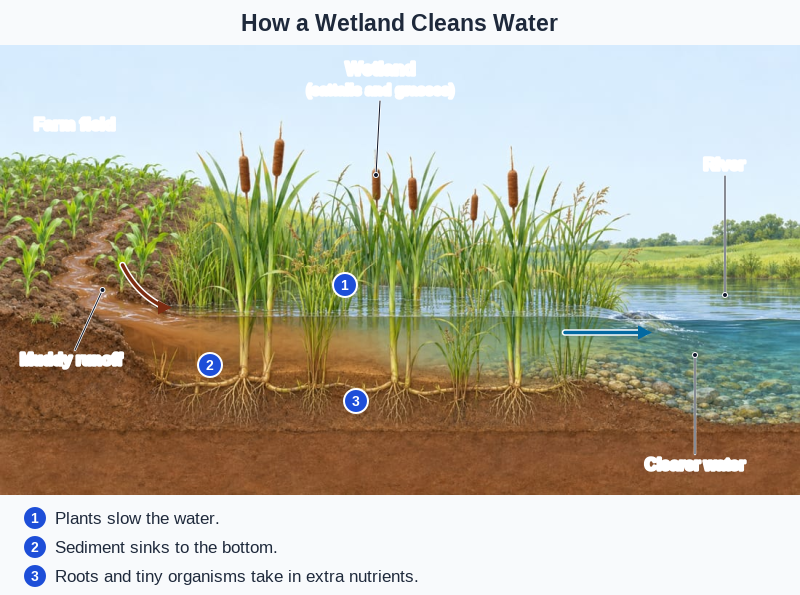
When rain falls on a farm field or a parking lot, it does not just soak into the ground. Much of it runs across the surface, picking up soil, fertilizer and other materials along the way. This runoff can make rivers and lakes muddy and unhealthy. Wetlands, such as marshes and swamps, help solve this problem.
First, wetland plants slow the water down. Thick stems of cattails and grasses act like a crowded hallway: the water has to squeeze between them, so it loses speed.
Next, because the water is moving slowly, sediment can settle out. Sediment is the soil, sand and tiny pieces of rock carried by moving water. In fast water, these pieces stay mixed in. In slow water, they sink to the bottom of the wetland.
Finally, plant roots and tiny organisms called microbes take in extra nutrients, such as the nitrogen in fertilizer. A small amount of nitrogen helps living things grow, but too much can cause huge blooms of algae that use up the oxygen fish need.
By the time the water leaves the wetland, it is often much cleaner than when it arrived. For this reason, some scientists call wetlands "the kidneys of the landscape." Today, many towns protect wetlands or even build new ones to help keep their water clean.
The question
Choose the best answer.
Why do some scientists call wetlands "the kidneys of the landscape"?
- Wetlands are shaped like kidneys.
- Wetlands are found inside the body of the land.
- Wetlands store water for dry seasons.
- Wetlands filter harmful materials out of water.Correct answer
Why “Wetlands filter harmful materials out of water.” is correct
This item asks students to interpret a comparison. Kidneys clean the blood by removing waste; wetlands clean water by removing sediment and extra nutrients. Students need some background knowledge about kidneys, which is typical of B-level science reading.
Why the other answers are wrong
- Wetlands are shaped like kidneys. — The comparison is about what wetlands do, not their shape.
- Wetlands are found inside the body of the land. — This takes the comparison too literally.
- Wetlands store water for dry seasons. — Storing water may be true of some wetlands, but the article does not say it.
Practice more of this
More reading practice for Grades 6–8, or see the WIDA practice test for 6th, 7th and 8th grade.
Unofficial practice. This site is not affiliated with, endorsed by, or connected to WIDA, the Wisconsin Center for Education Research, or the Board of Regents of the University of Wisconsin System. WIDA and WIDA ACCESS are trademarks of the Board of Regents of the University of Wisconsin System. Every question here is original practice material written to match the published test design.