WIDA speaking practice for kindergarten
Printable version. Original practice written to match the published WIDA format, not questions from the official test.
Speaking prompts
On the real test these are scored by a trained person against a rubric. The rubric and a sample response follow each prompt.
Prompt 1: Storybook speaking
Suggested time: about 2 minutes
Read the page aloud to your child, then look at the picture together.
Zoe's Yellow Hat: page 1
Picture description
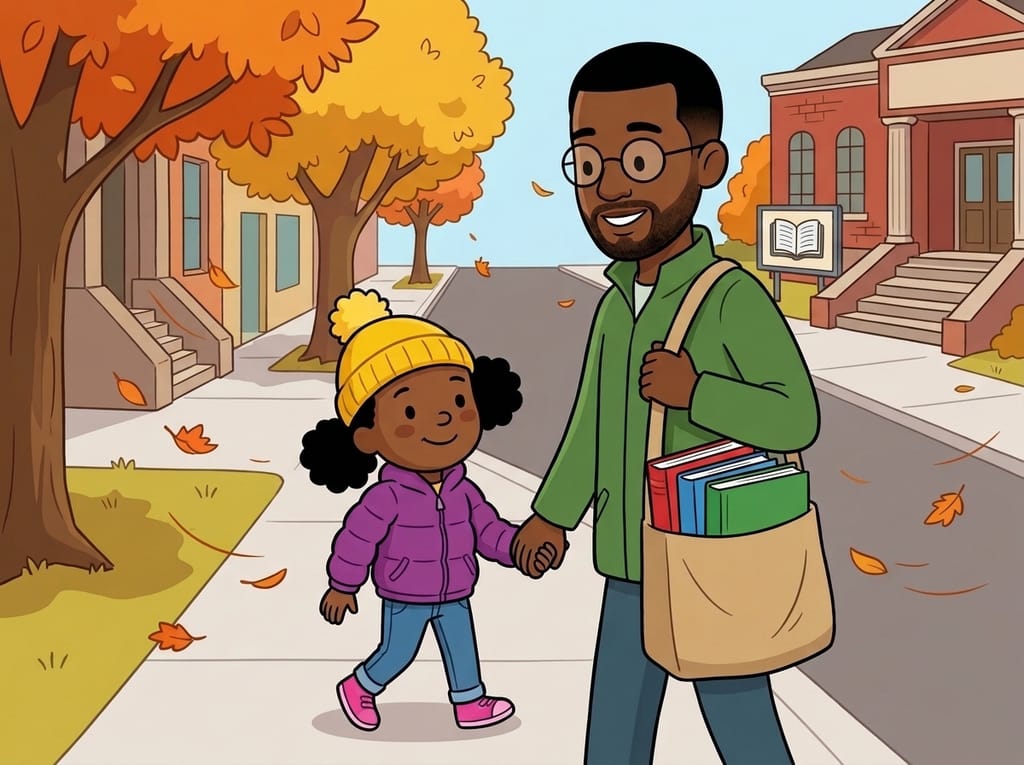
This is Zoe. Zoe has a new yellow hat. Zoe and Dad walk to the library. Dad has three books in his bag.
Picture: Zoe, a small girl in a purple coat and a bright yellow knit hat with a pom-pom, holds her dad's hand on a city sidewalk on a windy autumn day. Dad carries a cloth bag with three books sticking out: a red one, a blue one and a green one. At the end of the street is a brick library with wide steps.
Ask the questions one at a time and point to each thing as you ask. Wait after each one; five or six seconds of quiet is normal thinking time at this age. Your child answers out loud.
Point to the hat and ask: "What is this? What color is it?" Then point to the bag and ask: "What does Dad have in his bag?"
Scoring rubric
| Level | What it looks like |
|---|---|
| 4: Confident |
|
| 3: Developing |
|
| 2: Beginning |
|
| 1: Starting |
|
A strong sample response
What is this? — "A hat. It Zoe hat."
What color is it? — "Yellow. Is yellow and it have a ball on top."
What does Dad have in his bag? — "Books. He have three books. Red one, blue one, green one."
This shows level 4, Confident: every answer is right, the child uses story words (hat, yellow, books, three) and adds details nobody asked for, such as the pom-pom and the colors of the books. "It Zoe hat" and "he have" are ordinary at five and don't get in the way.
What to look for
- This is the easiest kind of task, naming things in a picture, so it is a good warm-up. A one-word answer such as "hat" is a real answer; take it, then ask one follow-up like "tell me more about the hat".
- If your child answers in their home language, say the English word back ("Yes, a hat!") and move on. That is part of learning, not a failure.
- The real Kindergarten test has its own speaking rubric, scored by the test administrator. The levels here are a simplified practice guide, not a score.
Prompt 2: Storybook speaking
Suggested time: about 2 minutes
Read the page aloud to your child, then look at the picture together.
Zoe's Yellow Hat: page 3
Picture description
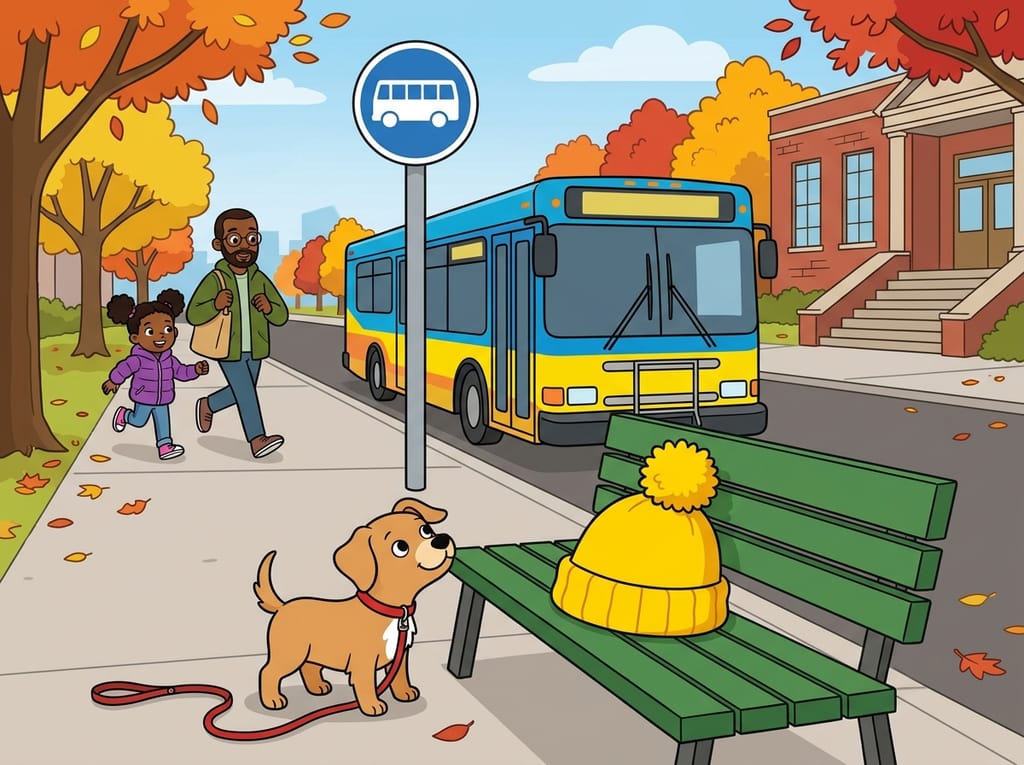
The hat lands on a bench at the bus stop. A little brown dog sees the hat.
Picture: a bus stop with a green bench and a pole with a bus sign. Zoe's yellow hat sits on the bench. A small light-brown dog with floppy ears, a white patch on its chest and a red collar stands next to the bench, looking at the hat, its red leash trailing on the ground. A city bus is pulling up in the background.
Point to the dog in the picture, ask the question, and wait. If your child says only one or two words, ask one follow-up: "What else can you tell me about the dog?"
Look at the dog. Tell me about the dog.
Scoring rubric
| Level | What it looks like |
|---|---|
| 4: Confident |
|
| 3: Developing |
|
| 2: Beginning |
|
| 1: Starting |
|
A strong sample response
"The dog is little and brown. He got a red collar. He looking at the hat. I think he gonna take it!"
This shows level 4, Confident: several sentences that describe what the dog looks like and what it is doing, using story words (little, brown, hat), plus a guess about what comes next that the child offered alone.
What to look for
- "Tell me about" is an open question, so it shows how much your child can say without being led. Resist asking "is it brown?"; a yes-or-no question gets a yes-or-no answer.
- Describing what something looks like and what it is doing are two different things. A child who does both is doing well; a child who only names colors is at an earlier step.
- The real Kindergarten test has its own speaking rubric, scored by the test administrator. The levels here are a simplified practice guide, not a score.
Prompt 3: Storybook speaking
Suggested time: about 2 minutes
Read the page aloud to your child, then look at the picture together.
Zoe's Yellow Hat: page 5
Picture description
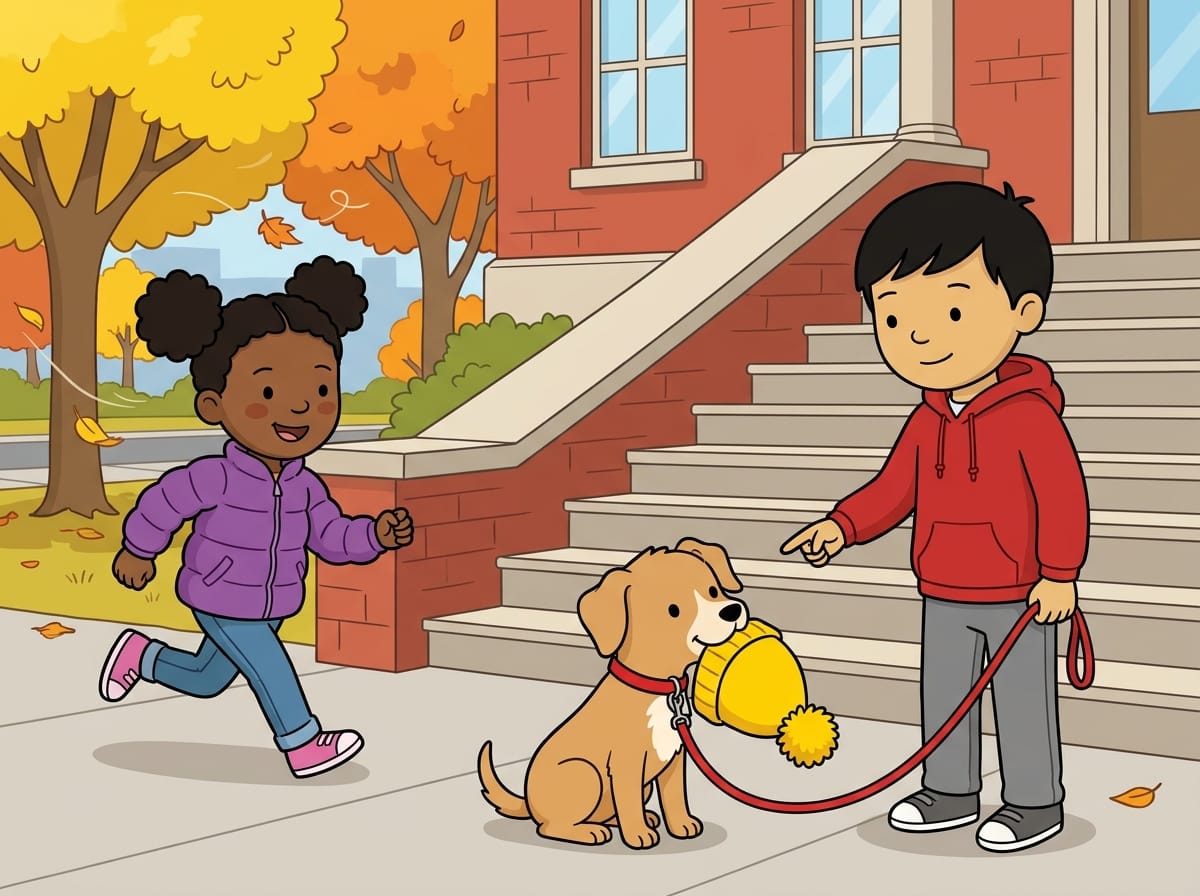
A boy runs after the dog. His name is Leo. Biscuit is his dog. "Biscuit, sit!" says Leo. Biscuit sits down.
Picture: at the bottom of the library steps, a boy in a red hooded sweatshirt holds the dog's red leash and points down at the ground. The little brown dog is sitting, with the yellow hat still in its mouth. Zoe is running up to them.
Point to Leo, then ask the three questions one at a time. Wait after each.
Who is this? What is he doing? What does he tell the dog?
Scoring rubric
| Level | What it looks like |
|---|---|
| 4: Confident |
|
| 3: Developing |
|
| 2: Beginning |
|
| 1: Starting |
|
A strong sample response
Who is this? — "Leo."
What is he doing? — "He holding the dog. The dog name Biscuit."
What does he tell the dog? — "Sit! He say Biscuit, sit."
This shows level 3, Developing: each answer fits, and the child uses the names and the word "sit" from the story, but in short phrases and without adding a detail of their own. Saying why Leo wants the dog to sit (so they can get the hat) would move it to level 4.
What to look for
- This task checks whether your child can say who a character is and what they do, and can repeat what someone said. Quoting "Biscuit, sit!" is a good answer.
- If the names are hard, it is fine for your child to say "the boy" and "the dog". Understanding who is who matters more than remembering names.
- The real Kindergarten test has its own speaking rubric, scored by the test administrator. The levels here are a simplified practice guide, not a score.
Prompt 4: Storybook speaking
Suggested time: about 3 minutes
Look at the three pictures together, in order. You can read the pages aloud first, or let your child tell the story from the pictures alone.
Zoe's Yellow Hat: pages 2 to 4
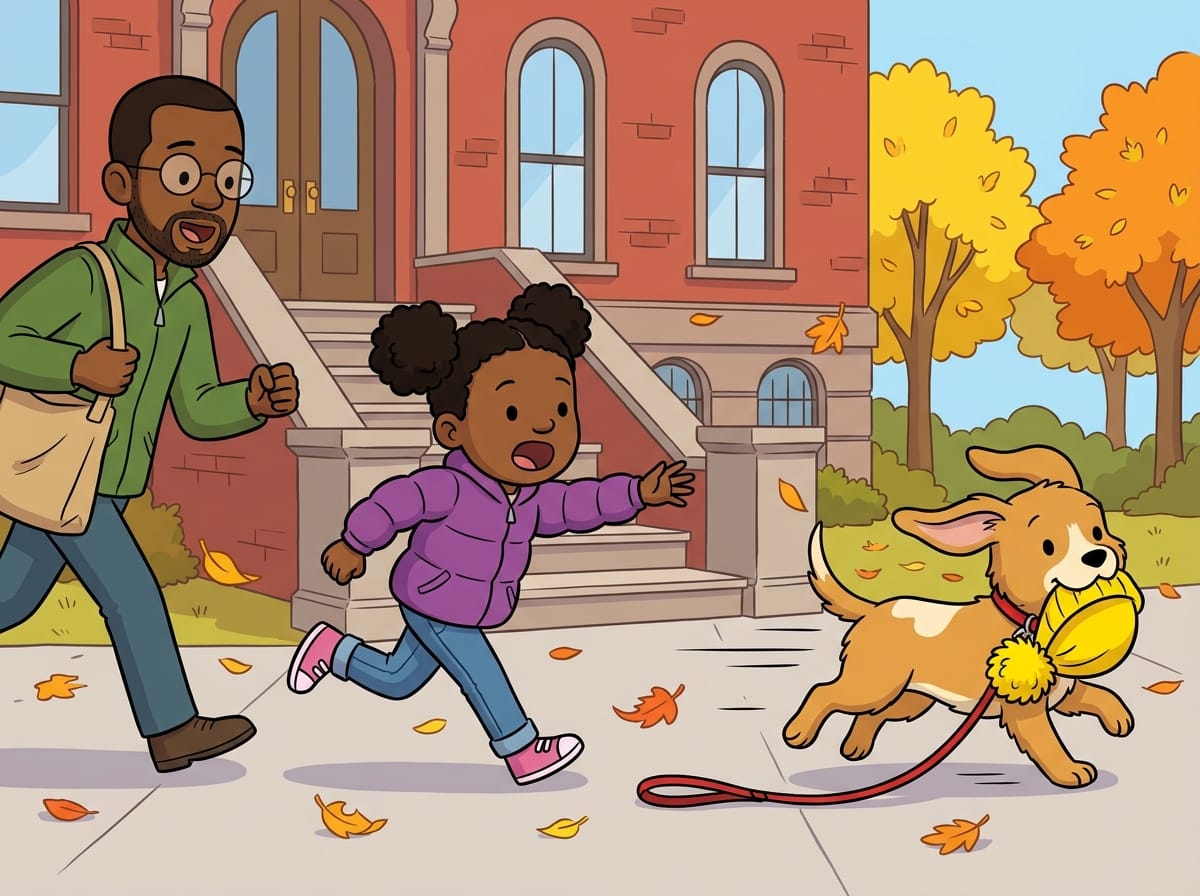
Picture description
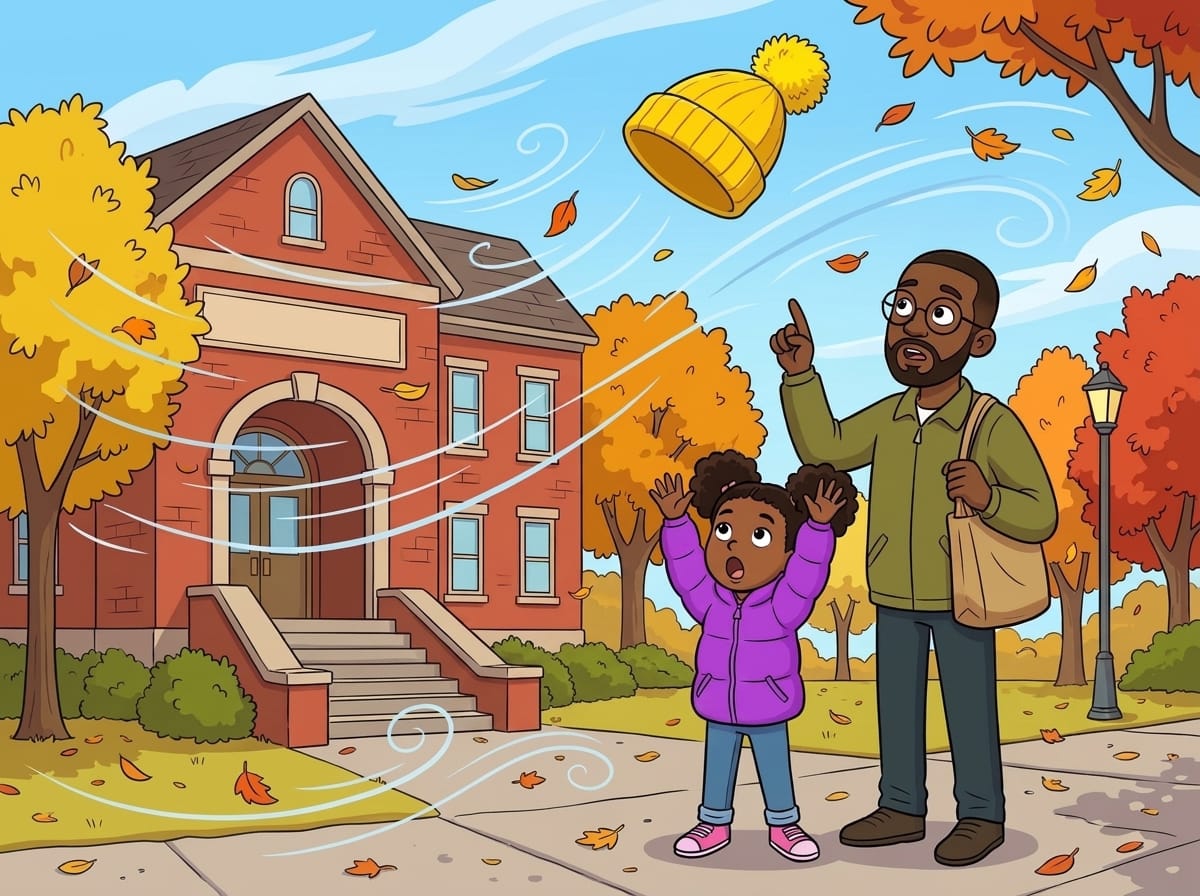
The wind blows. Whoosh! Zoe's hat flies off her head. Up, up, up it goes! The hat lands on a bench at the bus stop. A little brown dog sees the hat. The dog grabs the hat and runs away! "Stop, dog! That is my hat!" says Zoe.
Picture 1: the wind swirls orange leaves and Zoe's yellow hat flies high in the air. Zoe reaches up with both arms.
Picture 2: the yellow hat sits on a green bench at the bus stop. A small brown dog looks at it.
Picture 3: the dog runs along the sidewalk with the hat in its mouth. Zoe runs after it, calling.
Point to each picture in order as your child talks. Ask the question once and let your child tell it all before you say anything. If they stop after the first picture, point to the next one and say "and then?"
Tell me what happens to Zoe's hat.
Scoring rubric
| Level | What it looks like |
|---|---|
| 4: Confident |
|
| 3: Developing |
|
| 2: Beginning |
|
| 1: Starting |
|
A strong sample response
"The wind go whoosh and the hat fly up, up, up. Then it fall on the bench. And the dog see it. And then the dog take the hat and run! Zoe say stop, dog! She is sad because it her new hat."
This shows level 4, Confident: the child tells all three pictures in order with "then" and "and then", uses story words (wind, bench, dog, stop), and adds a reason (Zoe is sad because it is her new hat) without being asked. Missing past-tense endings (go, fly, fall) are expected at this age.
What to look for
- This is a retelling, which is the hardest kind of speaking at kindergarten: your child has to keep events in order and join them. Words like "then" and "and then" are exactly what to listen for.
- Don't correct grammar while your child is telling the story. "The hat fly up" tells the event clearly; you can say it back as "Yes, the hat flew up!" afterwards.
- The real Kindergarten test has its own speaking rubric, scored by the test administrator. The levels here are a simplified practice guide, not a score.
Prompt 5: Storybook speaking
Suggested time: about 2 minutes
Read the page aloud to your child, then look at the picture together.
Zoe's Yellow Hat: page 6
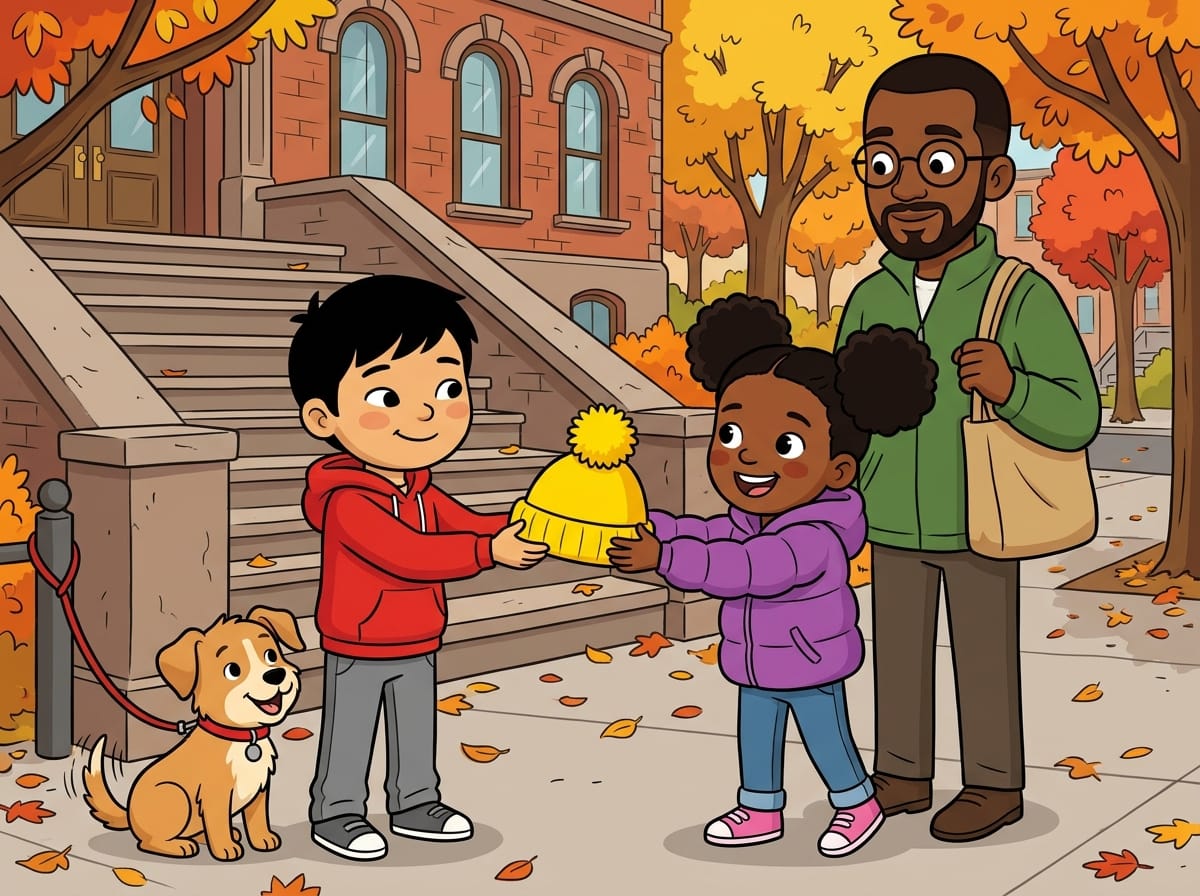
Picture description
Leo takes the hat. He gives it to Zoe. "Here is your hat," says Leo. "Thank you!" says Zoe.
Picture: Leo, in his red sweatshirt, holds out the yellow hat and Zoe takes it with one hand. Both children are smiling. The little brown dog sits near Leo, its leash tied to a post, wagging its tail. Dad stands behind Zoe, smiling.
Point to Zoe's face, ask the first question, wait, then ask "why?"
How does Zoe feel now? Why does she feel that way?
Scoring rubric
| Level | What it looks like |
|---|---|
| 4: Confident |
|
| 3: Developing |
|
| 2: Beginning |
|
| 1: Starting |
|
A strong sample response
How does Zoe feel? — "Happy! She smiling."
Why? — "Because Leo give her the hat back. She say thank you."
This shows level 4, Confident: a feeling word, evidence from the picture (she is smiling) and a reason joined with "because", using story words. A child who said only "happy" would be at level 2 or 3.
What to look for
- "Why" questions ask your child to explain, which is a step up from naming or describing. "Because" is the word to listen for, but "Leo give hat" with no "because" is still a reason.
- Any sensible feeling word counts: happy, glad, good, excited. If your child answers "sad", ask them to look at Zoe's face again; they may be remembering the earlier page.
- The real Kindergarten test has its own speaking rubric, scored by the test administrator. The levels here are a simplified practice guide, not a score.
Prompt 6: Storybook speaking
Suggested time: about 2 minutes
Read the last page aloud to your child, then look at the picture together.
Zoe's Yellow Hat: page 7
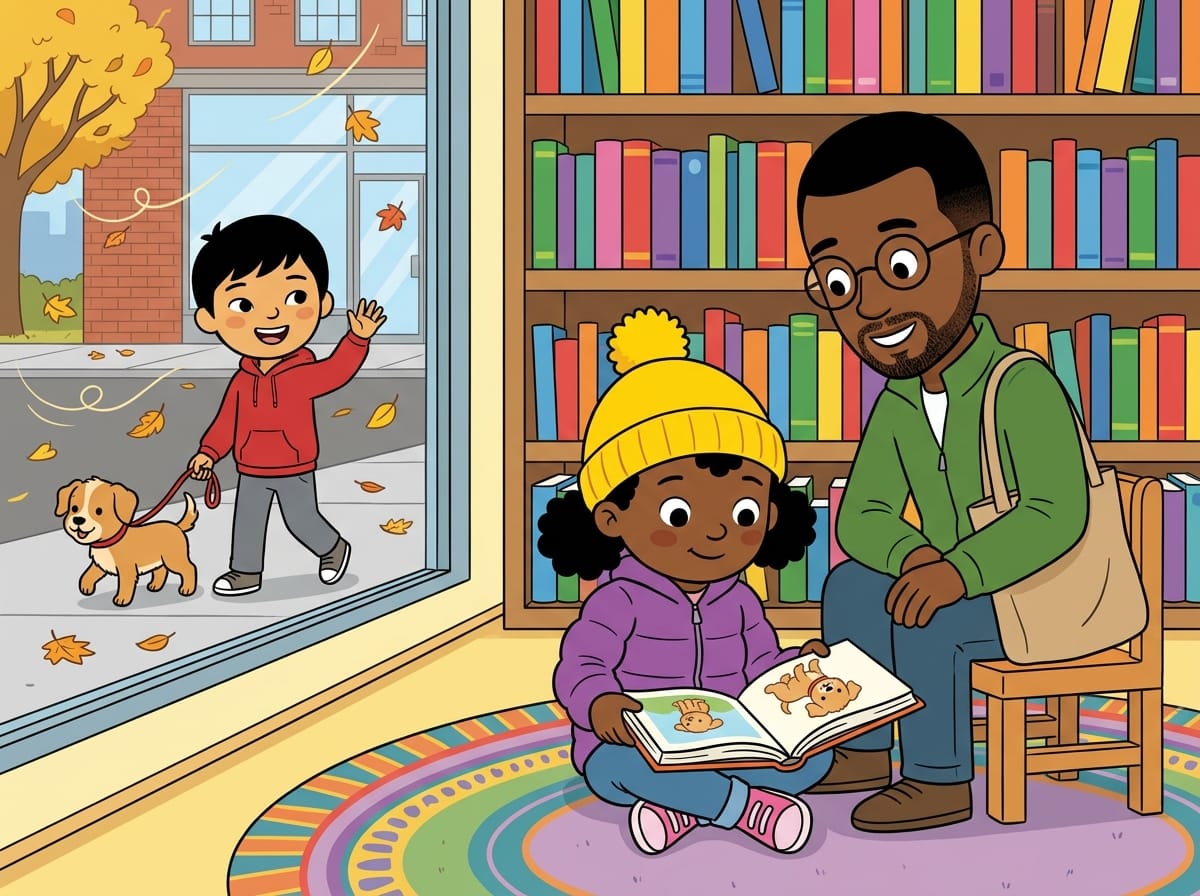
Picture description
Zoe and Dad go into the library. Zoe finds a book about a dog. The dog looks just like Biscuit!
Picture: inside the library, Zoe sits on a round rug with her yellow hat on, holding open a picture book that shows a small brown dog. Dad sits on a low chair next to her. Shelves of books fill the wall. Through the window, Leo and the little brown dog wave from the sidewalk.
Ask the question, wait, and then ask "why?" if your child doesn't say. Either answer, yes or no, is fine.
Would you like to have a dog like Biscuit? Tell me why.
Scoring rubric
| Level | What it looks like |
|---|---|
| 4: Confident |
|
| 3: Developing |
|
| 2: Beginning |
|
| 1: Starting |
|
A strong sample response
"Yes. I want a dog like Biscuit because he is little and he sit when you say sit. But no taking my hat! I gonna name him Cookie."
This shows level 4, Confident: a clear opinion, a reason with "because" that uses details from the story (little, sits when told), and an extra idea of the child's own. This is the earliest form of giving an opinion and backing it up.
What to look for
- This question asks for an opinion and a reason, the kindergarten version of arguing a point. There is no right answer: "No, because dogs are loud" is just as good as "yes".
- If your child says only "yes", ask "why?" once. If they still don't add anything, that is a fair picture of where their speaking is today.
- The real Kindergarten test has its own speaking rubric, scored by the test administrator. The levels here are a simplified practice guide, not a score.
Unofficial practice. This site is not affiliated with, endorsed by, or connected to WIDA, the Wisconsin Center for Education Research, or the Board of Regents of the University of Wisconsin System. WIDA and WIDA ACCESS are trademarks of the Board of Regents of the University of Wisconsin System. Every question here is original practice material written to match the published test design.