WIDA writing practice for high school (grades 9–12)
Printable version. Original practice written to match the published WIDA format, not questions from the official test.
Writing prompts
On the real test these are scored by a trained person against a rubric. The rubric and a sample response follow each prompt.
Prompt 1: Tier A tasks
Suggested time: about 15 minutes
Look at the four pictures. Then write your answer.
Science: Making a Simple Water Filter
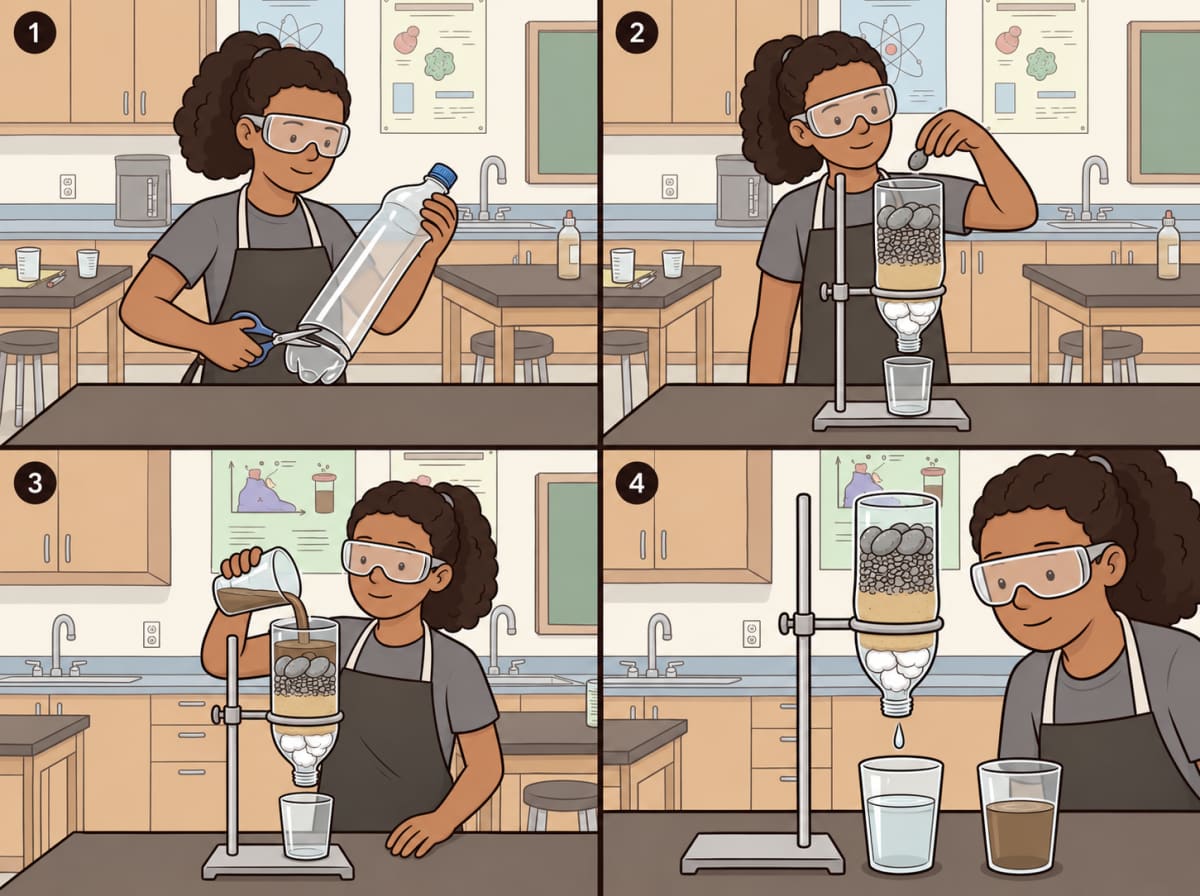
Picture description
Picture 1: A student cuts the bottom off a clear plastic bottle with scissors.
Picture 2: The student puts layers into the bottle. From the bottom up: cotton balls in the neck, then a layer of sand, then small gravel, then large gravel on top.
Picture 3: The student pours a cup of brown, muddy water into the top of the bottle.
Picture 4: Water drips out of the neck into a glass. The water in the glass is much clearer than before.
Word bank: bottle, layer, cotton, sand, gravel, pour, muddy, clearer, filter, first, next, then, finally.
Look at the pictures and use the word bank to help you.
Your science class made water filters. Write to a student who was absent. Explain the steps for making the filter, in order, and tell what happened to the muddy water.
Scoring rubric
| Level | What it looks like |
|---|---|
| 7: Fully developed |
|
| 6: Well developed |
|
| 5: Developed |
|
| 4: Expanding |
|
| 3: Emerging |
|
| 2: Beginning |
|
| 1: Starting |
|
A strong sample response
First, you cut the bottom of a plastic bottle. Next, you put cotton in the neck of the bottle. Then you put the layers. You put sand, small gravel and big gravel on the top. Then you pour the muddy water in the bottle. The water go down in the layers. Finally the water come out in the glass and it is more clearer. The sand and the gravel stop the dirt so the water is clean.
This sample sits at about level 4. It explains every step in order with sequence words and adds a simple reason ('stop the dirt so the water is clean'). Sentences are mostly simple with repeated patterns, and there are errors ('go', 'more clearer'), but the meaning is always clear.
What to look for
- Check that every step is there and in order. Sequence words from the word bank (first, next, then, finally) are a good sign.
- A stronger answer explains why the filter works, for example that the layers trap dirt of different sizes.
- It's worth telling students afterward that filtered water like this is clearer but still not safe to drink.
- If the response is blank, copied from the prompt or source, off topic, or not in English, note that instead of matching it to a level.
Prompt 2: Tier A tasks
Suggested time: about 15 minutes
Read about the steps and look at the chart. Then write your answer.
Social Studies: How a Bill Becomes a State Law
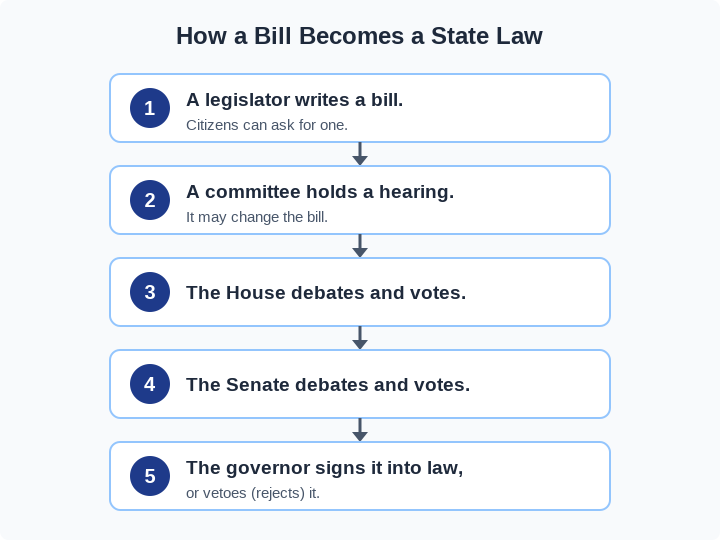
Picture description
Students at Fairview High wanted their state to make a new law requiring a water bottle filling station in every public school. Their teacher explained how an idea becomes a state law.
Step 1: A state legislator writes the idea as a bill. Citizens, including students, can ask a legislator to do this.
Step 2: A committee studies the bill. It holds a hearing where people can speak, and it may change the bill.
Step 3: The House of Representatives debates the bill and votes on it.
Step 4: The Senate debates the bill and votes on it.
Step 5: The governor signs the bill, and it becomes a law. If the governor vetoes, or rejects, the bill, it does not become law, unless the legislature votes again to override the veto.
Word bank: legislator, bill, committee, hearing, vote, House, Senate, governor, sign, veto, law.
Use the chart and the word bank to help you.
Your class is making a guide for new students called 'How Our Government Works.' Write a paragraph that tells how an idea, like the Fairview students' idea, can become a state law.
Scoring rubric
| Level | What it looks like |
|---|---|
| 7: Fully developed |
|
| 6: Well developed |
|
| 5: Developed |
|
| 4: Expanding |
|
| 3: Emerging |
|
| 2: Beginning |
|
| 1: Starting |
|
A strong sample response
Students can have a idea for a law, like the Fairview students. First they ask a legislator to write the bill. Then a committee study the bill. They have a hearing and people can talk about the bill, maybe the students can talk too. Next the House vote and the Senate vote. If they say yes, the bill go to the governor. The governor can sign it and then it is a law. But the governor can say no, this is a veto. So it is not easy to make a law, it need many steps.
This sample sits at about level 4. It covers all five steps in order, uses many content words from the word bank (legislator, committee, hearing, veto), connects ideas with 'if', 'but' and 'so', and adds a simple concluding idea. Errors in verb agreement repeat but do not block meaning.
What to look for
- Check that the steps are in the right order and that the student explains what happens at each one, not just names it.
- Reusing words from the word bank is expected at Tier A. Credit is higher when the student uses them in their own sentences.
- A detail beyond the chart, such as students speaking at the hearing, shows the student is applying the idea.
- If the response is blank, copied from the prompt or source, off topic, or not in English, note that instead of matching it to a level.
Prompt 3: Tier B/C tasks
Suggested time: about 30 minutes
Read the article and look at the chart. Then write your answer.
Science and Language Arts: Should High Schools Start Later?
Picture description
Source 1: "The Science of the Teenage Clock," an article from a school district newsletter.
Around the start of puberty, the body's internal clock shifts. Melatonin, a hormone that signals the brain that it is time to sleep, begins to be released later in the evening, often around 11 p.m. As a result, many teenagers simply cannot fall asleep early, even when they go to bed early. Sleep researchers estimate that teenagers need 8 to 10 hours of sleep a night.
When school starts at 7:30 a.m., a student who falls asleep at 11 and wakes at 6 gets about seven hours. Over weeks, that shortfall is linked to trouble concentrating, lower grades, more car accidents among teen drivers, and higher rates of anxiety and depression. For these reasons, the American Academy of Pediatrics has recommended that middle and high schools start no earlier than 8:30 a.m.
Later start times have costs, however. Many districts use the same buses for elementary, middle and high schools in separate rounds, so moving one start time can mean buying more buses or starting elementary school earlier. Afternoon sports practices and games end later, and students with after-school jobs may lose hours. Some parents depend on teenagers to watch younger siblings after school.
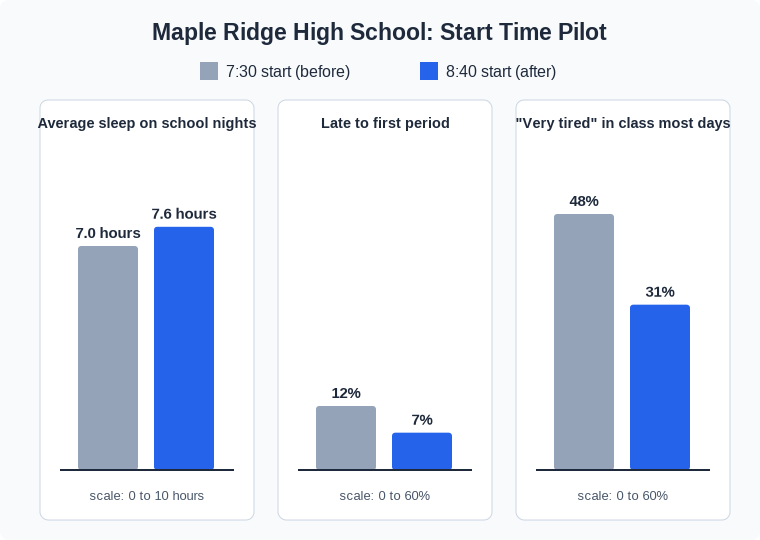
Source 2: A chart from Maple Ridge High School, which moved its start time from 7:30 to 8:40 a.m. as a one-year pilot.
Average sleep on school nights: 7.0 hours before the change, 7.6 hours after.
Students late to first period on a typical day: 12 percent before, 7 percent after.
Students who said they felt 'very tired' in class most days: 48 percent before, 31 percent after.
Read both sources. Then write your answer.
Your school board is deciding whether to move the high school start time from 7:30 to 8:30 a.m. Write a letter to the school board that argues for or against the change. Use evidence from both sources to support your position, and respond to at least one argument on the other side.
Scoring rubric
| Level | What it looks like |
|---|---|
| 7: Fully developed |
|
| 6: Well developed |
|
| 5: Developed |
|
| 4: Expanding |
|
| 3: Emerging |
|
| 2: Beginning |
|
| 1: Starting |
|
A strong sample response
Dear Members of the School Board,
I am writing to urge you to move our high school's start time from 7:30 to 8:30 a.m. This change is not about letting students be lazy; it is about matching the school day to the way teenage bodies actually work.
According to "The Science of the Teenage Clock," the hormone melatonin is released later in teenagers, often around 11 p.m., so many of us physically cannot fall asleep early. With a 7:30 start, a student who wakes at 6 gets only about seven hours of sleep, even though teenagers need between eight and ten. The article links this shortfall to lower grades, anxiety, depression and even car accidents among teen drivers. These are serious consequences, which is why the American Academy of Pediatrics recommends a start time of 8:30 or later.
The results from Maple Ridge High School show that a later start makes a measurable difference. After the school moved from 7:30 to 8:40, average sleep rose from 7.0 to 7.6 hours a night. The share of students late to first period dropped from 12 to 7 percent, and the share who felt very tired in class most days fell from 48 to 31 percent. In other words, students were not just sleeping more; they were arriving on time and ready to learn.
I understand that a later start would be inconvenient. The article admits that buses may need to be rescheduled, practices would end later, and some students would lose hours at their jobs. These problems are real, but they can be solved with planning, for example by adjusting bus routes or scheduling some practices before school. By contrast, a student's biology cannot be rescheduled. When a problem affects every student's health and learning, the district should accept some logistical costs to fix it.
For these reasons, I respectfully ask you to approve the 8:30 start time.
Sincerely,
Alexis Moreno, Grade 11
This sample sits at about level 7. It states a clear position, uses specific evidence from both sources (melatonin, the AAP recommendation, all three Maple Ridge results), explains why the evidence matters, and answers the strongest counterargument instead of ignoring it. Sentences are varied and controlled, and the vocabulary is precise (shortfall, measurable, logistical).
What to look for
- Either position can reach the top levels. Judge how well the student uses evidence, not which side they choose.
- Check that both sources are used. A response built only on the article or only on the chart is incomplete for this task.
- Look for a real response to the other side: naming a counterargument and then explaining why it is weaker.
- Numbers should be explained, not just listed. 'Tardiness fell from 12 to 7 percent' is stronger when the student says what it shows.
- If the response is blank, copied from the prompt or source, off topic, or not in English, note that instead of matching it to a level.
Prompt 4: Tier B/C tasks
Suggested time: about 30 minutes
Read the source and look at the picture. Then write your answer.
Social Studies and Language Arts: Arriving in Chicago, 1917
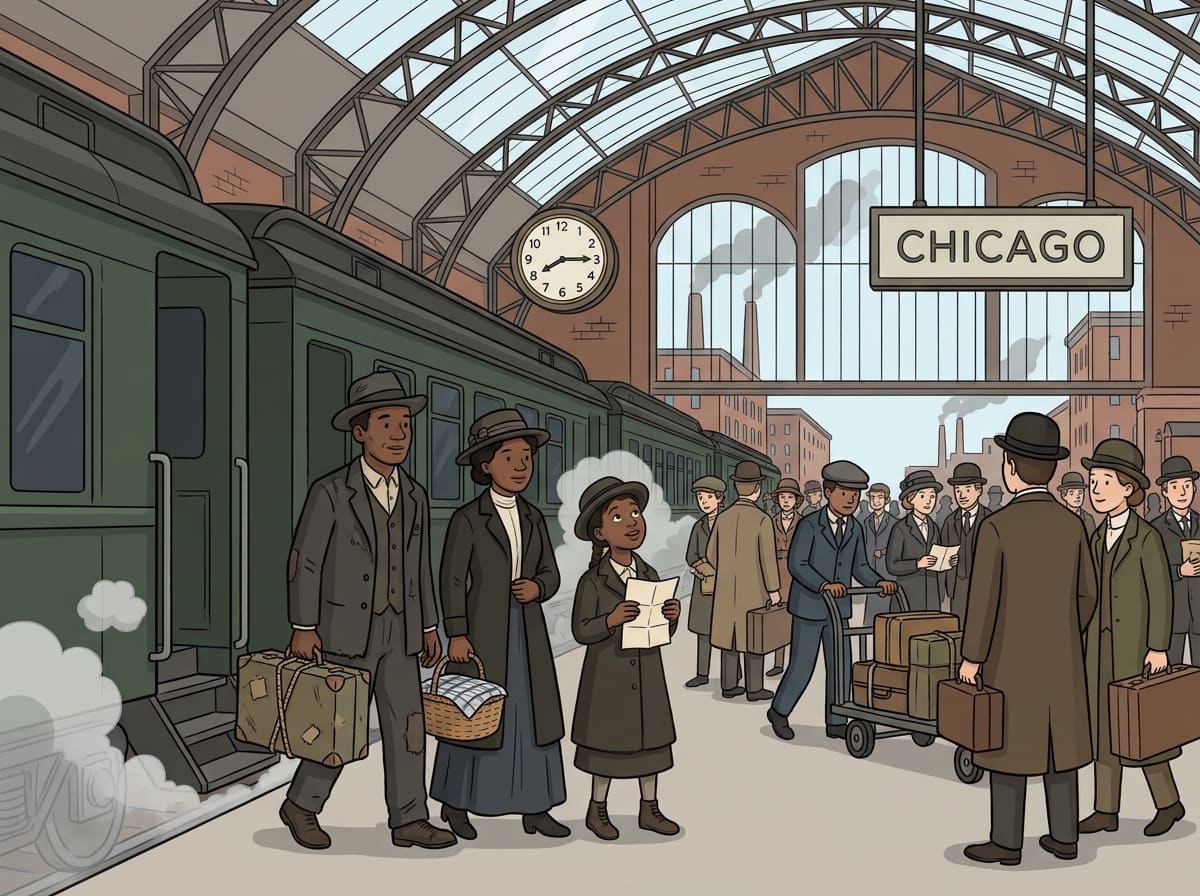
Picture description
The picture shows a busy train station in Chicago in 1917. A family of three has just stepped off a train onto a crowded platform: a father carrying a suitcase tied with rope, a mother holding a covered basket, and a girl of about twelve holding an open letter. Steam rises from the train. A large clock on the wall shows about a quarter past eight. Through tall windows, the city's brick buildings and factory smokestacks are visible.
Source: The Great Migration. Between about 1910 and 1970, roughly six million Black Americans moved from the rural South to cities in the North, Midwest and West. Many left to escape segregation laws, known as Jim Crow laws, and the threat of violence. Others came for jobs: when World War I began, factories in cities like Chicago, Detroit and Cleveland needed workers. Black newspapers such as the Chicago Defender printed stories and letters encouraging families to come north, and relatives who had already moved often sent letters describing jobs and housing.
Life in the North was not easy. New arrivals often found crowded, expensive housing, and they faced discrimination in jobs and neighborhoods there too. Still, many built strong communities, with churches, businesses, newspapers and music that changed American culture.
Read the source and look at the picture. Then write your story.
Imagine you are the girl in the picture. Write a narrative about your first day in Chicago. Describe what you see and feel, explain why your family moved, and include at least two historical details from the source.
Scoring rubric
| Level | What it looks like |
|---|---|
| 7: Fully developed |
|
| 6: Well developed |
|
| 5: Developed |
|
| 4: Expanding |
|
| 3: Emerging |
|
| 2: Beginning |
|
| 1: Starting |
|
A strong sample response
The letter in my hand was soft from being folded and unfolded so many times. It was from my aunt Linda, and I had read it every night on the long train ride from Mississippi: "There is work here at the packing house, and the children go to school with real books." Now the train hissed behind me, and for the first time, Chicago was not just words on paper.
The station was louder than anything I had ever heard. Hundreds of people pushed past us, and the clock on the wall said a quarter past eight, though it felt like the middle of the night. Papa held our suitcase tighter, the one tied with rope because the latch had broken in Memphis. Mama didn't say anything, but I could see her eyes moving over every face, searching for her sister.
We had left because Papa said there was no future for us back home. The Jim Crow laws told us where we could sit, where we could drink water, and which schools we could attend, and everyone knew what happened to people who argued. When Papa read in the Chicago Defender that the factories needed workers because of the war, he started saving. It took him almost a year.
Through the tall windows, I could see smokestacks, more than I could count, breathing gray clouds into the sky. I had imagined Chicago as a shining place. It looked harder than that, and dirtier. Aunt Linda had warned us in her letter that the rooms were small and the rent was high, and that some people here did not want us any more than the people back home did. I believed her. But when I finally saw her waving at the end of the platform, laughing and crying at the same time, I folded the letter one last time and put it in my pocket. I didn't need it anymore. We were here.
This sample sits at about level 7. It is a complete narrative with a clear beginning, middle and end, vivid sensory details drawn from the picture (the clock, the rope-tied suitcase, the smokestacks), and historical details from the source woven into the story (Jim Crow laws, the Chicago Defender, wartime factory jobs, crowded housing and discrimination in the North). Sentence structure is varied and controlled.
What to look for
- Check for at least two historical details from the source, used naturally in the story rather than copied as a list.
- A strong narrative uses the first person consistently and shows feelings through actions and details, not only by naming them.
- The story should explain why the family moved. Look for push and pull reasons: what they left behind and what drew them north.
- Details from the picture, such as the clock, the letter or the suitcase, show the student is connecting the image to the text.
- If the response is blank, copied from the prompt or source, off topic, or not in English, note that instead of matching it to a level.
Unofficial practice. This site is not affiliated with, endorsed by, or connected to WIDA, the Wisconsin Center for Education Research, or the Board of Regents of the University of Wisconsin System. WIDA and WIDA ACCESS are trademarks of the Board of Regents of the University of Wisconsin System. Every question here is original practice material written to match the published test design.