WIDA speaking practice for high school (grades 9–12)
Printable version. Original practice written to match the published WIDA format, not questions from the official test.
Speaking prompts
On the real test these are scored by a trained person against a rubric. The rubric and a sample response follow each prompt.
Prompt 1: Pre-A tier tasks
Suggested time: about 1 minutes
Model answer: read this aloud first
Listen to the model student answer a similar question first.
Model answer
Transcript for the adult to read aloud. The student listens and does not read it.
Mr. Anderson: Look at the counter in the picture. What is in the bowl?
Brianna: Apples. Red apples.
The student's own task
Look at the picture.
Social and Instructional: Cooking Class
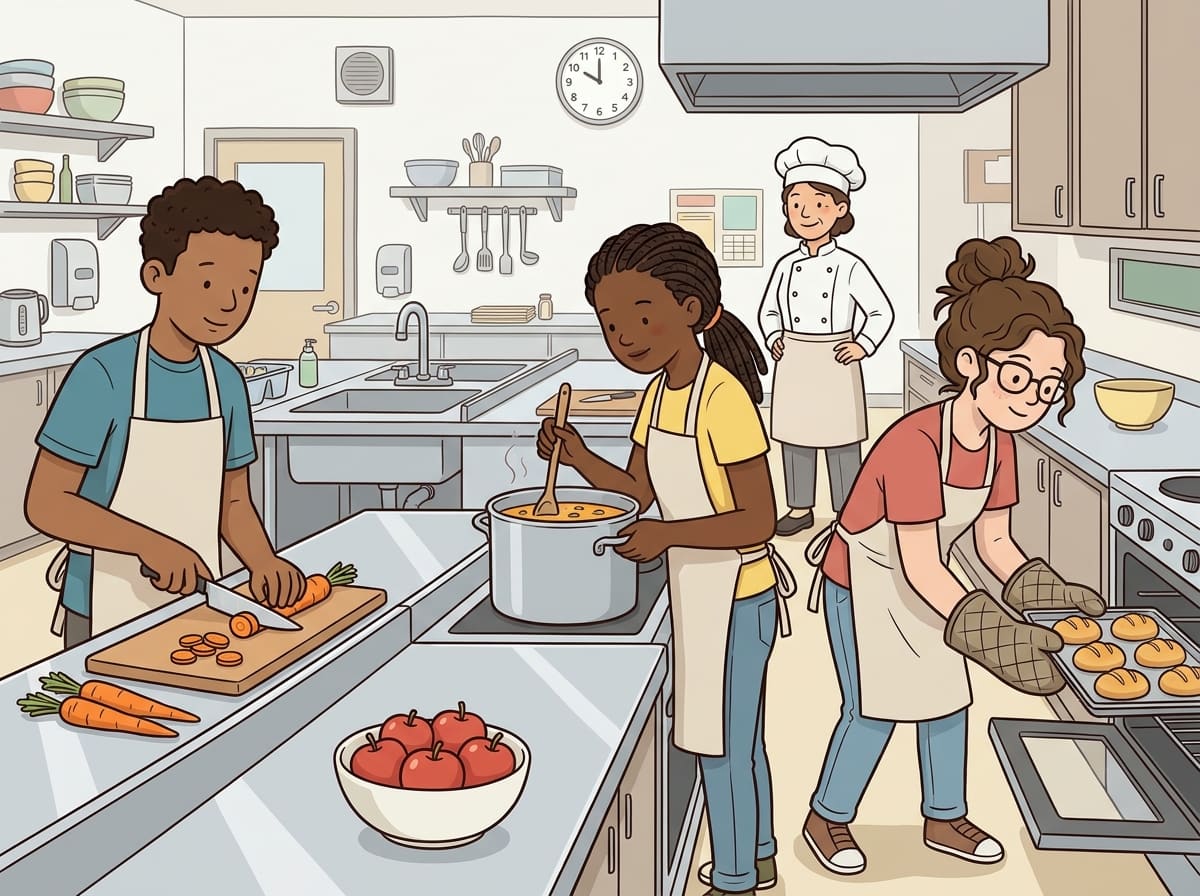
Picture description
The picture shows a high school cooking class in a big kitchen. All the students wear aprons.
On the left, a boy is cutting orange carrots on a cutting board with a knife.
In the middle, a girl is stirring a big pot of soup on the stove with a long spoon.
On the right, a girl in oven mitts is taking a tray of bread out of the oven.
On the counter in front, there is a bowl of red apples. The teacher, in a white chef's hat, is watching and smiling. A clock on the wall says ten o'clock.
Listen to the model student first. Then answer your question.
Look at the boy on the left. What is he cutting?
Scoring rubric
| Level | What it looks like |
|---|---|
| 4: Exemplary |
|
| 3: Strong |
|
| 2: Adequate |
|
| 1: Attempted |
|
A strong sample response
Carrots. He cut carrots.
This matches the model for a Pre-A task: the key word ('carrots') plus a short phrase. The small grammar slip ('cut' for 'is cutting') does not affect meaning, and nothing more is needed at level 1.
What to look for
- At Pre-A, one or two correct English words are a real answer. 'Carrots' alone answers the task.
- If the student is silent, point to the carrots and ask again. Pointing is fine for practice, but on the test they need to say a word.
- Praise the word, then model a longer phrase ('He is cutting carrots') without asking them to repeat it.
Prompt 2: Pre-A tier tasks
Suggested time: about 1 minutes
Model answer: read this aloud first
Listen to the model student answer a similar question first.
Model answer
Transcript for the adult to read aloud. The student listens and does not read it.
Mr. Anderson: Look at the girl at the oven. What is she holding?
Brianna: Bread. She has bread.
The student's own task
Look at the picture.
Social and Instructional: Cooking Class
Picture description
The picture shows a high school cooking class in a big kitchen. All the students wear aprons.
On the left, a boy is cutting orange carrots on a cutting board with a knife.
In the middle, a girl is stirring a big pot of soup on the stove with a long spoon.
On the right, a girl in oven mitts is taking a tray of bread out of the oven.
On the counter in front, there is a bowl of red apples. The teacher, in a white chef's hat, is watching and smiling. A clock on the wall says ten o'clock.
Listen to the model student first. Then answer your question.
Look at the girl in the middle, at the stove. What is she doing?
Scoring rubric
| Level | What it looks like |
|---|---|
| 4: Exemplary |
|
| 3: Strong |
|
| 2: Adequate |
|
| 1: Attempted |
|
A strong sample response
Cooking. She is cook soup.
This is a strong Pre-A answer. The student gives an action word and adds the object ('soup'), matching the model's word-plus-phrase pattern. The verb form error is normal at this level.
What to look for
- Accept any word that names the action: cooking, stirring, making soup.
- An object alone ('soup') is a partial answer; ask 'What is she doing?' again to draw out a verb.
- Don't correct the grammar during practice. Repeat the answer back correctly instead.
Prompt 3: Pre-A tier tasks
Suggested time: about 1 minutes
Model answer: read this aloud first
Listen to the model student answer a similar question first.
Model answer
Transcript for the adult to read aloud. The student listens and does not read it.
Mr. Anderson: What do you like to drink?
Brianna: Orange juice. I like orange juice.
The student's own task
Look at the picture.
Social and Instructional: Cooking Class
Picture description
The picture shows a high school cooking class in a big kitchen. All the students wear aprons.
On the left, a boy is cutting orange carrots on a cutting board with a knife.
In the middle, a girl is stirring a big pot of soup on the stove with a long spoon.
On the right, a girl in oven mitts is taking a tray of bread out of the oven.
On the counter in front, there is a bowl of red apples. The teacher, in a white chef's hat, is watching and smiling. A clock on the wall says ten o'clock.
Listen to the model student first. Then answer your question.
Do you like to cook? What food do you like to eat?
Scoring rubric
| Level | What it looks like |
|---|---|
| 4: Exemplary |
|
| 3: Strong |
|
| 2: Adequate |
|
| 1: Attempted |
|
A strong sample response
Yes. I like rice. Rice and chicken.
The student answers both parts of the question with short phrases, as the model did. Naming a food from home is fine; the task is about the student's own life.
What to look for
- This question is about the student, so there is no wrong food. Any English food word counts.
- 'Yes' or 'No' alone answers only half; ask the second part again.
- If the student knows a food only in another language, help with the English word afterward and try again.
Prompt 4: Tier A tasks
Suggested time: about 1 minutes
Model answer: read this aloud first
Listen to the model student answer a similar question first.
Model answer
Transcript for the adult to read aloud. The student listens and does not read it.
Mr. Anderson: Look at the table on the right. What do you see?
Brianna: I see a table. There are bags of dog food on the table. A woman is putting a collar on a puppy.
The student's own task
Look at the picture.
Social and Instructional: Pet Adoption Day

Picture description
The picture shows a pet adoption day in a city park. A banner says 'Pet Adoption Day'.
In the middle, a volunteer is brushing a big brown dog.
Next to her, a teenage boy is pouring water into a bowl for three puppies in a small pen.
On the left, a boy is waiting in line. He is holding an empty leash and a paper form, and he looks nervous.
On the right, there is a table with bags of pet food and a box labeled 'Free Collars'. A woman is putting a collar on a small puppy, and a little girl is watching.
Listen to the model student first. Then answer your question.
Look at the middle of the picture. Tell me what the people are doing.
Scoring rubric
| Level | What it looks like |
|---|---|
| 4: Exemplary |
|
| 3: Strong |
|
| 2: Adequate |
|
| 1: Attempted |
|
A strong sample response
A woman is brush a big dog. The dog is brown. A boy is put water in a bowl. The puppies drink the water.
This reaches the model's level for this task: several simple sentences that name the people, the actions and the objects. The '-ing' forms are missing, but every sentence is clear.
What to look for
- This task targets level 1 to 2 language: simple sentences that tell who is doing what.
- Listen for action words (brushing, pouring) and object words (dog, bowl, puppies).
- A list of nouns ('woman, dog, boy') is a start; ask 'What is she doing?' to get a sentence.
Prompt 5: Tier A tasks
Suggested time: about 2 minutes
Model answer: read this aloud first
Listen to the model student answer a similar question first.
Model answer
Transcript for the adult to read aloud. The student listens and does not read it.
Mr. Anderson: Look at the woman and the little girl on the right. Tell a story about them. What happened before, what is happening now, and what will happen next?
Brianna: Before, the little girl wanted a puppy for a long time. Her mom finally said yes, so they came to the adoption day in the park.
Brianna: Now the woman is putting a free collar on their new puppy. The little girl is watching, and she is very excited.
Brianna: Next, they will take the puppy home, and the girl will give him a name. She will take care of him every day.
The student's own task
Look at the picture.
Social and Instructional: Pet Adoption Day
Picture description
The picture shows a pet adoption day in a city park. A banner says 'Pet Adoption Day'.
In the middle, a volunteer is brushing a big brown dog.
Next to her, a teenage boy is pouring water into a bowl for three puppies in a small pen.
On the left, a boy is waiting in line. He is holding an empty leash and a paper form, and he looks nervous.
On the right, there is a table with bags of pet food and a box labeled 'Free Collars'. A woman is putting a collar on a small puppy, and a little girl is watching.
Listen to the model student first. Then tell your story.
Look at the boy on the left who is waiting in line. Tell a story about him. What happened before he came? What is happening now? What will happen next?
Scoring rubric
| Level | What it looks like |
|---|---|
| 4: Exemplary |
|
| 3: Strong |
|
| 2: Adequate |
|
| 1: Attempted |
|
A strong sample response
Before, the boy ask his parents for a dog for a long time. Finally they say yes, so he fill out the form and he bring a leash. Now he is waiting in the line, and he is nervous because he don't know if he can get a dog today. Next, a volunteer will show him a dog, and he will play with it. Then he will take the dog home and he will be very happy.
This is a strong level 3 narrative, close to the model. It uses time order (before, now, next, then), past, present and future, and gives a reason for the boy's feeling. Errors ('he ask', 'he don't') are frequent but never block meaning.
What to look for
- This task targets level 3: a short story in time order with before, now and next.
- Check that the story fits the picture: the empty leash, the form and the nervous face are clues.
- If the student only describes the picture, ask 'What happened before he came?' to push them into the past.
Prompt 6: Tier A tasks
Suggested time: about 2 minutes
Model answer: read this aloud first
Listen to the model student answer a similar question first.
Model answer
Transcript for the adult to read aloud. The student listens and does not read it.
Mr. Anderson: Explain why a metal spoon gets hot when you leave it in a bowl of hot soup.
Brianna: The soup is hot, and the spoon is metal. Metal lets heat move through it easily, so the heat goes from the soup into the spoon. The heat moves up the spoon to the handle. That's why the handle gets hot too, and you need to be careful when you touch it.
The student's own task
Listen to the teacher. Then answer the question.
Science: How Sweat Cools You Down
Transcript for the adult to read aloud. The student listens and does not read it.
When you exercise or when the weather is hot, your body makes sweat. Sweat is mostly water, and it comes out through tiny holes in your skin.
For water to evaporate, or change from a liquid into a gas, it needs energy. Sweat takes that energy from your skin, in the form of heat.
So when sweat evaporates, it carries heat away from your body, and your skin cools down.
On a humid day, the air already holds a lot of water, so sweat evaporates slowly. That is why you feel hotter and stickier on a humid day, even at the same temperature.
Listen to the model student first. Then answer your question.
Explain to a classmate how sweating cools your body, and why you feel hotter on a humid day.
Scoring rubric
| Level | What it looks like |
|---|---|
| 4: Exemplary |
|
| 3: Strong |
|
| 2: Adequate |
|
| 1: Attempted |
|
A strong sample response
When you are hot, your body make sweat. The sweat is water on your skin. The water need energy to evaporate, so it take the heat from your skin. When the sweat go in the air, the heat go too, and you feel more cool. On a humid day the air have a lot of water already, so the sweat don't evaporate fast. The heat stay on your body, so you feel hot and sticky.
This is a level 3 explanation that matches the model: it gives the cause (evaporation takes heat from the skin), the steps in order, and the second part about humid days. Verb endings are often wrong, but the science is clear.
What to look for
- This task targets level 3: explaining a cause and effect in connected sentences.
- Listen for the two parts of the question: how sweat cools the body, and why humid days feel hotter.
- Content words like 'evaporate', 'heat' and 'humid' show understanding even with errors. 'Energy' is a bonus, not a requirement.
Prompt 7: Tier B/C tasks
Suggested time: about 2 minutes
Model answer: read this aloud first
Listen to the model student answer a similar question first.
Model answer
Transcript for the adult to read aloud. The student listens and does not read it.
Mr. Anderson: A graph shows visits to the public library each month. Visits are low in the spring and very high in June and July. Describe the pattern and explain one possible reason for it.
Brianna: The graph shows that library visits stay pretty low from March to May, around two thousand a month, but then they jump up a lot in June and July, to almost four thousand. I think the reason is that school is out in the summer. Kids have more free time, and a lot of libraries have summer reading programs, so families come more often. After July, the visits go down again when school starts.
The student's own task
Look at the bar graph.
Math: City Bus Riders by Month

Picture description
The bar graph shows the average number of riders on a city's buses each weekday, for each month of one year.
January: 4,200. February: 4,100. March: 4,600. April: 4,900. May: 5,100. June: 3,600.
July: 3,200. August: 3,400. September: 5,300. October: 5,500. November: 5,000. December: 4,300.
Listen to the model student first. Then answer your question.
Describe the pattern in the bus graph. Then explain one possible reason why the number of riders changes during the year.
Scoring rubric
| Level | What it looks like |
|---|---|
| 4: Exemplary |
|
| 3: Strong |
|
| 2: Adequate |
|
| 1: Attempted |
|
A strong sample response
The graph shows that the number of bus riders goes up and down during the year. From January to May, it slowly increases, from about four thousand two hundred to five thousand one hundred. But in June, July and August it drops a lot. July is the lowest month, with only about three thousand two hundred riders. Then in September it goes up again very fast, and October is the highest month, with five thousand five hundred. I think the main reason is school. A lot of high school and college students take the bus to school, so when school is closed in the summer, fewer people ride. When school starts again in September, the riders come back.
This reaches level 3 to 4 and matches the model: it describes the overall trend, cites specific values for the lowest and highest months, and connects the pattern to a reasonable cause with 'because' and 'so'. A level 5 answer might add a second reason or compare the winter dip.
What to look for
- This task targets level 3: describe a trend with numbers and give a reason.
- Listen for comparison language: increases, drops, the lowest, the highest.
- Any reasonable cause counts (school, weather, holidays) as long as it fits the months the student points to.
Prompt 8: Tier B/C tasks
Suggested time: about 3 minutes
Model answer: read this aloud first
Listen to the model student answer a similar question first.
Model answer
Transcript for the adult to read aloud. The student listens and does not read it.
Mr. Anderson: Your town has money for one project: a new stadium for the high school, or repairing roads across town. Which should the town choose? Give reasons, and respond to the other side.
Brianna: I think the town should repair the roads. A stadium would definitely make games more exciting, and I understand why people want one, because the old bleachers are pretty uncomfortable. But roads affect everyone, every single day, not just people who go to football games. Potholes damage cars, and repairs can cost families hundreds of dollars. Bad roads are also dangerous for people on bikes. Another point is that a stadium is mostly used a few nights a year, while roads are used constantly. So, even though a stadium would be nice, fixing the roads is the more responsible choice, because it helps the whole community.
The student's own task
Listen to the news report. Then answer the question.
Social Studies: A Bike Lane on Main Street?
Transcript for the adult to read aloud. The student listens and does not read it.
Westbrook's city council must decide whether to replace the parking spaces on one side of Main Street with a protected bike lane, separated from cars by a low curb. Residents are divided.
Supporters say Main Street is dangerous for cyclists. Last year, there were eleven crashes involving bikes on that street. They say a safe lane would let more students bike to the high school and would bring more customers to downtown shops.
Many shop owners disagree. The plan would remove forty parking spaces, and they worry that customers who drive will shop somewhere else. Delivery trucks would also have fewer places to stop.
The bike lane would cost about six hundred thousand dollars. A state grant would pay most of the cost, but only if the city approves the plan by June.
The council will vote next month.
Listen to the model student first. Then give your opinion.
Should the Westbrook city council build the bike lane on Main Street? State your opinion, support it with reasons from the report, and respond to the other side.
Scoring rubric
| Level | What it looks like |
|---|---|
| 4: Exemplary |
|
| 3: Strong |
|
| 2: Adequate |
|
| 1: Attempted |
|
A strong sample response
In my opinion, the council should build the bike lane. I understand why shop owners are worried, because losing forty parking spaces sounds like a lot, and nobody wants to lose customers. However, the report says there were eleven bike crashes on Main Street last year, and that is a safety problem the city can't ignore. A protected lane would also let more students bike to the high school, and students are customers too; they stop for food on the way home. Another strong reason is the cost. A state grant would pay for most of the six hundred thousand dollars, but only if the city decides by June, so if the council waits, it could lose that money completely. The city could also help the shops by adding loading zones for delivery trucks on the side streets. So although parking matters, keeping people safe and using the grant is the smarter choice.
This is a level 5 argument, matching or going beyond the model. It states a clear position, concedes the other side's point ('I understand why...'), rebuts it with evidence from the report (eleven crashes, the grant deadline), offers a solution for delivery trucks, and ends with a conclusion. Linking words (however, also, so although) connect the ideas.
What to look for
- This task targets level 5: a clear position, reasons from the source, and a response to the other side.
- Either position can earn the top level. Judge the support, not the opinion.
- Check that the student uses facts from the report, such as the eleven crashes, the forty parking spaces or the June grant deadline, rather than only personal feelings.
- If the student skips the other side, ask 'What would someone who disagrees say?'
Prompt 9: Tier B/C tasks
Suggested time: about 3 minutes
Model answer: read this aloud first
Listen to the model student answer a similar question first.
Model answer
Transcript for the adult to read aloud. The student listens and does not read it.
Mr. Anderson: Explain how a ship can use sonar to measure how deep the ocean is.
Brianna: Sonar works by using sound and timing. First, a device on the bottom of the ship sends a pulse of sound down into the water. The sound wave travels down until it hits the ocean floor, and then it bounces back up as an echo. A receiver on the ship detects the echo and measures exactly how long the round trip took. Because scientists know how fast sound travels in seawater, about fifteen hundred meters per second, they can multiply the speed by the time and divide by two, since the sound went down and back. That gives the depth. So, essentially, the longer it takes the echo to return, the deeper the water is.
The student's own task
Listen to part of a physics lesson. Then answer the question.
Science: How Noise-Canceling Headphones Work
Transcript for the adult to read aloud. The student listens and does not read it.
Sound is a wave of pressure moving through the air. As a sound wave passes, the air is squeezed together, which we call a compression, and then spread apart, which we call a rarefaction.
Noise-canceling headphones use this fact. A tiny microphone on the outside of each ear cup picks up the noise around you, for example the hum of an airplane engine.
A computer chip in the headphones then produces a second sound wave that is the exact opposite of the noise. Where the noise has a compression, the new wave has a rarefaction.
When the two waves meet, they cancel each other out. This is called destructive interference, and the result is much quieter sound reaching your ear.
This works best for steady, low sounds, like an engine or an air conditioner, because the chip can predict what comes next. Sudden or changing sounds, like a person talking or a dog barking, are much harder to cancel, so you still hear some of them.
Listen to the model student first. Then answer your question.
Explain how noise-canceling headphones reduce noise. Then explain why they block an airplane's hum better than a person's voice.
Scoring rubric
| Level | What it looks like |
|---|---|
| 4: Exemplary |
|
| 3: Strong |
|
| 2: Adequate |
|
| 1: Attempted |
|
A strong sample response
Noise-canceling headphones work by using sound to fight sound. Sound is a pressure wave, so it has compressions, where the air is squeezed, and rarefactions, where it spreads out. First, a small microphone on the outside of the headphones picks up the noise around you, like an airplane engine. Then a chip creates a new wave that is the exact opposite, so every compression in the noise lines up with a rarefaction in the new wave. When they meet, they cancel each other out. That's called destructive interference, and it makes the noise much quieter. The reason it works better on an airplane hum is that the hum is steady and predictable, so the chip can keep making the opposite wave. A person's voice keeps changing, and it's sudden, so the chip can't predict it in time, and some of it still gets through.
This is a level 5 explanation that matches the model's structure: it defines the key concept, gives the process in sequence (first, then, when), uses the technical terms from the lesson correctly, and answers the second question with a clear contrast and cause.
What to look for
- This task targets level 5: a sequenced, precise explanation using technical vocabulary.
- Listen for the key terms: compression, rarefaction, opposite wave, destructive interference.
- The second part is a contrast. A strong answer explains why steady sounds are easier, not just that they are.
- A student who explains the process well but skips the second question is close, but not complete.
Unofficial practice. This site is not affiliated with, endorsed by, or connected to WIDA, the Wisconsin Center for Education Research, or the Board of Regents of the University of Wisconsin System. WIDA and WIDA ACCESS are trademarks of the Board of Regents of the University of Wisconsin System. Every question here is original practice material written to match the published test design.