WIDA writing practice for 6th, 7th and 8th grade
Printable version. Original practice written to match the published WIDA format, not questions from the official test.
Writing prompts
On the real test these are scored by a trained person against a rubric. The rubric and a sample response follow each prompt.
Prompt 1: Tier A tasks
Suggested time: about 15 minutes
Read about the experiment and look at the chart.
Science: Our Bean Plant Experiment
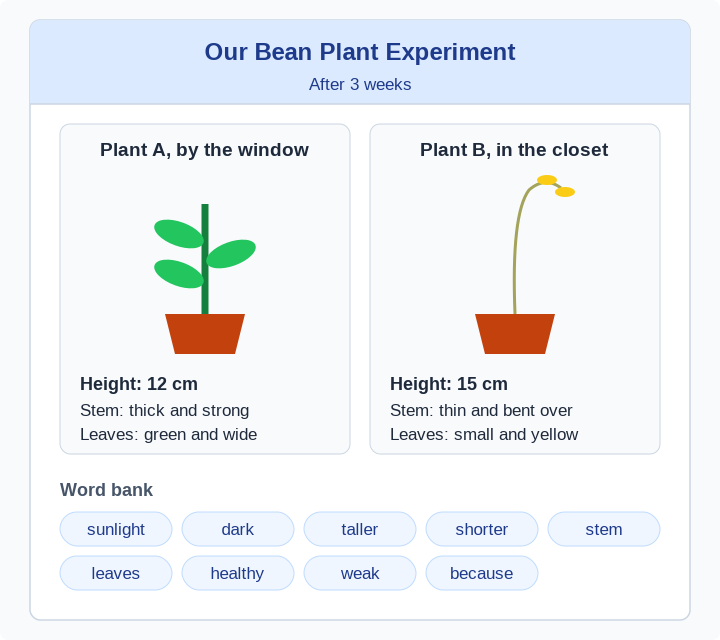
Picture description
Ms. Johnson's class planted two bean seeds in the same kind of soil. They gave both plants the same amount of water every day.
They put Plant A by a sunny window. They put Plant B in a dark closet. After 3 weeks, they measured and observed both plants.
Plant A (window): 12 cm tall. Stem: thick and strong. Leaves: green and wide.
Plant B (closet): 15 cm tall. Stem: thin and bent over. Leaves: small and yellow.
Word bank: sunlight, dark, taller, shorter, stem, leaves, healthy, weak, because
Read about the experiment and look at the chart. Use the word bank if it helps. Write at least five sentences.
Your class did a science experiment with two bean plants. Write a short report for the class science notebook. In your report: - tell what the class did - tell how Plant A and Plant B are different - tell which plant is healthier and why
Scoring rubric
| Level | What it looks like |
|---|---|
| 7: Fully developed |
|
| 6: Well developed |
|
| 5: Developed |
|
| 4: Expanding |
|
| 3: Emerging |
|
| 2: Beginning |
|
| 1: Starting |
|
A strong sample response
Our class put two bean plants in different places. Plant A was by the window with sunlight. Plant B was in the dark closet. We give them the same water.
After 3 weeks Plant B is taller, it is 15 cm and Plant A is 12 cm. But Plant B stem is thin and it is bent. The leaves are small and yellow. Plant A has a strong stem and green leaves.
I think Plant A is more healthy because it have sunlight. Plant B is tall but it is weak. Plants need sunlight to grow good.
This response sits around level 4 (Expanding), the top of what Tier A aims for. It covers all three bullets in order, compares the plants with "but" and "because," and uses specific words from the chart and word bank (stem, leaves, sunlight, weak). Errors such as "we give" for "we gave," "it have," "more healthy" and "grow good" are typical at this level and don't block meaning.
What to look for
- Check that the student covers all three bullets: what the class did, how the plants differ, and which is healthier.
- The tricky part is that Plant B is taller but less healthy. A student who explains that with "but" is thinking like a scientist.
- Words from the word bank are there to help; using them is fine and expected at Tier A.
- A blank, copied, off-topic or non-English response can't be placed on this rubric; note that instead of choosing a level.
Prompt 2: Tier A tasks
Suggested time: about 15 minutes
Look at the picture.
Language Arts: The Torn Bag

Picture description
An older man with a cane stands on the steps of an apartment building. The bottom of his grocery bag has torn open. Oranges and a loaf of bread are falling out and landing on the steps.
A girl with a backpack is running over to help. A younger boy is picking up oranges from the sidewalk.
Word bank: groceries, bag, oranges, steps, neighbor, help, carry, thank you, first, then, finally
Look at the picture. Use the word bank if it helps. Write at least five sentences.
Write a story about what happens in the picture. In your story: - tell what happens first - tell how the girl and the boy help - tell how the story ends
Scoring rubric
| Level | What it looks like |
|---|---|
| 7: Fully developed |
|
| 6: Well developed |
|
| 5: Developed |
|
| 4: Expanding |
|
| 3: Emerging |
|
| 2: Beginning |
|
| 1: Starting |
|
A strong sample response
One day Ana was walking home from school. She saw her neighbor Mr. Watson on the steps. He had a big bag of groceries. Then the bag broke and the oranges fall down the steps.
Ana run to help him. Her little brother Leo pick up the oranges on the sidewalk. Ana got the bread and she carry the bag for Mr. Watson because he have a cane.
Finally they put all the food in his kitchen. Mr. Watson said "Thank you so much, you are good neighbors." Ana and Leo felt happy.
This story is around level 4 (Expanding) for Tier A. It narrates in order with time words (one day, then, finally), names the characters, adds a reason with "because," and ends with dialogue and a feeling. Verb-tense slips (fall, run, pick, carry, have) are common at this level and the meaning stays clear.
What to look for
- Look for a beginning, middle and end, with words like first, then and finally.
- Giving the characters names and adding a line of dialogue are signs the student is moving beyond describing the picture into telling a story.
- Past tense is the main grammar target. Point out one or two verbs to fix rather than every error.
- A blank, copied, off-topic or non-English response can't be placed on this rubric; note that instead of choosing a level.
Prompt 3: Tier B/C tasks
Suggested time: about 30 minutes
Read about the two people.
Language Arts and Social Studies: Who Should Be on the Mural?
The town of Millbrook is painting a large mural on the wall of its new community center. The mural will honor one person from the town's history. The town council has asked students to help choose between two people.
Rosa Delgado (1931–2010) Rosa Delgado came to Millbrook in 1956 and worked as a nurse at the county hospital. In 1974, she noticed that many farm workers and their families could not afford to see a doctor. She opened a free clinic in the basement of a church, at first on Saturday mornings only. Over the next thirty years, the clinic grew into the Millbrook Community Health Center, which today serves about 8,000 patients a year, whether or not they can pay.
Walter Dixon (1922–2004) Walter Dixon grew up in Millbrook and served as a pilot in World War II. When he came home, he was refused a job at the local airfield because he was Black. Instead, he started his own flight school in a rented field outside town. Over forty years, he trained more than 600 pilots, many of them young people who could not afford lessons elsewhere. In 1965, he was elected the first Black member of the Millbrook school board, where he worked to open new schools in growing neighborhoods.
Read about the two people. Then write a letter of several paragraphs.
Write a letter to the Millbrook Town Council. Argue for which person should be honored on the community center mural: Rosa Delgado or Walter Dixon. In your letter: - state your choice clearly - give at least two reasons, using details from both profiles - explain why your choice fits a community center in particular - respond to people who would choose the other person
Scoring rubric
| Level | What it looks like |
|---|---|
| 7: Fully developed |
|
| 6: Well developed |
|
| 5: Developed |
|
| 4: Expanding |
|
| 3: Emerging |
|
| 2: Beginning |
|
| 1: Starting |
|
A strong sample response
Dear Members of the Millbrook Town Council,
Thank you for asking students to help choose the person for the new community center mural. Both Rosa Delgado and Walter Dixon made Millbrook a better place, but I believe Rosa Delgado is the best choice, because her work still serves our community every single day.
First, Rosa Delgado saw a problem that others ignored and did something about it. In 1974, many farm workers could not afford a doctor. Instead of waiting for someone else to help, she opened a free clinic in a church basement, even though it was only open on Saturday mornings at first. That shows the kind of courage and generosity a mural should celebrate.
Second, her impact has lasted and grown. The small clinic became the Millbrook Community Health Center, which now treats about 8,000 patients a year whether or not they can pay. Most residents have either been there themselves or know someone who has. A mural of Rosa Delgado would honor something that people in town can still see and use.
Most importantly, she fits a community center in particular. A community center is supposed to be a place open to everyone, regardless of money or background, and that is exactly what her clinic has always been.
Some people will argue that Walter Dixon deserves the honor more, and I understand why. He faced racism when he was refused a job, and he responded by training more than 600 pilots and serving on the school board. His story is inspiring. However, his flight school no longer exists, while Rosa Delgado's clinic is still open. Perhaps the town could name the school board meeting room or a new school after Mr. Dixon, so that both leaders are remembered.
For these reasons, I urge you to choose Rosa Delgado for the mural.
Sincerely,
Nadia Romero, Grade 8
This letter reaches level 7 (Fully developed). It follows letter conventions, states a clear claim, supports it with specific evidence from both profiles, explains why the choice suits a community center, and answers the opposing view respectfully with a concession and a compromise. Transitions (first, second, most importantly, however, for these reasons) tie the paragraphs together, and sentences are varied and controlled. It joins Language Arts (argument) with Social Studies (local history and civic decision-making).
What to look for
- Either person is a fair choice. Judge how well the student argues, not whom they pick.
- Check all four bullets. The fourth, responding to the other side, is the one most often skipped, and it is a big part of what lifts an argument to the top levels.
- Strong letters use exact details: years, numbers and actions from the profiles, rather than general praise like "she was nice."
- Look at letter form: a greeting, a clear opening, body paragraphs and a closing. A blank, copied, off-topic or non-English response can't be placed on this rubric; note that instead of choosing a level.
Prompt 4: Tier B/C tasks
Suggested time: about 30 minutes
Read the information and study the chart.
Mathematics and Science: Should Lakeview Switch to LED Lights?
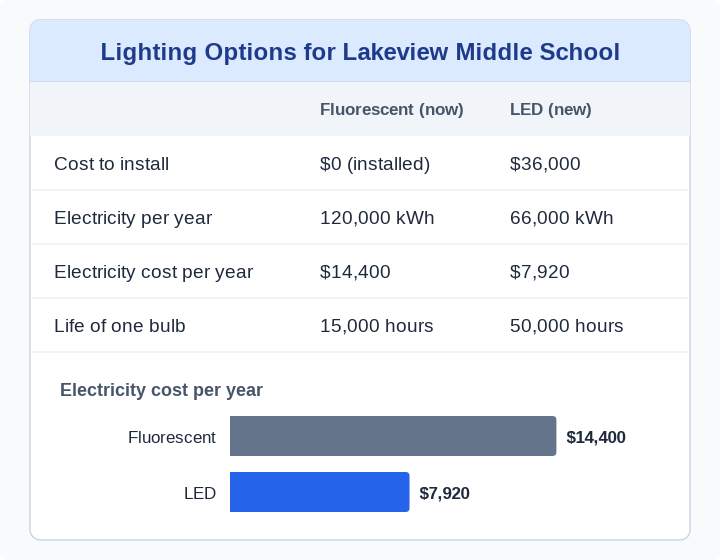
Picture description
Lakeview Middle School uses fluorescent tube lights in its classrooms. The school board is deciding whether to replace them with LED lights.
Fluorescent and LED lights both turn electrical energy into light, but neither is perfectly efficient. Some of the energy is always changed into heat instead. LED lights waste less energy as heat, so they need less electricity to make the same amount of light.
Current fluorescent lights: install cost $0 (already installed). Electricity per year: 120,000 kilowatt-hours. Electricity cost per year: $14,400. Bulb life: about 15,000 hours.
New LED lights: install cost $36,000. Electricity per year: 66,000 kilowatt-hours. Electricity cost per year: $7,920. Bulb life: about 50,000 hours.
Read the information and study the chart. Then write a report of several paragraphs.
The school board has asked students to explain the information and give a recommendation. Write a report that answers the question: Should Lakeview switch to LED lights? In your report: - explain the science of why LED lights use less electricity - use numbers from the chart to compare the two options, including how many years it would take for the savings to pay for the new lights - give a recommendation and explain your reasoning
Scoring rubric
| Level | What it looks like |
|---|---|
| 7: Fully developed |
|
| 6: Well developed |
|
| 5: Developed |
|
| 4: Expanding |
|
| 3: Emerging |
|
| 2: Beginning |
|
| 1: Starting |
|
A strong sample response
Should Lakeview Switch to LED Lights?
The school board is deciding whether to replace the fluorescent lights in our classrooms with LED lights. After studying the information, I recommend making the switch, because the LED lights would pay for themselves in about five and a half years and keep saving money after that.
To understand why LEDs cost less to run, it helps to know what happens inside a light. Every light turns electrical energy into light energy, but some of the energy is always lost as heat. Fluorescent tubes waste more energy this way than LEDs do. As a result, an LED needs less electricity to produce the same amount of light, which is why the chart shows the LED option using only 66,000 kilowatt-hours a year instead of 120,000.
The numbers show that this difference matters. Right now, the school spends $14,400 a year on electricity for lighting. With LEDs, that cost would drop to $7,920, a savings of $6,480 every year. The new lights cost $36,000 to install, so I divided $36,000 by $6,480 to find the payback time, which is about 5.6 years. In other words, by the middle of the sixth year, the savings would equal the cost of the lights.
There is a second advantage the chart points out. An LED bulb lasts about 50,000 hours, more than three times as long as a fluorescent bulb, so the custodians would replace bulbs far less often. Although the chart does not give the cost of replacement bulbs, this would most likely save even more money and time.
The main argument against switching is the large up-front cost. Spending $36,000 at once is difficult for a school budget. However, since the lights would keep working for many years after the payback point, the school would come out ahead in the long run, and it would use less energy, which is better for the environment. For these reasons, I recommend that Lakeview switch to LED lights.
This report reaches level 7 (Fully developed). It integrates Science (energy transformation and efficiency) with Mathematics (finding yearly savings and a payback period by division) and uses the numbers accurately. It is organized with an introduction, a paragraph for each bullet, a counterargument and a conclusion, and it uses precise technical vocabulary (kilowatt-hours, energy, efficiency, payback) and cause-and-effect language (as a result, which is why, in other words).
What to look for
- Check the math: yearly savings of $14,400 minus $7,920 is $6,480, and $36,000 divided by $6,480 is about 5.6 years.
- The science part should explain that both kinds of lights lose some energy as heat, and LEDs lose less. A student who only says "LEDs are better" has not explained.
- A recommendation either way can score well if the reasoning uses the data. A student could argue for waiting because of the up-front cost.
- Look for words that join ideas across paragraphs, such as "as a result," "in other words" and "however." A blank, copied, off-topic or non-English response can't be placed on this rubric; note that instead of choosing a level.
Unofficial practice. This site is not affiliated with, endorsed by, or connected to WIDA, the Wisconsin Center for Education Research, or the Board of Regents of the University of Wisconsin System. WIDA and WIDA ACCESS are trademarks of the Board of Regents of the University of Wisconsin System. Every question here is original practice material written to match the published test design.