WIDA speaking practice for 6th, 7th and 8th grade
Printable version. Original practice written to match the published WIDA format, not questions from the official test.
Speaking prompts
On the real test these are scored by a trained person against a rubric. The rubric and a sample response follow each prompt.
Prompt 1: Pre-A tier tasks
Suggested time: about 1 minutes
Model answer: read this aloud first
Listen to the model student answer a similar question first.
Model answer
Transcript for the adult to read aloud. The student listens and does not read it.
Ms. Jenkins: Look at this picture of a kitchen. Name two things you see.
Daniel: A table. And a cat.
The student's own task
Look at the picture.
Social and Instructional: The Bus Stop
Picture description
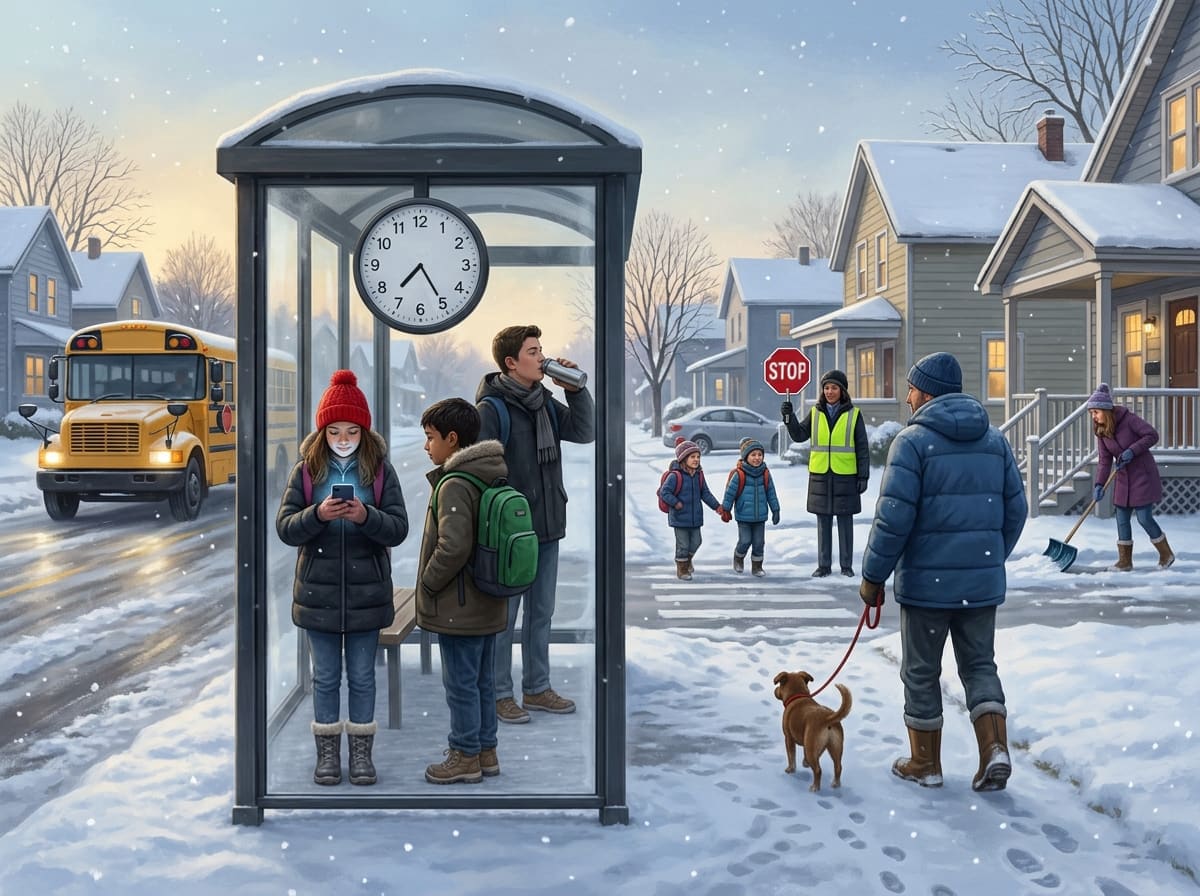
The picture shows a snowy morning on a neighborhood street. Snow is falling, and a yellow school bus is coming down the street.
Three middle school students wait in a bus shelter. A girl in a red hat looks at her phone. A boy has a green backpack. A tall boy drinks from a thermos. A clock on the shelter says 7:25.
On the sidewalk, a man in a blue coat walks a small brown dog. A crossing guard in a yellow vest holds up a stop sign while two younger children cross the street.
In front of a house, a woman shovels snow at the bottom of her steps.
Listen to the model student first. Then press Record and answer.
Look at the picture of the bus stop. Name two things you see.
Scoring rubric
| Level | What it looks like |
|---|---|
| 4: Exemplary |
|
| 3: Strong |
|
| 2: Adequate |
|
| 1: Attempted |
|
A strong sample response
A bus. Snow. A dog.
This answer is at the Pre-A target, proficiency level 1: single English words that name things in the picture. Naming two or more things, as the model student does, fully answers the task.
What to look for
- At this level, single words are a complete answer. Don't push for full sentences.
- If the student is silent, point to the bus and ask "What is this?" to show what kind of answer fits.
- Words for nearby things, such as "hat," "bag" or "snow," all count.
Prompt 2: Pre-A tier tasks
Suggested time: about 1 minutes
Model answer: read this aloud first
Listen to the model student answer a similar question first.
Model answer
Transcript for the adult to read aloud. The student listens and does not read it.
Ms. Jenkins: This picture shows a beach. What is the weather like?
Daniel: Sunny. It is hot.
The student's own task
Look at the picture.
Social and Instructional: The Bus Stop
Picture description
The picture shows a snowy morning on a neighborhood street. Snow is falling, and a yellow school bus is coming down the street.
Three middle school students wait in a bus shelter. A girl in a red hat looks at her phone. A boy has a green backpack. A tall boy drinks from a thermos. A clock on the shelter says 7:25.
On the sidewalk, a man in a blue coat walks a small brown dog. A crossing guard in a yellow vest holds up a stop sign while two younger children cross the street.
In front of a house, a woman shovels snow at the bottom of her steps.
Listen to the model student first. Then press Record and answer.
Look at the picture again. What is the weather like?
Scoring rubric
| Level | What it looks like |
|---|---|
| 4: Exemplary |
|
| 3: Strong |
|
| 2: Adequate |
|
| 1: Attempted |
|
A strong sample response
Snow. It is cold.
A proficiency level 1 answer: a weather word plus a short memorized pattern ("It is cold"), matching the model student's answer about the beach.
What to look for
- "Snow," "snowing," "cold" and "winter" are all correct.
- If the student gestures shivering, say the word for them and invite them to repeat it.
- Two English words is a strong answer at this level.
Prompt 3: Pre-A tier tasks
Suggested time: about 1 minutes
Model answer: read this aloud first
Listen to the model student answer a similar question first.
Model answer
Transcript for the adult to read aloud. The student listens and does not read it.
Ms. Jenkins: In this picture of a park, a woman is sitting on a bench. What is she doing?
Daniel: She is reading. A book.
The student's own task
Look at the picture.
Social and Instructional: The Bus Stop
Picture description
The picture shows a snowy morning on a neighborhood street. Snow is falling, and a yellow school bus is coming down the street.
Three middle school students wait in a bus shelter. A girl in a red hat looks at her phone. A boy has a green backpack. A tall boy drinks from a thermos. A clock on the shelter says 7:25.
On the sidewalk, a man in a blue coat walks a small brown dog. A crossing guard in a yellow vest holds up a stop sign while two younger children cross the street.
In front of a house, a woman shovels snow at the bottom of her steps.
Listen to the model student first. Then press Record and answer.
Find the man with the small brown dog. What is he doing?
Scoring rubric
| Level | What it looks like |
|---|---|
| 4: Exemplary |
|
| 3: Strong |
|
| 2: Adequate |
|
| 1: Attempted |
|
A strong sample response
He is walking. Walking the dog.
This answer matches the model student at level 1: a short action phrase with a familiar verb, repeated to add the object.
What to look for
- A single verb such as "walking" answers the question. A short phrase like "walk dog" is also fine.
- Listen for an action word, not just the name of the animal.
- If needed, mime walking a dog and ask again.
Prompt 4: Tier A tasks
Suggested time: about 2 minutes
Model answer: read this aloud first
Listen to the model student answer a similar question first.
Model answer
Transcript for the adult to read aloud. The student listens and does not read it.
Ms. Jenkins: These pictures show a boy giving his dog a bath. Tell what happens first, next and last.
Daniel: First, the dog is very muddy, so the boy puts him in the tub.
Daniel: Next, he washes the dog with soap and water. The dog shakes and the boy gets wet too.
Daniel: Last, he dries the dog with a big towel. The dog is clean and happy.
The student's own task
Look at the four pictures. They tell a story in order.
Language Arts: Fixing a Flat Tire
Picture description
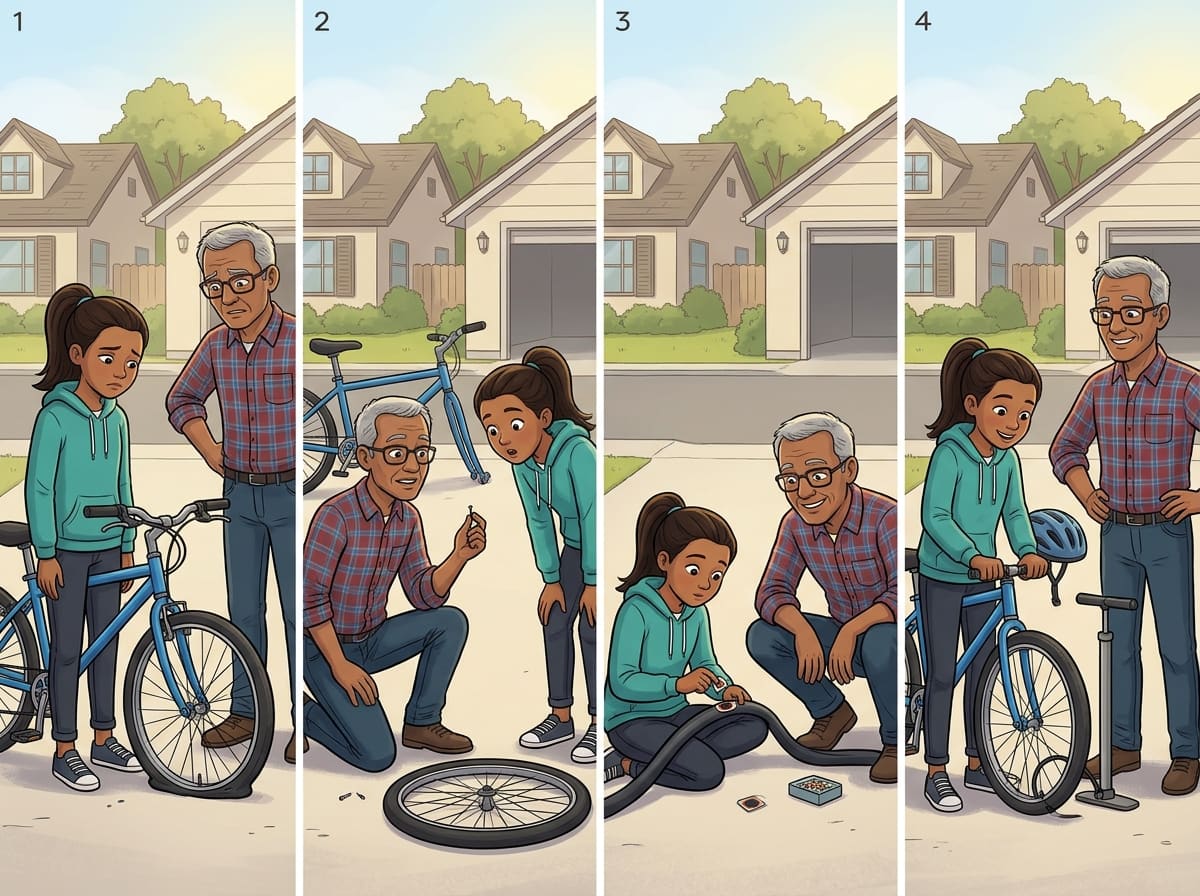
Picture 1: A girl looks sadly at her bike in the driveway. The front tire is flat.
Picture 2: She and her grandfather have taken the front wheel off the bike. He holds up a small nail they found in the tire.
Picture 3: She presses a patch onto the tube inside the tire. Her grandfather watches.
Picture 4: The tire is full of air again. The pump stands next to the bike. She smiles and gets ready to ride.
Listen to the model student first. Then press Record and answer.
Look at the four pictures. Tell the story of how the girl fixes her bike. Tell what happens first, next, then and last.
Scoring rubric
| Level | What it looks like |
|---|---|
| 4: Exemplary |
|
| 3: Strong |
|
| 2: Adequate |
|
| 1: Attempted |
|
A strong sample response
First, the girl wants to ride her bike, but the front tire is flat. She is sad.
Next, she and her grandpa take off the tire. They find a nail in it. That is why the tire is flat.
Then she puts a patch on the tube. Her grandpa is watching her.
Last, the tire is full of air again, and the pump is next to the bike. Now the bike is fixed and she is happy, so she can go ride.
This retelling sits at the Tier A target, around proficiency level 3: it follows the pictures in order with sequence words (first, next, then, last), adds simple reasons with "that is why" and "so," and uses everyday vocabulary from the pictures such as tire, nail, patch and pump. It is a little fuller than the model student's answer about the dog bath.
What to look for
- Check that the student tells all four parts in order. Sequence words are the easiest way to do this.
- Words like "patch," "tube" and "pump" are a bonus; "fix the tire" is fine at this level.
- Present tense ("she fixes") and past tense ("she fixed") are both acceptable as long as the student stays consistent.
- A student who only names objects ("bike, nail, pump") is answering at Pre-A level; prompt with "What does she do next?"
Prompt 5: Tier A tasks
Suggested time: about 2 minutes
Model answer: read this aloud first
Listen to the model student answer a similar question first.
Model answer
Transcript for the adult to read aloud. The student listens and does not read it.
Ms. Jenkins: Our library got a new 3D printer. The librarian told us it can make small plastic objects, like gears and phone stands, from a design on the computer.
Ms. Jenkins: Daniel, tell two things the printer can make, and tell why students use it.
Daniel: The 3D printer can make gears and phone stands. It makes them from plastic.
Daniel: Students use it because they can design something on the computer and then print it. So they can test their idea for real.
The student's own task
Listen to the teacher talk about the school's weather station.
Science: Our Weather Station
Transcript for the adult to read aloud. The student listens and does not read it.
Ms. Jenkins: This month, our school put a small weather station on the roof. It has three main tools.
Ms. Jenkins: A thermometer measures the temperature. A rain gauge collects rain, so we can measure how much falls.
Ms. Jenkins: And the tool with little spinning cups is an anemometer. It measures how fast the wind is blowing.
Ms. Jenkins: Every morning, a different student reads the numbers and writes them on our class chart. At the end of the year, we will use the data to see how the weather changed from fall to spring.
Listen to the model student first. Then press Record and answer.
You listened to a talk about the school's weather station. Tell two things the weather station measures. Then tell why the class collects the data.
Scoring rubric
| Level | What it looks like |
|---|---|
| 4: Exemplary |
|
| 3: Strong |
|
| 2: Adequate |
|
| 1: Attempted |
|
A strong sample response
The weather station measures the temperature with a thermometer. It also measures the wind, how fast it blows, with the anemometer. And it measures rain too.
The class collects the data because at the end of the year they want to see how the weather changes from fall to spring. A student writes the numbers every morning on the chart.
This answer is at the upper end of Tier A, around proficiency level 3 moving toward 4. It names more than two measurements with the matching tools, gives the reason with "because," and adds a detail about the daily routine. Small slips ("how fast it blows" tacked on) do not get in the way of meaning.
What to look for
- The task has two parts: two things measured, and why the class collects data. Check both.
- Accept "heat" or "how hot it is" for temperature. "Anemometer" is a bonus word, not a requirement.
- Listen for "because" or "so" to connect the reason. That is the step from level 1 toward level 3.
- Replay the talk if the student needs it; on the real test, students hear it once, so practice listening for the key words.
Prompt 6: Tier A tasks
Suggested time: about 2 minutes
Model answer: read this aloud first
Listen to the model student answer a similar question first.
Model answer
Transcript for the adult to read aloud. The student listens and does not read it.
Ms. Jenkins: Look at this picture of the school cafeteria at lunchtime. Tell what the people are doing.
Daniel: There are many students in the cafeteria. Some students are sitting at a long table and eating. One boy is carrying a tray with pizza and milk.
Daniel: A lunch worker is giving food to a girl. Next to the door, two students are throwing trash in the recycling bins. It is very busy and loud.
The student's own task
Look at the picture.
Social and Instructional: The Bus Stop
Picture description
The picture shows a snowy morning on a neighborhood street. Snow is falling, and a yellow school bus is coming down the street.
Three middle school students wait in a bus shelter. A girl in a red hat looks at her phone. A boy has a green backpack. A tall boy drinks from a thermos. A clock on the shelter says 7:25.
On the sidewalk, a man in a blue coat walks a small brown dog. A crossing guard in a yellow vest holds up a stop sign while two younger children cross the street.
In front of a house, a woman shovels snow at the bottom of her steps.
Listen to the model student first. Then press Record and answer.
Look at the picture of the bus stop. Describe what the people in the neighborhood are doing this morning. Tell about at least three people.
Scoring rubric
| Level | What it looks like |
|---|---|
| 4: Exemplary |
|
| 3: Strong |
|
| 2: Adequate |
|
| 1: Attempted |
|
A strong sample response
In the picture it is a snowy morning and people are getting ready for the day. Three students are waiting for the school bus at the bus stop. One girl is looking at her phone and one boy has a green backpack.
There is a crossing guard in a yellow vest. She is holding a stop sign so the little kids can cross the street safe.
A man is walking his dog on the sidewalk, and a woman is shoveling the snow in front of her house. Everybody is busy because it is morning.
This description sits around proficiency levels 3 to 4, the top of Tier A. It goes well beyond three people, uses present progressive verbs correctly ("is holding," "is shoveling"), gives a purpose with "so," and wraps up with a reason. The small error "cross the street safe" is typical at this level and does not affect meaning.
What to look for
- This is the same picture as the Pre-A tasks, but now the student should speak in sentences about what people are doing.
- Count the people described and listen for action verbs ending in -ing.
- Words like "crossing guard" and "shovel" are specific vocabulary; "a woman with a sign" or "cleaning the snow" still communicates.
- Encourage linking words such as "and," "so" and "because" to join ideas instead of a list.
Prompt 7: Tier B/C tasks
Suggested time: about 3 minutes
Model answer: read this aloud first
Listen to the model student answer a similar question first.
Model answer
Transcript for the adult to read aloud. The student listens and does not read it.
Ms. Jenkins: On a sunny afternoon, the black asphalt on the basketball court feels much hotter than the light gray sidewalk next to it. Explain why.
Daniel: The main reason is that dark and light surfaces treat sunlight differently. Sunlight carries energy, and when it hits a surface, some of that energy is reflected and some is absorbed.
Daniel: A light-colored surface, like the gray sidewalk, reflects a lot of the light back, so it doesn't heat up very much. Black asphalt, on the other hand, absorbs most of the light, and that absorbed energy turns into heat.
Daniel: So, after a few hours in the sun, the asphalt has taken in much more energy than the sidewalk, and that's why it can burn your hand while the sidewalk only feels warm. It's also why people wear light-colored clothes in summer.
The student's own task
Listen to the teacher explain a plant experiment.
Science: Plants That Bend Toward Light
Transcript for the adult to read aloud. The student listens and does not read it.
Ms. Jenkins: Last week, we put a bean plant on the windowsill, with sunlight coming from only one side. Today, its stem is bending toward the window.
Ms. Jenkins: This response is called phototropism. "Photo" means light, and "tropism" means turning.
Ms. Jenkins: Here is how it works. Plants make a chemical messenger called auxin. When light comes from one side, auxin collects on the shady side of the stem.
Ms. Jenkins: Auxin makes the cells on that shady side grow longer. When one side of the stem grows longer than the other, the stem curves, and the leaves end up facing the light.
Ms. Jenkins: That matters because leaves need light to make food through photosynthesis.
Listen to the model student first. Then press Record and answer.
You heard a lesson about a bean plant on a windowsill. Explain why the plant's stem bends toward the window. Use information from the lesson, and tell why this helps the plant.
Scoring rubric
| Level | What it looks like |
|---|---|
| 4: Exemplary |
|
| 3: Strong |
|
| 2: Adequate |
|
| 1: Attempted |
|
A strong sample response
The plant bends toward the window because of something called phototropism, which basically means turning toward light.
What happens is that the plant makes a chemical called auxin. When the sunlight only comes from one side, the auxin moves to the shady side of the stem, the side away from the window. The auxin makes the cells on that side grow longer. So now one side of the stem is longer than the other side, and that makes the stem curve toward the light.
This is helpful for the plant because the leaves need sunlight to do photosynthesis, which is how a plant makes its food. If the leaves are facing the window, they get more light, so the plant can make more food and grow better.
This explanation is at the B/C target, around proficiency level 5. It explains a cause-and-effect process in a logical order, uses technical words from the lesson (phototropism, auxin, photosynthesis) accurately, and connects ideas with "because," "so" and "which." It matches the model answer about asphalt in depth and organization.
What to look for
- The key link is the chain: light from one side, auxin on the shady side, longer cells, stem curves. Check whether the student gets the order right.
- A common mix-up is saying auxin goes to the sunny side. Ask "Which side grows longer?" to check understanding.
- Listen for academic connectors such as "as a result," "that's why" and "which means."
- The task has a second part: why bending helps the plant. Many students forget it.
Prompt 8: Tier B/C tasks
Suggested time: about 3 minutes
Model answer: read this aloud first
Listen to the model student answer a similar question first.
Model answer
Transcript for the adult to read aloud. The student listens and does not read it.
Ms. Jenkins: Some people think middle schools should switch to a four-day school week, with longer school days. Do you agree or disagree? Give reasons.
Daniel: I disagree with a four-day week, even though I know a lot of students would love a three-day weekend.
Daniel: My first reason is that longer days would be really hard for younger students. If school ends at five o'clock, kids are tired by the last class, and they probably won't learn as much.
Daniel: Second, a lot of families would have a problem on the fifth day. Parents still have to work on Fridays, so they would need to pay for childcare or leave kids home alone.
Daniel: Some people say a four-day week saves the school money on buses and heating. That might be true, but I think the cost for families is bigger than the savings for the school. So I would keep the five-day week.
The student's own task
Read the town notice.
Social Studies: The Empty Lot on Elm Street
Town of Millbrook: Public Input Needed
The town owns an empty lot on Elm Street, next to the middle school. The town council has $250,000 to spend on it and is considering two plans.
Plan 1: A skate park with ramps, benches and lights, open until 9 p.m.
Plan 2: A 60-space parking lot for the shops on Elm Street and for school events.
Residents of all ages may share their opinions at the council meeting on March 3.
Listen to the model student first. Then press Record and answer.
Read the town notice. The town council wants to hear from students. Which plan do you think the town should choose for the empty lot: the skate park or the parking lot? Give at least two reasons, and respond to one reason someone might give for the other plan.
Scoring rubric
| Level | What it looks like |
|---|---|
| 4: Exemplary |
|
| 3: Strong |
|
| 2: Adequate |
|
| 1: Attempted |
|
A strong sample response
I think the town should choose Plan 1, the skate park.
My first reason is that kids in Millbrook don't have many safe places to go after school. The lot is right next to the middle school, so students could walk there, and it's open until nine, which gives teens something to do in the evening instead of just sitting at home on their phones.
My second reason is that a skate park could actually help the shops. If kids and their families are hanging out on Elm Street, they'll probably stop and buy snacks or food.
Some people will say the shops need the parking lot because customers can't find a spot. I understand that, but the parking is mostly a problem during school events, which only happen a few times a month. The town could let people park at the school lot during those times. So overall, I believe the skate park would help more people, more often.
This argument is at proficiency level 5, the top of the B/C target. It states a clear position, supports it with two developed reasons tied to details from the notice (location, hours), and addresses a counterargument with a concession ("I understand that, but...") and a solution. Varied sentences and linking words (my first reason, so overall, which) make it cohesive.
What to look for
- Look for three parts: a clear opinion, at least two reasons, and a response to the other side.
- Either plan is acceptable. Judge the reasoning, not the choice.
- Strong answers use details from the notice, such as the location next to the school or the 9 p.m. hours.
- If the student stops after one reason, ask "What else?" Practice adding a counterargument with "Some people think... but..."
Prompt 9: Tier B/C tasks
Suggested time: about 3 minutes
Model answer: read this aloud first
Listen to the model student answer a similar question first.
Model answer
Transcript for the adult to read aloud. The student listens and does not read it.
Ms. Jenkins: Your class can rent a bus for a trip from Company A or Company B. Company A charges a flat $400. Company B charges $150 plus $5 per student, and 40 students are going. Compare the two and tell which you would choose.
Daniel: To compare them, I need to find the total for Company B. Forty students times five dollars is two hundred, and two hundred plus one-fifty is three hundred fifty dollars.
Daniel: So Company B costs three-fifty and Company A costs four hundred, which means Company B is fifty dollars cheaper for our class.
Daniel: However, Company B's price depends on the number of students. If more than fifty students went, Company B would actually cost more than Company A. Since we only have forty, I would choose Company B and use the fifty dollars we save for snacks.
The student's own task
Look at the chart.
Mathematics: Two Ways to Raise Money
Picture description
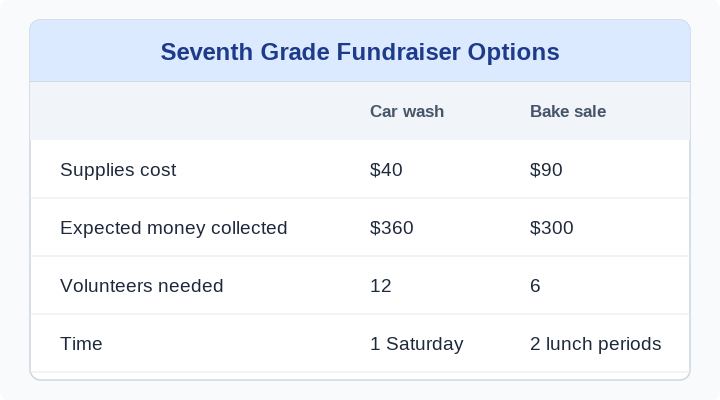
Seventh Grade Fundraiser Options
Car wash: supplies cost $40. Expected money collected: $360. Volunteers needed: 12. Time: 1 Saturday.
Bake sale: supplies cost $90. Expected money collected: $300. Volunteers needed: 6. Time: 2 lunch periods.
Listen to the model student first. Then press Record and answer.
Look at the chart. Your class must choose one fundraiser. Compare the car wash and the bake sale, using numbers from the chart. Then tell which one you would choose and why.
Scoring rubric
| Level | What it looks like |
|---|---|
| 4: Exemplary |
|
| 3: Strong |
|
| 2: Adequate |
|
| 1: Attempted |
|
A strong sample response
To compare them fairly, I think you have to look at profit, not just the money collected. For the car wash, we'd collect three hundred sixty dollars, but supplies cost forty, so the profit is three hundred twenty. For the bake sale, we'd collect three hundred and spend ninety, so the profit is only two hundred ten. That means the car wash makes a hundred and ten dollars more.
On the other hand, the bake sale is easier to organize. It only needs six volunteers instead of twelve, and it happens during lunch, so nobody has to give up a Saturday.
I would still choose the car wash, because the difference in profit is pretty big. If we can find twelve people, which shouldn't be hard in a whole grade, we earn a lot more for the same goal.
This comparison is at proficiency level 5, the top of the B/C target. The student calculates profit correctly, explains the math in words, weighs a non-money factor (volunteers and time) with "on the other hand," and gives a reasoned choice. Its structure matches the model student's bus comparison but applies it to new data.
What to look for
- Check the math: car wash profit $320, bake sale profit $210, a difference of $110.
- Strong answers notice that "money collected" is not the same as profit. If the student compares $360 and $300 only, ask "What about the supplies?"
- Listen for comparison language: "more than," "instead of," "on the other hand," "however."
- Either choice is fine if it is supported. A student who picks the bake sale because of volunteers or time is reasoning well.
Unofficial practice. This site is not affiliated with, endorsed by, or connected to WIDA, the Wisconsin Center for Education Research, or the Board of Regents of the University of Wisconsin System. WIDA and WIDA ACCESS are trademarks of the Board of Regents of the University of Wisconsin System. Every question here is original practice material written to match the published test design.