WIDA reading practice for 6th, 7th and 8th grade
Printable version. Original practice written to match the published WIDA format, not questions from the official test. The answer key, with an explanation for every answer, is at the end.
Questions
Level A folders
Read the notice. Then answer the questions.
Social and Instructional: Lost and Found
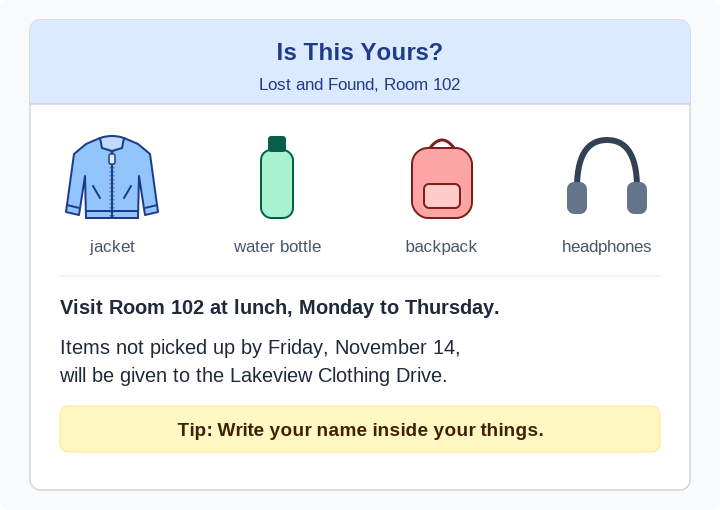
Picture description
Is This Yours? Lost and Found, Room 102
We have jackets, water bottles, a backpack and headphones.
Visit Room 102 at lunch, Monday to Thursday.
Items not picked up by Friday, November 14, will be given to the Lakeview Clothing Drive.
Tip: Write your name inside your things.
Choose the best answer.
1. Where can students find the lost items?
- A In the gym
- B In Room 102
- C In the main office
- D At the clothing drive
Choose the best answer.
2. What will happen to items that are not picked up by November 14?
- A They will be thrown away.
- B They will stay in Room 102.
- C They will be given away.
- D They will be sent home.
Choose the best answer.
3. Why does the notice tell students to write their name inside their things?
- A So lost things can be returned to them
- B So teachers can grade their work
- C So the clothing drive knows who gave them
- D So they can sell the things later
Read the two emails. Then answer the questions.
Social and Instructional: An Email to a Teacher
From: Darnell Dixon To: Ms. Ferraro Subject: Missing assignment
Dear Ms. Ferraro, I was absent on Monday and Tuesday because I had the flu. I missed the reading log that was due on Tuesday. Can I turn it in on Friday? I am feeling better now. Thank you, Darnell
From: Ms. Ferraro To: Darnell Dixon Subject: RE: Missing assignment
Hi Darnell, I'm glad you are feeling better. Yes, Friday is fine. You also missed a short quiz. You can take it in my room on Thursday before school, at 7:45. Ms. Ferraro
Choose the best answer.
4. Why did Darnell miss school?
- A He was on a trip.
- B He forgot the date.
- C His bus was late.
- D He was sick.
Choose the best answer.
5. What does Darnell ask Ms. Ferraro?
- A If he can take the quiz at home instead of at school
- B If he can turn in the reading log on Friday
- C If he can skip the reading log
- D If she can call his family
Choose the best answer.
6. When will Darnell take the quiz?
- A On Friday after school ends
- B On Tuesday during class
- C On Thursday before school
- D On Monday at lunch
Read the story. Then answer the questions.
Language Arts: The First Day at the Truck

Picture description
On Saturday, Emily helped at her uncle's food truck for the first time. The truck was parked on a busy street, and a long line of people was already waiting.
Emily's job was to take orders at the window. Her hands felt jittery, and she dropped the first order slip on the floor.
"Take a breath," Uncle Steve said. "Smile, listen, and write it down. That's all."
Emily tried again. By lunchtime, she was writing orders quickly and even making customers laugh. When the last bowl of noodles was sold, Uncle Steve gave her a high five. "Same time next Saturday?" he asked.
Choose the best answer.
7. Where does the story take place?
- A At a food truck on a busy street
- B In a school cafeteria
- C At a restaurant in a mall
- D In Uncle Steve's kitchen at his home
Choose the best answer.
8. The story says Emily's hands "felt jittery." What does jittery mean?
- A Cold
- B Strong
- C Nervous and shaky
- D Wet and dirty
Choose the best answer.
9. How does Emily change from the beginning to the end of the story?
- A She starts happy and ends angry at her uncle.
- B She starts nervous and ends confident.
- C She starts busy and ends bored.
- D She starts tired and ends sick.
Read the bar graph. Then answer the questions.
Mathematics: The Canned Food Drive
Picture description
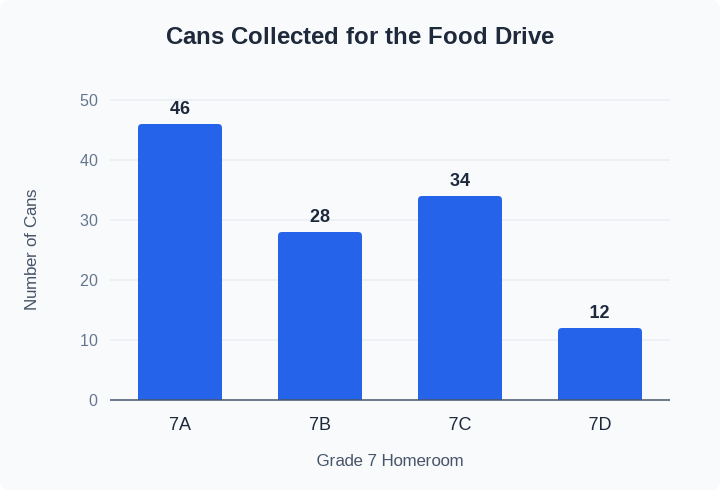
Ms. Henderson's math class counted the cans that each grade 7 homeroom brought in for the Lakeview Food Drive.
Homeroom 7A: 46 cans. Homeroom 7B: 28 cans. Homeroom 7C: 34 cans. Homeroom 7D: 12 cans.
Choose the best answer.
10. Which homeroom collected the fewest cans?
- A 7A
- B 7B
- C 7C
- D 7D
Choose the best answer.
11. How many cans did homeroom 7C collect?
- A 12
- B 34
- C 28
- D 46
Choose the best answer.
12. How many more cans did 7A collect than 7B?
- A 74
- B 12
- C 18
- D 22
Level B folders
Read the article and the diagram. Then answer the questions.
Science: How Wetlands Clean Water
Picture description
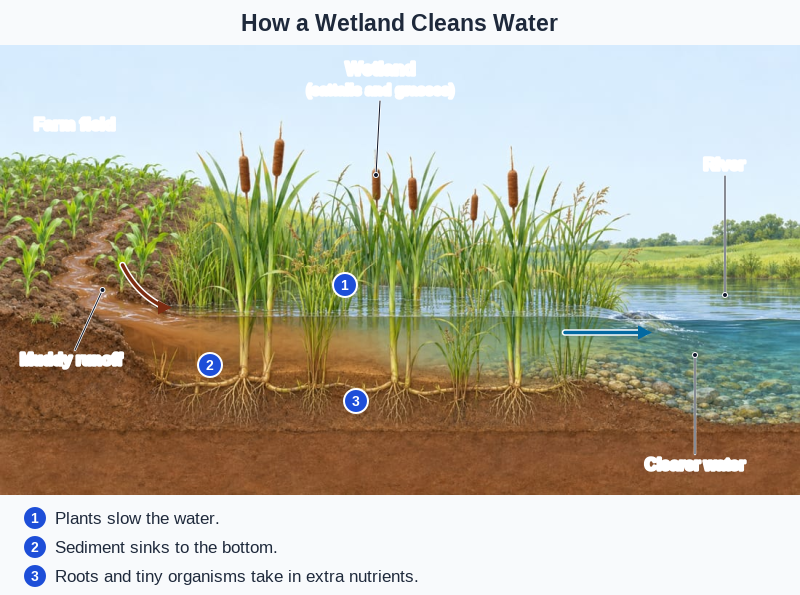
When rain falls on a farm field or a parking lot, it does not just soak into the ground. Much of it runs across the surface, picking up soil, fertilizer and other materials along the way. This runoff can make rivers and lakes muddy and unhealthy. Wetlands, such as marshes and swamps, help solve this problem.
First, wetland plants slow the water down. Thick stems of cattails and grasses act like a crowded hallway: the water has to squeeze between them, so it loses speed.
Next, because the water is moving slowly, sediment can settle out. Sediment is the soil, sand and tiny pieces of rock carried by moving water. In fast water, these pieces stay mixed in. In slow water, they sink to the bottom of the wetland.
Finally, plant roots and tiny organisms called microbes take in extra nutrients, such as the nitrogen in fertilizer. A small amount of nitrogen helps living things grow, but too much can cause huge blooms of algae that use up the oxygen fish need.
By the time the water leaves the wetland, it is often much cleaner than when it arrived. For this reason, some scientists call wetlands "the kidneys of the landscape." Today, many towns protect wetlands or even build new ones to help keep their water clean.
Choose the best answer.
13. What is the main idea of the article?
- A Farm fields use too much fertilizer on their crops.
- B Algae is harmful to all fish.
- C Wetlands help clean water in several steps.
- D Cattails are the tallest wetland plants.
Choose the best answer.
14. According to the article, why does sediment sink in a wetland?
- A The water there is moving slowly.
- B Microbes eat the sediment.
- C Wetland water is colder than river water.
- D Fertilizer makes the sediment heavier.
Choose the best answer.
15. Why do some scientists call wetlands "the kidneys of the landscape"?
- A Wetlands are shaped like kidneys.
- B Wetlands are found inside the body of the land.
- C Wetlands store water for dry seasons.
- D Wetlands filter harmful materials out of water.
Read the passage. Then answer the questions.
Social Studies: The Navajo Code Talkers
During World War II, the United States military faced a serious problem in the Pacific. Japanese forces were skilled at breaking American codes, so secret plans sent by radio could be discovered.
In 1942, the U.S. Marine Corps tried a new idea. It recruited 29 young Navajo men to create a code based on their own language. Navajo is a complex language. At the time, very few people outside the Navajo Nation could speak or understand it, and it was rarely written down.
The code talkers did more than speak Navajo over the radio. They invented code words for military terms that had no Navajo word. A submarine became besh-lo, which means "iron fish," and a fighter plane became da-he-tih-hi, or "hummingbird." Each code talker memorized hundreds of these terms, because a written list could be captured.
The code was fast and accurate. Code talkers could send a short message in about twenty seconds, a job that took a coding machine about half an hour. During the Battle of Iwo Jima in 1945, six code talkers sent more than 800 messages without an error. The code was never broken. In all, about 400 Navajo men served as code talkers.
After the war, the code talkers were told to keep their work secret, because the military thought it might need the code again. The program stayed classified until 1968. In 2001, the original 29 code talkers were awarded the Congressional Gold Medal, and the others who served received silver medals.
Today, the Navajo code talkers are honored as heroes. Their story also has a painful side. As children, many of them had been punished at boarding schools for speaking Navajo. The language they had been told to forget helped protect their country.
Choose the best answer.
16. What does the word "classified" mean in paragraph 5?
- A Sorted into groups
- B Kept secret by the government
- C Printed in newspapers
- D Given an award
Choose the best answer.
17. Why did the Marine Corps want a code based on the Navajo language?
- A Navajo soldiers were the only ones who could use radios.
- B The language was easy for anyone to learn quickly.
- C Very few people outside the Navajo Nation understood it.
- D All of the coding machines had been destroyed.
Choose the best answer.
18. What is the author's main purpose in the last paragraph?
- A To show that the code talkers' story is both proud and painful
- B To explain how the code words were invented
- C To persuade readers to learn the Navajo language
- D To describe what happened at the Battle of Iwo Jima
Read the opinion article from the school newspaper. Then answer the questions.
Language Arts: Keep the Library Open at Lunch
by Lauren Mendoza, Grade 8
This fall, our school library started closing during lunch so that the librarian could take her break. I understand that everyone needs a break. Still, I believe Lakeview should find a way to keep the library open at lunch, because many students depend on it.
First, the library is the only quiet place in the building at midday. The cafeteria is loud, and the hallways are crowded. Students who want to finish homework, read or study for a test have nowhere else to go.
Second, not every student has a computer or internet at home. Last year, the library's sign-in sheet showed that about forty students a day used the computers at lunch. For some of them, lunch was the only time to type an essay or check a grade.
Some people say there is no one available to watch the library. That is a fair point. However, there are solutions. Parent volunteers could take turns, or the librarian could take her break during a different period.
The library is more than a room full of books. It is a place where students can focus and get help. Let's work together to open its doors again at lunch.
Choose the best answer.
19. What is the writer's main claim?
- A The librarian should not take a break.
- B The school should keep the library open during lunch.
- C The cafeteria is too loud for students.
- D Every student at Lakeview should have a computer at home.
Choose the best answer.
20. Which detail from the article is the strongest evidence that students use the library at lunch?
- A "Students who want to finish homework, read or study for a test have nowhere else to go."
- B "I understand that everyone needs a break."
- C "Parent volunteers could take turns."
- D "About forty students a day used the computers at lunch."
Choose the best answer.
21. How does the writer respond to people who say no one is available to watch the library?
- A She says they are wrong and then ignores the problem.
- B She agrees the library should stay closed.
- C She admits it is a fair point and offers solutions.
- D She asks the principal to decide.
Level C folders
Read the passage and the table. Then answer the questions.
Mathematics: Building a Scale Model
Picture description
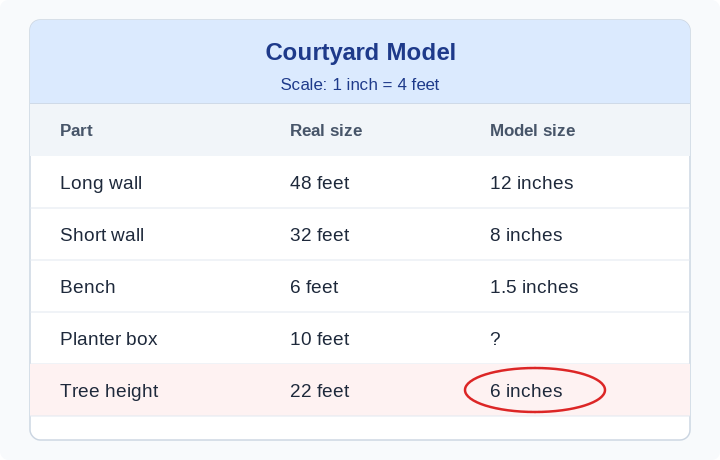
Mr. Collins's seventh graders were asked to design a new layout for the school courtyard. Before presenting their ideas to the principal, they decided to build a scale model, a small copy in which every part is reduced by the same amount.
The class chose a scale of 1 inch to 4 feet. This means that every 4 feet in the real courtyard would be shown as 1 inch on the model. A wall that is 48 feet long would therefore be 12 inches long on the model, because 48 divided by 4 equals 12.
A scale works because the relationship between real size and model size is proportional. In other words, the ratio stays the same for every part: if one object is twice as long as another in real life, it must also be twice as long on the model. If the ratio changes, the model will look stretched or squeezed, and the class will not be able to trust it when planning.
Shanice recorded the measurements in a table. When the group checked her work, they found that one entry did not follow the scale. A tree that is 22 feet tall had been listed as 6 inches tall. Eric pointed out that 6 inches would represent 24 feet, not 22. The correct model height was 5.5 inches.
The group also still needed to calculate the size of the planter box before they could start cutting cardboard.
Choose the best answer.
22. What does "proportional" mean as it is used in paragraph 3?
- A Every part is made from the same material.
- B Every part is the same size on the model.
- C The model is larger than the real courtyard.
- D Real sizes and model sizes keep the same ratio.
Choose the best answer.
23. Based on the scale, how long should the planter box be on the model?
- A 2.5 inches
- B 40 inches
- C 6 inches
- D 14 inches
Choose the best answer.
24. Why did the group decide the tree entry was a mistake?
- A A tree should not be included in a courtyard model.
- B Shanice measured the tree in inches instead of feet.
- C The tree was taller than the long wall.
- D Its model height did not match the scale.
Read the passage. Then answer the questions.
Science: The Trouble with Clear Water
In 1988, scientists found a small striped shellfish clinging to rocks in Lake St. Clair, between Michigan and Ontario. It was the zebra mussel, a species native to lakes and rivers in Eastern Europe and western Asia. Researchers believe it arrived in the ballast water of cargo ships, which take on water in one port for balance and release it in another.
Zebra mussels spread with astonishing speed. Within a decade, they had reached all five Great Lakes and the Mississippi River. Part of the reason is reproduction: a single female can release hundreds of thousands of eggs in a year. Another reason is that, in their new home, they had few natural predators to keep their numbers in check.
At first, some lakeshore residents were pleased. The mussels are filter feeders. Each one pulls in water, eats tiny floating organisms called plankton, and pushes the water back out. In many areas, lake water became noticeably clearer.
However, clear water was a sign of a problem, not a solution. Plankton is the base of the lake's food web. When mussels consume enormous amounts of it, less is left for young fish and for the small animals that fish depend on. In addition, clearer water lets sunlight reach deeper, which can encourage the growth of certain harmful algae along the bottom.
The mussels also cause expensive damage. They attach in thick layers to the inside of pipes that bring lake water to cities and power plants, slowing or blocking the flow. Removing them costs communities millions of dollars each year.
Today, ships entering the Great Lakes are required to manage their ballast water, and boaters are asked to clean, drain and dry their boats. Scientists agree that preventing a new invasion is far easier than controlling one after it begins.
Choose the best answer.
25. Which sentence best states the central idea of the article?
- A Zebra mussels make lake water clear, which helps fish find food.
- B Zebra mussels came from Europe and Asia on cargo ships.
- C Cleaning boats is the best way to remove zebra mussels from pipes.
- D An invasive species can harm an ecosystem in ways that are not obvious at first.
Choose the best answer.
26. According to the article, why did the clearer water harm the lake's food web?
- A The mussels ate plankton that young fish need.
- B Sunlight made the water too warm for fish.
- C Clear water made it easier for birds to catch fish.
- D The mussels released chemicals into the water.
Choose the best answer.
27. What is the purpose of paragraph 3 in the structure of the article?
- A It introduces a new species that competes with the mussels.
- B It presents an early positive view that the next paragraph challenges.
- C It gives the final solution to the problem.
- D It explains how ships carry ballast water.
Read the passage. Then answer the questions.
Social Studies: Where Rivers Meet
Look at a map of the United States, and you will notice that many large inland cities sit beside rivers. This is no accident. Before railroads and highways, rivers were the most efficient way to move people and heavy goods, and the places where rivers met were especially valuable.
Pittsburgh is a clear example. The city grew at the point where the Allegheny and Monongahela Rivers join to form the Ohio River. In the 1700s, both France and Britain built forts there because whoever controlled the spot could control travel into the Ohio Valley. Later, boats carried coal, iron and steel from Pittsburgh down the Ohio to markets in the West and South.
St. Louis followed a similar pattern. Located just south of where the Missouri River flows into the Mississippi, it became a gathering point for traders, and later a starting point for many settlers heading west. Goods from the Great Plains could float down the Missouri, while goods from the North and South moved along the Mississippi.
Geography did not guarantee success, however. River cities faced floods, and those that failed to adapt to new technology sometimes declined. When railroads spread in the late 1800s, some river towns that lacked rail connections lost business to cities that had both.
Still, the pattern remains visible today. The rivers that first drew settlers continue to shape where people live, where industries locate and how goods move across the country.
Choose the best answer.
28. Which statement best expresses the central idea of the passage?
- A Pittsburgh is the most important river city in the United States.
- B Railroads destroyed most of the cities built on rivers.
- C Rivers, and the places where they meet, shaped where cities grew.
- D France and Britain fought many wars over the Ohio River.
Choose the best answer.
29. Why did France and Britain both build forts at the site of Pittsburgh?
- A Holding the spot meant controlling travel into the Ohio Valley.
- B The site had the largest and richest coal mines in North America.
- C They wanted to protect the settlers heading to St. Louis.
- D They planned to build a railroad there.
Choose the best answer.
30. How does paragraph 4 relate to the rest of the passage?
- A It gives a third example of a successful river city.
- B It adds a limit to the main idea by showing that rivers alone did not ensure growth.
- C It explains how rivers were formed.
- D It repeats the information about St. Louis in different words.
Answer key
Level A folders
1. Where can students find the lost items?
From “Social and Instructional: Lost and Found”
- In the gym
- In Room 102Correct answer
- In the main office
- At the clothing drive
Why “In Room 102” is correct
This checks a key detail in a notice. The title and the second line both name Room 102.
Why the other answers are wrong
- In the gym — The gym is not mentioned.
- In the main office — The office is not mentioned.
- At the clothing drive — Items go to the clothing drive only if nobody picks them up.
2. What will happen to items that are not picked up by November 14?
From “Social and Instructional: Lost and Found”
- They will be thrown away.
- They will stay in Room 102.
- They will be given away.Correct answer
- They will be sent home.
Why “They will be given away.” is correct
This checks a sentence with a condition. The notice says items not picked up "will be given to the Lakeview Clothing Drive," which means they will be given away.
Why the other answers are wrong
- They will be thrown away. — The notice says the items will be donated, not thrown away.
- They will stay in Room 102. — The date is a deadline, after which items leave Room 102.
- They will be sent home. — Nothing says items will be sent home.
3. Why does the notice tell students to write their name inside their things?
From “Social and Instructional: Lost and Found”
- So lost things can be returned to themCorrect answer
- So teachers can grade their work
- So the clothing drive knows who gave them
- So they can sell the things later
Why “So lost things can be returned to them” is correct
This asks for the purpose of a tip, which students must infer. A name inside a jacket or bottle helps the school return it to the owner if it is lost.
Why the other answers are wrong
- So teachers can grade their work — Grading is not connected to lost items.
- So the clothing drive knows who gave them — Writing a name is about getting things back, not about donating.
- So they can sell the things later — Selling is not mentioned.
4. Why did Darnell miss school?
From “Social and Instructional: An Email to a Teacher”
- He was on a trip.
- He forgot the date.
- His bus was late.
- He was sick.Correct answer
Why “He was sick.” is correct
This checks a reason given with "because." Darnell writes, "I was absent on Monday and Tuesday because I had the flu." Students need to know that the flu is an illness.
Why the other answers are wrong
- He was on a trip. — No trip is mentioned.
- He forgot the date. — He knows the reading log was due on Tuesday.
- His bus was late. — No bus is mentioned.
5. What does Darnell ask Ms. Ferraro?
From “Social and Instructional: An Email to a Teacher”
- If he can take the quiz at home instead of at school
- If he can turn in the reading log on FridayCorrect answer
- If he can skip the reading log
- If she can call his family
Why “If he can turn in the reading log on Friday” is correct
This checks the main request in an email. Darnell asks, "Can I turn it in on Friday?" where "it" means the reading log.
Why the other answers are wrong
- If he can take the quiz at home instead of at school — The quiz is mentioned only by Ms. Ferraro, and she says to take it in her room.
- If he can skip the reading log — He asks for more time, not to skip it.
- If she can call his family — He does not ask her to call anyone.
6. When will Darnell take the quiz?
From “Social and Instructional: An Email to a Teacher”
- On Friday after school ends
- On Tuesday during class
- On Thursday before schoolCorrect answer
- On Monday at lunch
Why “On Thursday before school” is correct
This checks a detail in the reply. Ms. Ferraro writes that he can take the quiz "in my room on Thursday before school, at 7:45."
Why the other answers are wrong
- On Friday after school ends — Friday is the new date for the reading log, not the quiz.
- On Tuesday during class — Tuesday is a day Darnell was absent.
- On Monday at lunch — Monday is a day Darnell was absent.
7. Where does the story take place?
From “Language Arts: The First Day at the Truck”
- At a food truck on a busy streetCorrect answer
- In a school cafeteria
- At a restaurant in a mall
- In Uncle Steve's kitchen at his home
Why “At a food truck on a busy street” is correct
This checks the setting. The first paragraph says Emily helped "at her uncle's food truck" that "was parked on a busy street." The picture supports this.
Why the other answers are wrong
- In a school cafeteria — There is no school in the story.
- At a restaurant in a mall — The food is sold from a truck, not a restaurant.
- In Uncle Steve's kitchen at his home — The cooking happens in the truck, not at home.
8. The story says Emily's hands "felt jittery." What does jittery mean?
From “Language Arts: The First Day at the Truck”
- Cold
- Strong
- Nervous and shakyCorrect answer
- Wet and dirty
Why “Nervous and shaky” is correct
This is a vocabulary-in-context item. The next detail, that Emily "dropped the first order slip," and Uncle Steve's advice to "take a breath" show that she was nervous and her hands were shaking.
Why the other answers are wrong
- Cold — Nothing about the weather or temperature is mentioned.
- Strong — Dropping the slip suggests the opposite of strong, steady hands.
- Wet and dirty — Her hands are not described as wet or dirty.
9. How does Emily change from the beginning to the end of the story?
From “Language Arts: The First Day at the Truck”
- She starts happy and ends angry at her uncle.
- She starts nervous and ends confident.Correct answer
- She starts busy and ends bored.
- She starts tired and ends sick.
Why “She starts nervous and ends confident.” is correct
This checks character change, a key Language Arts idea. At first Emily is jittery and drops the slip; by lunchtime she is "writing orders quickly and even making customers laugh."
Why the other answers are wrong
- She starts happy and ends angry at her uncle. — Emily is never angry; the story ends with a high five.
- She starts busy and ends bored. — She is busy the whole day and is not bored.
- She starts tired and ends sick. — Nothing in the story says she is tired or sick.
10. Which homeroom collected the fewest cans?
From “Mathematics: The Canned Food Drive”
- 7A
- 7B
- 7C
- 7DCorrect answer
Why “7D” is correct
This checks reading a bar graph. The shortest bar is 7D, with 12 cans. "Fewest" means the smallest number.
Why the other answers are wrong
- 7A — 7A has the tallest bar, so it collected the most, not the fewest.
- 7B — 7B collected 28 cans, more than 7D.
- 7C — 7C collected 34 cans, more than 7D.
11. How many cans did homeroom 7C collect?
From “Mathematics: The Canned Food Drive”
- 12
- 34Correct answer
- 28
- 46
Why “34” is correct
This checks reading one value from the graph. The 7C bar stops at 34.
Why the other answers are wrong
- 12 — 12 is the number for 7D.
- 28 — 28 is the number for 7B.
- 46 — 46 is the number for 7A.
12. How many more cans did 7A collect than 7B?
From “Mathematics: The Canned Food Drive”
- 74
- 12
- 18Correct answer
- 22
Why “18” is correct
The phrase "how many more" signals subtraction: 46 cans from 7A minus 28 cans from 7B is 18. This is a common way math language is tested.
Why the other answers are wrong
- 74 — 74 adds the two numbers instead of finding the difference.
- 12 — 12 is the difference between 7A and 7C.
- 22 — 22 is the difference between 7C and 7D.
Level B folders
13. What is the main idea of the article?
From “Science: How Wetlands Clean Water”
- Farm fields use too much fertilizer on their crops.
- Algae is harmful to all fish.
- Wetlands help clean water in several steps.Correct answer
- Cattails are the tallest wetland plants.
Why “Wetlands help clean water in several steps.” is correct
This checks the central idea. The article introduces the runoff problem, then explains three steps (slowing, settling, absorbing) that make water cleaner. The other choices are details or ideas the article does not claim.
Why the other answers are wrong
- Farm fields use too much fertilizer on their crops. — Fertilizer is part of the runoff problem, but it is not the main idea.
- Algae is harmful to all fish. — The article says too much algae can harm fish, not that all algae is harmful.
- Cattails are the tallest wetland plants. — Cattails are an example of wetland plants; their height is not discussed.
14. According to the article, why does sediment sink in a wetland?
From “Science: How Wetlands Clean Water”
- The water there is moving slowly.Correct answer
- Microbes eat the sediment.
- Wetland water is colder than river water.
- Fertilizer makes the sediment heavier.
Why “The water there is moving slowly.” is correct
This is a cause-and-effect item. Paragraph 3 says "because the water is moving slowly, sediment can settle out," and that in slow water the pieces "sink to the bottom."
Why the other answers are wrong
- Microbes eat the sediment. — Microbes take in nutrients, not sediment.
- Wetland water is colder than river water. — Temperature is not mentioned.
- Fertilizer makes the sediment heavier. — The article does not say fertilizer changes the weight of sediment.
15. Why do some scientists call wetlands "the kidneys of the landscape"?
From “Science: How Wetlands Clean Water”
- Wetlands are shaped like kidneys.
- Wetlands are found inside the body of the land.
- Wetlands store water for dry seasons.
- Wetlands filter harmful materials out of water.Correct answer
Why “Wetlands filter harmful materials out of water.” is correct
This item asks students to interpret a comparison. Kidneys clean the blood by removing waste; wetlands clean water by removing sediment and extra nutrients. Students need some background knowledge about kidneys, which is typical of B-level science reading.
Why the other answers are wrong
- Wetlands are shaped like kidneys. — The comparison is about what wetlands do, not their shape.
- Wetlands are found inside the body of the land. — This takes the comparison too literally.
- Wetlands store water for dry seasons. — Storing water may be true of some wetlands, but the article does not say it.
16. What does the word "classified" mean in paragraph 5?
From “Social Studies: The Navajo Code Talkers”
- Sorted into groups
- Kept secret by the governmentCorrect answer
- Printed in newspapers
- Given an award
Why “Kept secret by the government” is correct
This checks a word with more than one meaning, explained by the sentence before it. The code talkers "were told to keep their work secret," so a program that "stayed classified" was kept secret by the government.
Why the other answers are wrong
- Sorted into groups — This is another meaning of "classified," but it does not fit a program that had to stay secret.
- Printed in newspapers — Printing the story in newspapers is the opposite of keeping it secret.
- Given an award — The awards came in 2001, long after the program stopped being classified.
17. Why did the Marine Corps want a code based on the Navajo language?
From “Social Studies: The Navajo Code Talkers”
- Navajo soldiers were the only ones who could use radios.
- The language was easy for anyone to learn quickly.
- Very few people outside the Navajo Nation understood it.Correct answer
- All of the coding machines had been destroyed.
Why “Very few people outside the Navajo Nation understood it.” is correct
This is a cause-and-effect question. Paragraph 2 explains that very few people outside the Navajo Nation could speak or understand Navajo and that it was rarely written down, so the enemy would have no way to learn it.
Why the other answers are wrong
- Navajo soldiers were the only ones who could use radios. — Radios are not said to be limited to Navajo soldiers.
- The language was easy for anyone to learn quickly. — The passage calls Navajo "a complex language," not an easy one.
- All of the coding machines had been destroyed. — Coding machines are mentioned only to compare speed; nothing says they were destroyed.
18. What is the author's main purpose in the last paragraph?
From “Social Studies: The Navajo Code Talkers”
- To show that the code talkers' story is both proud and painfulCorrect answer
- To explain how the code words were invented
- To persuade readers to learn the Navajo language
- To describe what happened at the Battle of Iwo Jima
Why “To show that the code talkers' story is both proud and painful” is correct
This checks author's purpose for one paragraph. The last paragraph says the code talkers are "honored as heroes" but adds that many were punished as children for speaking Navajo. It leaves the reader with both sides of their story.
Why the other answers are wrong
- To explain how the code words were invented — The code words are explained in paragraph 3.
- To persuade readers to learn the Navajo language — The passage informs; it does not ask readers to do anything.
- To describe what happened at the Battle of Iwo Jima — Iwo Jima is described in paragraph 4.
19. What is the writer's main claim?
From “Language Arts: Keep the Library Open at Lunch”
- The librarian should not take a break.
- The school should keep the library open during lunch.Correct answer
- The cafeteria is too loud for students.
- Every student at Lakeview should have a computer at home.
Why “The school should keep the library open during lunch.” is correct
This checks the claim of an argument, stated at the end of paragraph 1: "Lakeview should find a way to keep the library open at lunch." The other choices are reasons, details or ideas the writer does not argue.
Why the other answers are wrong
- The librarian should not take a break. — The writer says she understands that everyone needs a break.
- The cafeteria is too loud for students. — The noise is a reason that supports the claim, not the claim itself.
- Every student at Lakeview should have a computer at home. — Students without computers are evidence; the writer does not argue for home computers.
20. Which detail from the article is the strongest evidence that students use the library at lunch?
From “Language Arts: Keep the Library Open at Lunch”
- "Students who want to finish homework, read or study for a test have nowhere else to go."
- "I understand that everyone needs a break."
- "Parent volunteers could take turns."
- "About forty students a day used the computers at lunch."Correct answer
Why “"About forty students a day used the computers at lunch."” is correct
This item asks students to judge evidence. A number from the library's sign-in sheet is specific, factual support for the idea that students rely on the library at lunch.
Why the other answers are wrong
- "Students who want to finish homework, read or study for a test have nowhere else to go." — This explains why students might want the library, but it does not show how many actually use it.
- "I understand that everyone needs a break." — This is the writer's understanding of the other side, not evidence.
- "Parent volunteers could take turns." — This is a solution, not evidence of use.
21. How does the writer respond to people who say no one is available to watch the library?
From “Language Arts: Keep the Library Open at Lunch”
- She says they are wrong and then ignores the problem.
- She agrees the library should stay closed.
- She admits it is a fair point and offers solutions.Correct answer
- She asks the principal to decide.
Why “She admits it is a fair point and offers solutions.” is correct
This checks how an argument handles a counterclaim. In paragraph 5 the writer says "That is a fair point. However, there are solutions," and names parent volunteers and a different break time.
Why the other answers are wrong
- She says they are wrong and then ignores the problem. — She calls the point fair, so she does not say it is wrong.
- She agrees the library should stay closed. — She still argues for opening the library.
- She asks the principal to decide. — The principal is never mentioned.
Level C folders
22. What does "proportional" mean as it is used in paragraph 3?
From “Mathematics: Building a Scale Model”
- Every part is made from the same material.
- Every part is the same size on the model.
- The model is larger than the real courtyard.
- Real sizes and model sizes keep the same ratio.Correct answer
Why “Real sizes and model sizes keep the same ratio.” is correct
This tests an academic math word defined in context. The passage restates it with "In other words, the ratio stays the same for every part," and then gives an example about objects that are twice as long.
Why the other answers are wrong
- Every part is made from the same material. — Materials are not part of what proportional means.
- Every part is the same size on the model. — Parts keep their relative sizes; they are not all the same size.
- The model is larger than the real courtyard. — A scale model is smaller than the real courtyard.
23. Based on the scale, how long should the planter box be on the model?
From “Mathematics: Building a Scale Model”
- 2.5 inchesCorrect answer
- 40 inches
- 6 inches
- 14 inches
Why “2.5 inches” is correct
The scale is 1 inch to 4 feet, so the real length is divided by 4: 10 feet divided by 4 is 2.5 inches. Students must read the scale language and apply it to a value the passage leaves for them to find.
Why the other answers are wrong
- 40 inches — 40 multiplies by 4 instead of dividing.
- 6 inches — 6 inches is the incorrect tree height from the table.
- 14 inches — 14 adds 4 to 10, which is not how a scale works.
24. Why did the group decide the tree entry was a mistake?
From “Mathematics: Building a Scale Model”
- A tree should not be included in a courtyard model.
- Shanice measured the tree in inches instead of feet.
- The tree was taller than the long wall.
- Its model height did not match the scale.Correct answer
Why “Its model height did not match the scale.” is correct
This checks reasoning from the passage. Eric shows that 6 inches stands for 24 feet, so the entry breaks the 1-to-4 ratio used everywhere else. Paragraph 3 explains why a broken ratio matters.
Why the other answers are wrong
- A tree should not be included in a courtyard model. — The group corrects the tree height; they do not remove the tree.
- Shanice measured the tree in inches instead of feet. — The real height was listed in feet, as the table shows; the problem was the conversion.
- The tree was taller than the long wall. — At 22 feet, the tree is shorter than the 48-foot wall.
25. Which sentence best states the central idea of the article?
From “Science: The Trouble with Clear Water”
- Zebra mussels make lake water clear, which helps fish find food.
- Zebra mussels came from Europe and Asia on cargo ships.
- Cleaning boats is the best way to remove zebra mussels from pipes.
- An invasive species can harm an ecosystem in ways that are not obvious at first.Correct answer
Why “An invasive species can harm an ecosystem in ways that are not obvious at first.” is correct
This tests the central idea of a longer science text. The article's turn in paragraph 4, "clear water was a sign of a problem, not a solution," shows that its main point is how an invader causes hidden harm. The other choices are details or misreadings.
Why the other answers are wrong
- Zebra mussels make lake water clear, which helps fish find food. — This repeats the early, mistaken view that the article goes on to correct.
- Zebra mussels came from Europe and Asia on cargo ships. — This is a detail from paragraph 1, not the central idea.
- Cleaning boats is the best way to remove zebra mussels from pipes. — Cleaning boats prevents spread; it does not remove mussels from pipes.
26. According to the article, why did the clearer water harm the lake's food web?
From “Science: The Trouble with Clear Water”
- The mussels ate plankton that young fish need.Correct answer
- Sunlight made the water too warm for fish.
- Clear water made it easier for birds to catch fish.
- The mussels released chemicals into the water.
Why “The mussels ate plankton that young fish need.” is correct
This is a cause-and-effect question across sentences. The water is clear because the mussels filter out plankton, and paragraph 4 explains that plankton "is the base of the lake's food web," so less is left for young fish.
Why the other answers are wrong
- Sunlight made the water too warm for fish. — Sunlight is linked to algae growth, not to water temperature.
- Clear water made it easier for birds to catch fish. — Birds are not mentioned.
- The mussels released chemicals into the water. — The article does not say the mussels release chemicals.
27. What is the purpose of paragraph 3 in the structure of the article?
From “Science: The Trouble with Clear Water”
- It introduces a new species that competes with the mussels.
- It presents an early positive view that the next paragraph challenges.Correct answer
- It gives the final solution to the problem.
- It explains how ships carry ballast water.
Why “It presents an early positive view that the next paragraph challenges.” is correct
This C-level item asks how a paragraph functions. Paragraph 3 describes residents who were "pleased" by clearer water; paragraph 4 opens with "However" and explains why that view was wrong. Recognizing this setup and turn is a key skill in academic reading.
Why the other answers are wrong
- It introduces a new species that competes with the mussels. — No other species is introduced in paragraph 3.
- It gives the final solution to the problem. — Solutions come in the last paragraph.
- It explains how ships carry ballast water. — Ballast water is explained in paragraph 1.
28. Which statement best expresses the central idea of the passage?
From “Social Studies: Where Rivers Meet”
- Pittsburgh is the most important river city in the United States.
- Railroads destroyed most of the cities built on rivers.
- Rivers, and the places where they meet, shaped where cities grew.Correct answer
- France and Britain fought many wars over the Ohio River.
Why “Rivers, and the places where they meet, shaped where cities grew.” is correct
This checks the central idea, stated in paragraph 1 and supported by the examples of Pittsburgh and St. Louis. The last paragraph returns to it: rivers "continue to shape where people live."
Why the other answers are wrong
- Pittsburgh is the most important river city in the United States. — Pittsburgh is one example, and the passage does not rank cities.
- Railroads destroyed most of the cities built on rivers. — Paragraph 4 says some river towns declined, not most of them.
- France and Britain fought many wars over the Ohio River. — The forts are a detail about Pittsburgh, not the main point.
29. Why did France and Britain both build forts at the site of Pittsburgh?
From “Social Studies: Where Rivers Meet”
- Holding the spot meant controlling travel into the Ohio Valley.Correct answer
- The site had the largest and richest coal mines in North America.
- They wanted to protect the settlers heading to St. Louis.
- They planned to build a railroad there.
Why “Holding the spot meant controlling travel into the Ohio Valley.” is correct
This is a cause-and-effect detail from paragraph 2: "whoever controlled the spot could control travel into the Ohio Valley." Students need to follow the reasoning in a complex sentence.
Why the other answers are wrong
- The site had the largest and richest coal mines in North America. — Coal is mentioned later as a good shipped from the city, not as the reason for the forts.
- They wanted to protect the settlers heading to St. Louis. — St. Louis is discussed separately and is not connected to the forts.
- They planned to build a railroad there. — Railroads came about a century later.
30. How does paragraph 4 relate to the rest of the passage?
From “Social Studies: Where Rivers Meet”
- It gives a third example of a successful river city.
- It adds a limit to the main idea by showing that rivers alone did not ensure growth.Correct answer
- It explains how rivers were formed.
- It repeats the information about St. Louis in different words.
Why “It adds a limit to the main idea by showing that rivers alone did not ensure growth.” is correct
This C-level item asks how a paragraph functions in an argument. The words "did not guarantee success, however" signal a qualification: floods and the arrival of railroads show that location helped but was not enough.
Why the other answers are wrong
- It gives a third example of a successful river city. — Paragraph 4 discusses cities that struggled, not a new success story.
- It explains how rivers were formed. — How rivers form is never discussed.
- It repeats the information about St. Louis in different words. — St. Louis is not mentioned in paragraph 4.
Unofficial practice. This site is not affiliated with, endorsed by, or connected to WIDA, the Wisconsin Center for Education Research, or the Board of Regents of the University of Wisconsin System. WIDA and WIDA ACCESS are trademarks of the Board of Regents of the University of Wisconsin System. Every question here is original practice material written to match the published test design.