WIDA listening practice for 6th, 7th and 8th grade
Printable version. Original practice written to match the published WIDA format, not questions from the official test. The answer key, with an explanation for every answer, is at the end.
Questions
Level A folders
Look at the club calendar. Then press Play and listen to the morning announcement.
Social and Instructional: A Snow Day Change
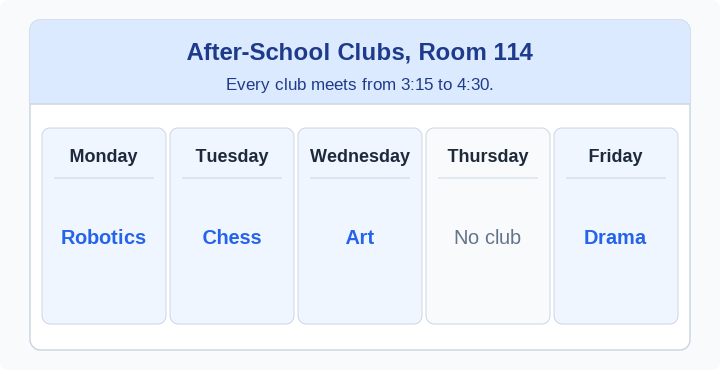
Picture: A weekly calendar titled After-School Clubs, Room 114. Monday: Robotics. Tuesday: Chess. Wednesday: Art. Thursday: no club. Friday: Drama. Every club meets from 3:15 to 4:30.
Transcript for the adult to read aloud. The student listens and does not read it.
Ms. Pruitt: Good morning, Lakeview Middle School. This is Ms. Pruitt with an important change for today, Tuesday.
Ms. Pruitt: Heavy snow is coming this afternoon. Because of the snow, buses will leave at two o'clock today, not at three-fifteen.
Ms. Pruitt: All after-school clubs are canceled today. The club that usually meets on Tuesdays will meet on Thursday this week instead, in the same room.
Ms. Pruitt: Please take your boots and coats home with you. Stay warm, and drive safely, everyone.
Choose the best answer.
1. Why will the buses leave early today?
- A A club meeting is canceled.
- B Heavy snow is coming.
- C The buses need repairs.
- D There is a school holiday.
Choose the best answer.
2. What time will the buses leave today?
- A At 3:15
- B At 4:30
- C At 2:00
- D At 12:00
Choose the best answer.
3. Look at the calendar. Which club will meet on Thursday this week?
- A Chess
- B Robotics
- C Art
- D Drama
Listen to two students plan a project.
Social and Instructional: Planning a Poster
Transcript for the adult to read aloud. The student listens and does not read it.
Shanice: Eric, our poster for Mr. Thompson is due on Friday. Can you draw the map of the state?
Eric: Sure, I like drawing maps. But I don't have any colored pencils at home.
Shanice: No problem. I have a big box. I'll bring it tomorrow. And I can write the five facts.
Eric: Great. What about the pictures? We need three.
Shanice: Let's print them in the library at lunch on Wednesday. Then we can glue everything on Thursday.
Choose the best answer.
4. What will Eric do for the poster?
- A Write the facts
- B Print the pictures
- C Bring the pencils
- D Draw the map
Choose the best answer.
5. Why will Shanice bring colored pencils?
- A Eric does not have any.
- B Mr. Thompson asked her to.
- C The library has none.
- D She needs them for the facts.
Choose the best answer.
6. When will the students print the pictures?
- A Friday morning
- B Wednesday at lunch
- C Thursday after school
- D Tomorrow in class
Listen to the teacher talk about a book.
Language Arts: A New Book in the Class Library
Transcript for the adult to read aloud. The student listens and does not read it.
Ms. Ferraro: I want to tell you about a new book in our class library. It is called North of the Ferry.
Ms. Ferraro: The main character is a girl named Abigail. She lives on a small island in Lake Superior with her family.
Ms. Ferraro: In summer, a ferry boat takes people to the mainland. But in winter, the lake freezes and the ferry stops.
Ms. Ferraro: One night, Abigail's little brother gets very sick, and the doctor is on the mainland. Abigail has to find a way across the ice.
Ms. Ferraro: I won't tell you the ending. If you want to read it next, write your name on the list by the door.
Choose the best answer.
7. Where does Abigail live?
- A In a big city
- B On a ferry boat
- C On an island
- D Next to a doctor
Choose the best answer.
8. What is the problem in the story?
- A Abigail's brother is sick and the doctor is far away.
- B Abigail loses a library book that belongs to her teacher.
- C The ferry is too small for the family.
- D Abigail does not like the cold winter.
Choose the best answer.
9. What should students do if they want to read the book?
- A Ask Ms. Ferraro for the ending
- B Write their name on a list
- C Go to the public library
- D Take the book home today
Level B folders
Look at the price tags. Then listen to two students plan what to buy.
Mathematics: Snacks for the Field Trip
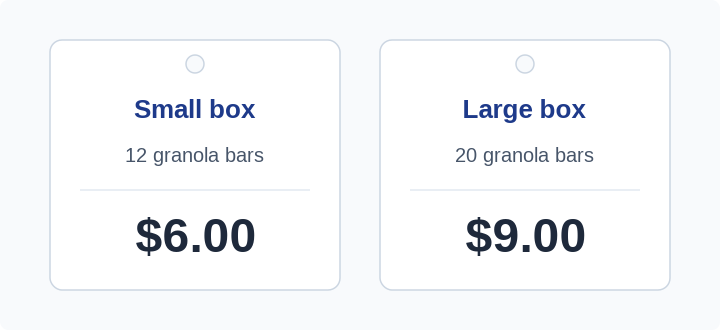
Picture: Two price tags. Small box: 12 granola bars for $6.00. Large box: 20 granola bars for $9.00.
Transcript for the adult to read aloud. The student listens and does not read it.
Bethany: Okay, Owen, we have thirty dollars for snacks, and there are twenty-six students on the field trip.
Bethany: What if we buy two small boxes? That's twelve dollars.
Owen: But two small boxes is only twenty-four bars. Two kids would get nothing.
Owen: Look at the large box. Nine dollars for twenty bars is forty-five cents a bar. The small box is fifty cents a bar.
Bethany: So the large box is the better deal. Then let's get one large box and one small box. That's thirty-two bars for fifteen dollars.
Owen: Perfect. Everyone gets one, we have a few extras, and the rest of the money can pay for juice.
Choose the best answer.
10. Why does Owen say Bethany's first plan will not work?
- A It costs more than thirty dollars.
- B The small boxes are sold out.
- C It does not give enough bars for every student.
- D The teacher wants them to buy juice instead of snacks.
Choose the best answer.
11. What does Owen mean when he says the large box is "forty-five cents a bar"?
- A Each bar in the large box costs $0.45.
- B The large box costs 45 cents more than the small box.
- C The large box has 45 bars in it.
- D They will save 45 cents in total.
Choose the best answer.
12. How much money will the students have left for juice?
- A $3
- B $12
- C $21
- D $15
Listen to the teacher explain an experiment.
Science: Which Cup Keeps Water Hot?
Transcript for the adult to read aloud. The student listens and does not read it.
Ms. Johnson: Today we're testing three cups: a foam cup, a metal cup and a glass cup. Each one will hold the same amount of hot water.
Ms. Johnson: Our question is: which cup keeps the water hot the longest?
Darnell: I think the metal cup will, because it's the strongest.
Ms. Johnson: That's a good guess to test, Darnell. But remember, strong is not the same as warm. Metal is a conductor. It lets heat move through it quickly.
Ms. Johnson: Foam is an insulator. It slows heat down. So keep your prediction in mind and watch the numbers.
Ms. Johnson: Put a thermometer in each cup. Every five minutes, write the temperature in your data table. We'll stop after thirty minutes.
Choose the best answer.
13. What is the purpose of the experiment?
- A To find out which cup is the strongest
- B To find out which cup keeps water hot the longest
- C To see how fast water boils in each cup
- D To measure how much water each cup holds
Choose the best answer.
14. According to Ms. Johnson, what does a conductor do?
- A It keeps the heat inside the cup for a long time.
- B It makes the water hotter.
- C It lets heat move through it quickly.
- D It slows heat down.
Choose the best answer.
15. What will students write in their data tables?
- A Their own guesses about which of the cups is the strongest
- B The weight of each cup
- C How long the water took to boil
- D The temperature in each cup every five minutes
Listen to part of a lesson.
Social Studies: The Mill Workers of Lowell
Transcript for the adult to read aloud. The student listens and does not read it.
Mr. Thompson: In the 1820s, a group of businessmen built large cloth factories, called mills, beside a river in Lowell, Massachusetts. The fast-moving river turned water wheels, and the water wheels powered the machines.
Mr. Thompson: To run the machines, the mills hired thousands of young women. Most of them came from farm families in New England, and many were only fifteen to twenty-five years old.
Mr. Thompson: For many of these women, it was the first time they had earned their own money. Some sent part of their pay home to help their families or to pay for a brother's schooling.
Mr. Thompson: But the work was hard. A typical workday was twelve hours or more, six days a week, in hot, noisy rooms full of cotton dust.
Mr. Thompson: In 1834, the owners cut the workers' pay. Hundreds of women walked out of the mills in protest. It was one of the first strikes by women workers in the United States.
Choose the best answer.
16. Why were the mills in Lowell built beside a river?
- A Workers could travel to the mills by boat.
- B The river gave the workers water to drink.
- C Cotton grew along the banks of the river.
- D The moving water powered the machines.
Choose the best answer.
17. What did some of the young women do with part of their pay?
- A They sent it home to help their families.
- B They used it to buy farms in New England.
- C They gave it back to the mill owners.
- D They saved it to build their own mill.
Choose the best answer.
18. Why does Mr. Thompson say the 1834 walkout was important?
- A It closed the Lowell mills for good.
- B It was the first time the mills hired women.
- C It was one of the first strikes by women workers.
- D It made the owners shorten the workday.
Level C folders
Listen to the science lesson.
Science: Why Lakes Freeze from the Top Down
Transcript for the adult to read aloud. The student listens and does not read it.
Ms. Johnson: Most substances get denser as they get colder. Their particles move closer together, so a cup of the cold liquid weighs more than a cup of the warm liquid.
Ms. Johnson: Water follows that rule, but only to a point. Water is densest at about four degrees Celsius. Below that, it actually becomes less dense.
Ms. Johnson: So think about a lake in Minnesota in November. As the surface cools to four degrees, that dense water sinks to the bottom.
Ms. Johnson: Water that cools below four degrees is lighter, so it stays on top. That top layer is the one that reaches zero degrees and freezes.
Ms. Johnson: And when ice forms, it's even less dense, which is why it floats. That sheet of ice works like a lid. It insulates the water underneath from the freezing air.
Ms. Johnson: That's why fish can survive all winter near the bottom of the lake, in water that stays close to four degrees.
Ms. Johnson: Now, here's something to think about for tomorrow. What would happen to that lake if ice were denser than liquid water?
Choose the best answer.
19. What is the lesson mainly about?
- A How fish find food in winter
- B Why the way water changes density lets lakes freeze on top
- C Why Minnesota has cold winters
- D How to measure the temperature of a lake
Choose the best answer.
20. Why does the teacher compare the ice to a lid?
- A Ice is flat and round like a lid.
- B Ice keeps fish from swimming to the top.
- C Ice can be lifted off the lake like a lid when spring comes.
- D Ice keeps the cold air from cooling the water below.
Choose the best answer.
21. Based on the lesson, what would most likely happen if ice were denser than liquid water?
- A The lake would never freeze at all.
- B Ice would sink, and the lake could freeze from the bottom up.
- C Fish would swim closer to the surface.
- D The ice on top would become thicker and stronger.
Listen to a class discussion.
Social Studies: Should the Town Ban Plastic Bags?
Transcript for the adult to read aloud. The student listens and does not read it.
Mr. Thompson: Our town council is voting on a plan to ban plastic shopping bags in stores and charge ten cents for each paper bag. Who wants to start?
Lauren: I'm for it. When our class cleaned up the riverbank in April, plastic bags were the most common thing we found. We picked up more than two hundred.
Lauren: They also jam the machines at the recycling center, so workers have to stop and cut them out. Some towns that passed bans say they found far fewer bags in their parks afterward.
Owen: I get that, but think about families who are already struggling. Ten cents a bag adds up when you buy groceries for six people every week.
Owen: And paper bags aren't perfect either. My uncle owns a corner store, and he says paper bags cost him about three times as much as plastic ones. Making them uses a lot of water and energy, too.
Lauren: That's fair, but people could bring reusable bags, and the town could hand out free ones to families who need them.
Mr. Thompson: You're both using evidence, which is exactly what council members want to hear. Remember, any resident can speak during public comment at the council meeting on the fourteenth.
Choose the best answer.
22. What is Lauren's main reason for supporting the ban?
- A It would save stores money.
- B Her uncle's store asked for the ban.
- C Plastic bags cause litter and recycling problems.
- D Paper bags cost less than plastic ones.
Choose the best answer.
23. Which evidence does Owen use to support his position?
- A The cost to big families and to his uncle's store
- B The number of bags found at the riverbank
- C The problems at the recycling center
- D What happened in towns that passed bans
Choose the best answer.
24. Why does Mr. Thompson mention the council meeting on the fourteenth?
- A To say the council has already decided
- B To tell the students the ban starts that day
- C To ask Lauren and Owen to stop arguing
- D To remind them residents can speak to the council
Answer key
Level A folders
1. Why will the buses leave early today?
From “Social and Instructional: A Snow Day Change”
- A club meeting is canceled.
- Heavy snow is coming.Correct answer
- The buses need repairs.
- There is a school holiday.
Why “Heavy snow is coming.” is correct
This checks the main reason in a short announcement. Ms. Pruitt says "Because of the snow, buses will leave at two o'clock." The word "because" is the signal students should listen for.
Why the other answers are wrong
- A club meeting is canceled. — Clubs are canceled because of the snow too; that is a result, not the reason.
- The buses need repairs. — Nothing is said about the buses needing repairs.
- There is a school holiday. — It is a normal school day, Tuesday, with an early dismissal.
2. What time will the buses leave today?
From “Social and Instructional: A Snow Day Change”
- At 3:15
- At 4:30
- At 2:00Correct answer
- At 12:00
Why “At 2:00” is correct
This tests catching a number in speech. The announcement says "two o'clock today, not three-fifteen." Students have to notice which time is the new one and which is the usual one.
Why the other answers are wrong
- At 3:15 — 3:15 is the usual time, which the speaker says is not today's time.
- At 4:30 — 4:30 is when clubs usually end on the calendar, not a bus time.
- At 12:00 — Noon is never mentioned.
3. Look at the calendar. Which club will meet on Thursday this week?
From “Social and Instructional: A Snow Day Change”
- ChessCorrect answer
- Robotics
- Art
- Drama
Why “Chess” is correct
The student must join the audio to the picture. Ms. Pruitt says the club that usually meets on Tuesdays will meet on Thursday. The calendar shows that the Tuesday club is Chess.
Why the other answers are wrong
- Robotics — Robotics meets on Monday, which is not changed.
- Art — Art meets on Wednesday, which is not changed.
- Drama — Drama meets on Friday, which is not changed.
4. What will Eric do for the poster?
From “Social and Instructional: Planning a Poster”
- Write the facts
- Print the pictures
- Bring the pencils
- Draw the mapCorrect answer
Why “Draw the map” is correct
This checks who does which job in a conversation. Shanice asks Eric to draw the map and he says, "Sure, I like drawing maps."
Why the other answers are wrong
- Write the facts — Shanice says she will write the five facts.
- Print the pictures — They plan to print the pictures together in the library.
- Bring the pencils — Shanice will bring the colored pencils, because Eric has none.
5. Why will Shanice bring colored pencils?
From “Social and Instructional: Planning a Poster”
- Eric does not have any.Correct answer
- Mr. Thompson asked her to.
- The library has none.
- She needs them for the facts.
Why “Eric does not have any.” is correct
This item asks for a reason that is spoken one line before the offer. Eric says he doesn't have colored pencils at home, and Shanice answers, "No problem. I have a big box."
Why the other answers are wrong
- Mr. Thompson asked her to. — The teacher is named, but he does not ask for pencils.
- The library has none. — The library is only mentioned as the place to print pictures.
- She needs them for the facts. — The pencils are for Eric's map, not for writing facts.
6. When will the students print the pictures?
From “Social and Instructional: Planning a Poster”
- Friday morning
- Wednesday at lunchCorrect answer
- Thursday after school
- Tomorrow in class
Why “Wednesday at lunch” is correct
This checks a day and time in a plan with several days. Shanice says, "Let's print them in the library at lunch on Wednesday." Thursday is for gluing and Friday is the due date.
Why the other answers are wrong
- Friday morning — Friday is when the poster is due.
- Thursday after school — Thursday is the day they will glue everything.
- Tomorrow in class — "Tomorrow" is when Shanice brings the pencils.
7. Where does Abigail live?
From “Language Arts: A New Book in the Class Library”
- In a big city
- On a ferry boat
- On an islandCorrect answer
- Next to a doctor
Why “On an island” is correct
This checks the setting of a story told aloud. The teacher says Abigail "lives on a small island in Lake Superior."
Why the other answers are wrong
- In a big city — No city is mentioned; the family lives on a small island.
- On a ferry boat — The ferry is how people travel in summer, not where Abigail lives.
- Next to a doctor — The doctor is on the mainland, far from Abigail's home.
8. What is the problem in the story?
From “Language Arts: A New Book in the Class Library”
- Abigail's brother is sick and the doctor is far away.Correct answer
- Abigail loses a library book that belongs to her teacher.
- The ferry is too small for the family.
- Abigail does not like the cold winter.
Why “Abigail's brother is sick and the doctor is far away.” is correct
This item asks for the central problem, a basic story element. The teacher explains that the brother "gets very sick" and the doctor is on the mainland, so Abigail must cross the frozen lake.
Why the other answers are wrong
- Abigail loses a library book that belongs to her teacher. — A library list is mentioned for the class, not a lost book in the story.
- The ferry is too small for the family. — The ferry stops in winter; its size is never the problem.
- Abigail does not like the cold winter. — Winter is the setting, but not liking the cold is never said.
9. What should students do if they want to read the book?
From “Language Arts: A New Book in the Class Library”
- Ask Ms. Ferraro for the ending
- Write their name on a listCorrect answer
- Go to the public library
- Take the book home today
Why “Write their name on a list” is correct
This checks a classroom direction at the end of a talk. Ms. Ferraro says, "write your name on the list by the door."
Why the other answers are wrong
- Ask Ms. Ferraro for the ending — She says she won't tell the ending.
- Go to the public library — The book is in the class library, not the public library.
- Take the book home today — Students sign up first; nobody is told to take it today.
Level B folders
10. Why does Owen say Bethany's first plan will not work?
From “Mathematics: Snacks for the Field Trip”
- It costs more than thirty dollars.
- The small boxes are sold out.
- It does not give enough bars for every student.Correct answer
- The teacher wants them to buy juice instead of snacks.
Why “It does not give enough bars for every student.” is correct
This checks a reason built on simple math. Two small boxes make 24 bars, but there are 26 students, so "two kids would get nothing." Students need to follow the numbers, not just hear them.
Why the other answers are wrong
- It costs more than thirty dollars. — Two small boxes cost $12, well under the $30 budget.
- The small boxes are sold out. — Nobody says the boxes are sold out.
- The teacher wants them to buy juice instead of snacks. — Juice is mentioned only as something to buy with leftover money.
11. What does Owen mean when he says the large box is "forty-five cents a bar"?
From “Mathematics: Snacks for the Field Trip”
- Each bar in the large box costs $0.45.Correct answer
- The large box costs 45 cents more than the small box.
- The large box has 45 bars in it.
- They will save 45 cents in total.
Why “Each bar in the large box costs $0.45.” is correct
This item tests the language of unit price, a grade 6 math idea. "Cents a bar" means the cost for one bar: $9.00 divided by 20 bars is $0.45.
Why the other answers are wrong
- The large box costs 45 cents more than the small box. — The large box costs $3.00 more than the small box, not 45 cents.
- The large box has 45 bars in it. — The large box has 20 bars.
- They will save 45 cents in total. — 45 cents is the price of one bar, not a saving.
12. How much money will the students have left for juice?
From “Mathematics: Snacks for the Field Trip”
- $3
- $12
- $21
- $15Correct answer
Why “$15” is correct
The student has to combine what is heard: the budget is $30 and the snacks cost $15, so $15 is left. The speakers never say the answer directly, which makes this a B-level listening and math item.
Why the other answers are wrong
- $3 — $3 is the difference in price between the two boxes.
- $12 — $12 was the cost of Bethany's first plan.
- $21 — $21 would be left after buying only the large box, which is not the plan.
13. What is the purpose of the experiment?
From “Science: Which Cup Keeps Water Hot?”
- To find out which cup is the strongest
- To find out which cup keeps water hot the longestCorrect answer
- To see how fast water boils in each cup
- To measure how much water each cup holds
Why “To find out which cup keeps water hot the longest” is correct
This checks the research question, which the teacher states directly: "which cup keeps the water hot the longest?" Students should separate the question from Darnell's guess about strength.
Why the other answers are wrong
- To find out which cup is the strongest — Strength is Darnell's reason for his guess, not what is being tested.
- To see how fast water boils in each cup — The water starts hot; nothing is boiled during the test.
- To measure how much water each cup holds — Each cup holds the same amount on purpose, so amount is not measured.
14. According to Ms. Johnson, what does a conductor do?
From “Science: Which Cup Keeps Water Hot?”
- It keeps the heat inside the cup for a long time.
- It makes the water hotter.
- It lets heat move through it quickly.Correct answer
- It slows heat down.
Why “It lets heat move through it quickly.” is correct
This is a content vocabulary item. The teacher defines the term right after using it: metal "is a conductor. It lets heat move through it quickly."
Why the other answers are wrong
- It keeps the heat inside the cup for a long time. — Keeping heat in is what a good insulator does, not a conductor.
- It makes the water hotter. — No cup makes the water hotter; they only lose heat at different speeds.
- It slows heat down. — Slowing heat down describes foam, the insulator.
15. What will students write in their data tables?
From “Science: Which Cup Keeps Water Hot?”
- Their own guesses about which of the cups is the strongest
- The weight of each cup
- How long the water took to boil
- The temperature in each cup every five minutesCorrect answer
Why “The temperature in each cup every five minutes” is correct
This checks a procedure step from the last line of the talk: "Every five minutes, write the temperature in your data table." Listening for the verb "write" helps.
Why the other answers are wrong
- Their own guesses about which of the cups is the strongest — The prediction is something to keep in mind, not the data that is recorded.
- The weight of each cup — Weight is never mentioned.
- How long the water took to boil — The water is already hot; boiling is not part of the test.
16. Why were the mills in Lowell built beside a river?
From “Social Studies: The Mill Workers of Lowell”
- Workers could travel to the mills by boat.
- The river gave the workers water to drink.
- Cotton grew along the banks of the river.
- The moving water powered the machines.Correct answer
Why “The moving water powered the machines.” is correct
This checks a key fact from the lesson. Mr. Thompson says the river "turned water wheels, and the water wheels powered the machines." Students need to link the place to its purpose.
Why the other answers are wrong
- Workers could travel to the mills by boat. — Boats and travel are never mentioned.
- The river gave the workers water to drink. — Drinking water is not mentioned.
- Cotton grew along the banks of the river. — The lesson does not say where the cotton grew.
17. What did some of the young women do with part of their pay?
From “Social Studies: The Mill Workers of Lowell”
- They sent it home to help their families.Correct answer
- They used it to buy farms in New England.
- They gave it back to the mill owners.
- They saved it to build their own mill.
Why “They sent it home to help their families.” is correct
This checks a detail about the workers' lives. The lesson says some "sent part of their pay home to help their families or to pay for a brother's schooling."
Why the other answers are wrong
- They used it to buy farms in New England. — The women came from farm families, but nobody says they bought farms.
- They gave it back to the mill owners. — Nothing says the women gave money to the owners.
- They saved it to build their own mill. — Building a mill is never mentioned.
18. Why does Mr. Thompson say the 1834 walkout was important?
From “Social Studies: The Mill Workers of Lowell”
- It closed the Lowell mills for good.
- It was the first time the mills hired women.
- It was one of the first strikes by women workers.Correct answer
- It made the owners shorten the workday.
Why “It was one of the first strikes by women workers.” is correct
This asks why an event matters. After describing the pay cut and the walkout, Mr. Thompson says it "was one of the first strikes by women workers in the United States." Students must catch the speaker's own judgment at the end.
Why the other answers are wrong
- It closed the Lowell mills for good. — The lesson does not say the mills closed.
- It was the first time the mills hired women. — Women had worked in the mills since the 1820s, before the strike.
- It made the owners shorten the workday. — The lesson says nothing about the strike changing the hours.
Level C folders
19. What is the lesson mainly about?
From “Science: Why Lakes Freeze from the Top Down”
- How fish find food in winter
- Why the way water changes density lets lakes freeze on topCorrect answer
- Why Minnesota has cold winters
- How to measure the temperature of a lake
Why “Why the way water changes density lets lakes freeze on top” is correct
This checks the main idea of an academic talk. Every part of the lesson explains how water's density changes near four degrees and why that makes ice form at the surface. Fish and Minnesota are supporting details.
Why the other answers are wrong
- How fish find food in winter — Fish come up only as an example of why the ice matters; food is not discussed.
- Why Minnesota has cold winters — Minnesota is the example setting, not the topic.
- How to measure the temperature of a lake — Temperatures are mentioned, but measuring them is not taught.
20. Why does the teacher compare the ice to a lid?
From “Science: Why Lakes Freeze from the Top Down”
- Ice is flat and round like a lid.
- Ice keeps fish from swimming to the top.
- Ice can be lifted off the lake like a lid when spring comes.
- Ice keeps the cold air from cooling the water below.Correct answer
Why “Ice keeps the cold air from cooling the water below.” is correct
This item asks students to interpret a comparison. Right after saying the ice "works like a lid," the teacher explains that it "insulates the water underneath from the freezing air." The lid is about keeping heat in.
Why the other answers are wrong
- Ice is flat and round like a lid. — The comparison is about what the ice does, not its shape.
- Ice keeps fish from swimming to the top. — The lesson does not say the ice traps fish; it protects them.
- Ice can be lifted off the lake like a lid when spring comes. — Spring melting is not discussed.
21. Based on the lesson, what would most likely happen if ice were denser than liquid water?
From “Science: Why Lakes Freeze from the Top Down”
- The lake would never freeze at all.
- Ice would sink, and the lake could freeze from the bottom up.Correct answer
- Fish would swim closer to the surface.
- The ice on top would become thicker and stronger.
Why “Ice would sink, and the lake could freeze from the bottom up.” is correct
This is an inference question that answers the teacher's closing question. Denser things sink, so ice would drop to the bottom and keep building there, with no floating layer to insulate the lake. Students must apply the rule, not repeat a fact.
Why the other answers are wrong
- The lake would never freeze at all. — Water would still freeze at zero degrees; it would just collect at the bottom.
- Fish would swim closer to the surface. — Without a floating insulating layer, the lake would be colder, which gives fish no reason to move up.
- The ice on top would become thicker and stronger. — Ice that sinks would not stay on top to thicken there.
22. What is Lauren's main reason for supporting the ban?
From “Social Studies: Should the Town Ban Plastic Bags?”
- It would save stores money.
- Her uncle's store asked for the ban.
- Plastic bags cause litter and recycling problems.Correct answer
- Paper bags cost less than plastic ones.
Why “Plastic bags cause litter and recycling problems.” is correct
This checks a speaker's central claim and reason. Lauren describes the bags her class found at the riverbank and the bags that jam recycling machines. Both point to the harm plastic bags cause.
Why the other answers are wrong
- It would save stores money. — Owen says paper bags cost stores more, so this is the opposite of the evidence.
- Her uncle's store asked for the ban. — The uncle is Owen's, and he describes a cost of the plan.
- Paper bags cost less than plastic ones. — Owen says paper bags cost about three times as much.
23. Which evidence does Owen use to support his position?
From “Social Studies: Should the Town Ban Plastic Bags?”
- The cost to big families and to his uncle's storeCorrect answer
- The number of bags found at the riverbank
- The problems at the recycling center
- What happened in towns that passed bans
Why “The cost to big families and to his uncle's store” is correct
This item asks students to match evidence to a speaker. Owen says ten cents a bag "adds up" for a family of six, and that paper bags cost his uncle's store about three times as much. Both are costs of the plan.
Why the other answers are wrong
- The number of bags found at the riverbank — The riverbank cleanup is Lauren's evidence for the ban.
- The problems at the recycling center — The recycling machines are Lauren's evidence.
- What happened in towns that passed bans — Lauren mentions other towns, and she uses them to support the ban.
24. Why does Mr. Thompson mention the council meeting on the fourteenth?
From “Social Studies: Should the Town Ban Plastic Bags?”
- To say the council has already decided
- To tell the students the ban starts that day
- To ask Lauren and Owen to stop arguing
- To remind them residents can speak to the councilCorrect answer
Why “To remind them residents can speak to the council” is correct
This tests the purpose of a closing remark in a civics discussion. Mr. Thompson praises both speakers for using evidence and reminds them that "any resident can speak during public comment," linking the class debate to how local government takes input.
Why the other answers are wrong
- To say the council has already decided — He says at the start that the council is still voting on the plan.
- To tell the students the ban starts that day — The council has not voted, so no ban has started.
- To ask Lauren and Owen to stop arguing — He praises the discussion; he does not ask them to stop.
Unofficial practice. This site is not affiliated with, endorsed by, or connected to WIDA, the Wisconsin Center for Education Research, or the Board of Regents of the University of Wisconsin System. WIDA and WIDA ACCESS are trademarks of the Board of Regents of the University of Wisconsin System. Every question here is original practice material written to match the published test design.