WIDA speaking practice for 4th and 5th grade
Printable version. Original practice written to match the published WIDA format, not questions from the official test.
Speaking prompts
On the real test these are scored by a trained person against a rubric. The rubric and a sample response follow each prompt.
Prompt 1: Pre-A tier tasks
Suggested time: about 1 minutes
Model answer: read this aloud first
Listen to the model student answer a similar question first.
Model answer
Transcript for the adult to read aloud. The student listens and does not read it.
Mr. Wilson: Here is a picture of a classroom. A boy is standing at the whiteboard. What is the boy holding?
Ashley: A marker. He is holding a marker.
The student's own task
Look at the picture. Then listen to the question and answer it.
Science: A Class Trip to the Museum
Picture description
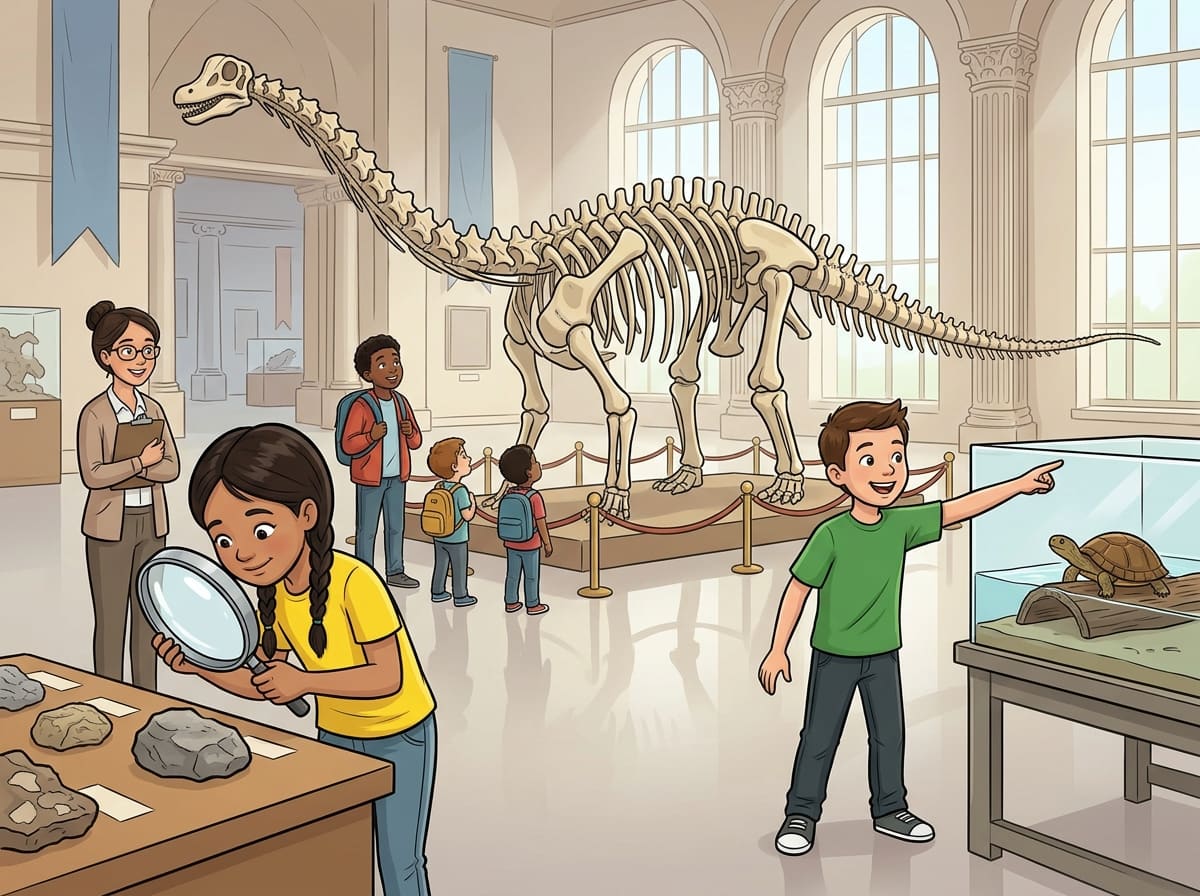
A class is visiting a science museum. In the middle of the room stands a very large dinosaur skeleton.
On the left, a girl with two braids and a yellow shirt is holding a magnifying glass over a gray rock on a table.
On the right, a boy in a green shirt is pointing at a glass tank. Inside the tank, a turtle is sitting on a log.
In the back, a teacher is holding a clipboard and smiling.
Look at the picture. Listen to the model student first. Then answer.
Look at the girl in the yellow shirt. What is she holding?
Scoring rubric
| Level | What it looks like |
|---|---|
| 4: Exemplary |
|
| 3: Strong |
|
| 2: Adequate |
|
| 1: Attempted |
|
A strong sample response
A magnifying glass. She is holding a magnifying glass to look at the rock.
This names the object with the right word and adds a short sentence, a little more than the model ("A marker. He is holding a marker."). For a Pre-A task, "magnifying glass" on its own is already a correct answer.
What to look for
- Pre-A tasks are for beginners. A single correct English word is a real start; two or more English words, or a short phrase, match the model.
- If the student does not know "magnifying glass," a description such as "a glass to see big" still shows English. Teach the word afterward.
- Pointing alone is not an answer in English; ask the student to say a word.
Prompt 2: Pre-A tier tasks
Suggested time: about 1 minutes
Model answer: read this aloud first
Listen to the model student answer a similar question first.
Model answer
Transcript for the adult to read aloud. The student listens and does not read it.
Mr. Wilson: This picture shows a farm. There is a red barn, and an animal is standing next to it. What animal is next to the barn?
Ashley: A horse. A brown horse.
The student's own task
Look at the picture. Then listen to the question and answer it.
Science: A Class Trip to the Museum
Picture description
A class is visiting a science museum. In the middle of the room stands a very large dinosaur skeleton.
On the left, a girl with two braids and a yellow shirt is holding a magnifying glass over a gray rock on a table.
On the right, a boy in a green shirt is pointing at a glass tank. Inside the tank, a turtle is sitting on a log.
In the back, a teacher is holding a clipboard and smiling.
Look at the picture. Listen to the model student first. Then answer.
Look at the glass tank. What animal is in the tank?
Scoring rubric
| Level | What it looks like |
|---|---|
| 4: Exemplary |
|
| 3: Strong |
|
| 2: Adequate |
|
| 1: Attempted |
|
A strong sample response
A turtle. I see a turtle. It is sitting on a log in the tank.
The student names the animal and adds where it is, which matches and slightly goes beyond the model ("A horse. A brown horse."). A one-word answer, "turtle," would also be correct at this level.
What to look for
- Pre-A tasks are for beginners. A single correct English word is a real start; two or more English words, or a short phrase, match the model.
- "Tortoise" or "a turtle animal" is fine. The point is naming the animal in English.
- Some students answer "dinosaur" because it is the biggest thing in the picture. Repeat the question and point to the tank.
Prompt 3: Pre-A tier tasks
Suggested time: about 1 minutes
Model answer: read this aloud first
Listen to the model student answer a similar question first.
Model answer
Transcript for the adult to read aloud. The student listens and does not read it.
Mr. Wilson: This picture shows a park. A girl is on the path in her sneakers. What is the girl doing?
Ashley: Running. The girl is running.
The student's own task
Look at the picture. Then listen to the question and answer it.
Science: A Class Trip to the Museum
Picture description
A class is visiting a science museum. In the middle of the room stands a very large dinosaur skeleton.
On the left, a girl with two braids and a yellow shirt is holding a magnifying glass over a gray rock on a table.
On the right, a boy in a green shirt is pointing at a glass tank. Inside the tank, a turtle is sitting on a log.
In the back, a teacher is holding a clipboard and smiling.
Look at the picture. Listen to the model student first. Then answer.
Look at the boy in the green shirt. What is he doing?
Scoring rubric
| Level | What it looks like |
|---|---|
| 4: Exemplary |
|
| 3: Strong |
|
| 2: Adequate |
|
| 1: Attempted |
|
A strong sample response
Pointing. The boy is pointing at the turtle in the glass tank.
The answer gives the action word, "pointing," and then a full sentence that says what he is pointing at. The model ("Running. The girl is running.") shows the same pattern: action word first, then a sentence.
What to look for
- Pre-A tasks are for beginners. A single correct English word is a real start; two or more English words, or a short phrase, match the model.
- Listen for an action word (a verb). "Look turtle" or "He point" also shows English and fits the task.
- Do not correct grammar during the answer; this level is about getting words out.
Prompt 4: Tier A tasks
Suggested time: about 1 minutes
Model answer: read this aloud first
Listen to the model student answer a similar question first.
Model answer
Transcript for the adult to read aloud. The student listens and does not read it.
Mr. Wilson: This picture shows a school book fair. There are tables with many books, and children are standing at the tables. What are the children doing?
Ashley: They are buying books. Some kids are looking at books on the table.
The student's own task
Look at the picture. Then listen to the question and answer it.
Social Studies: River Cleanup Day
Picture description
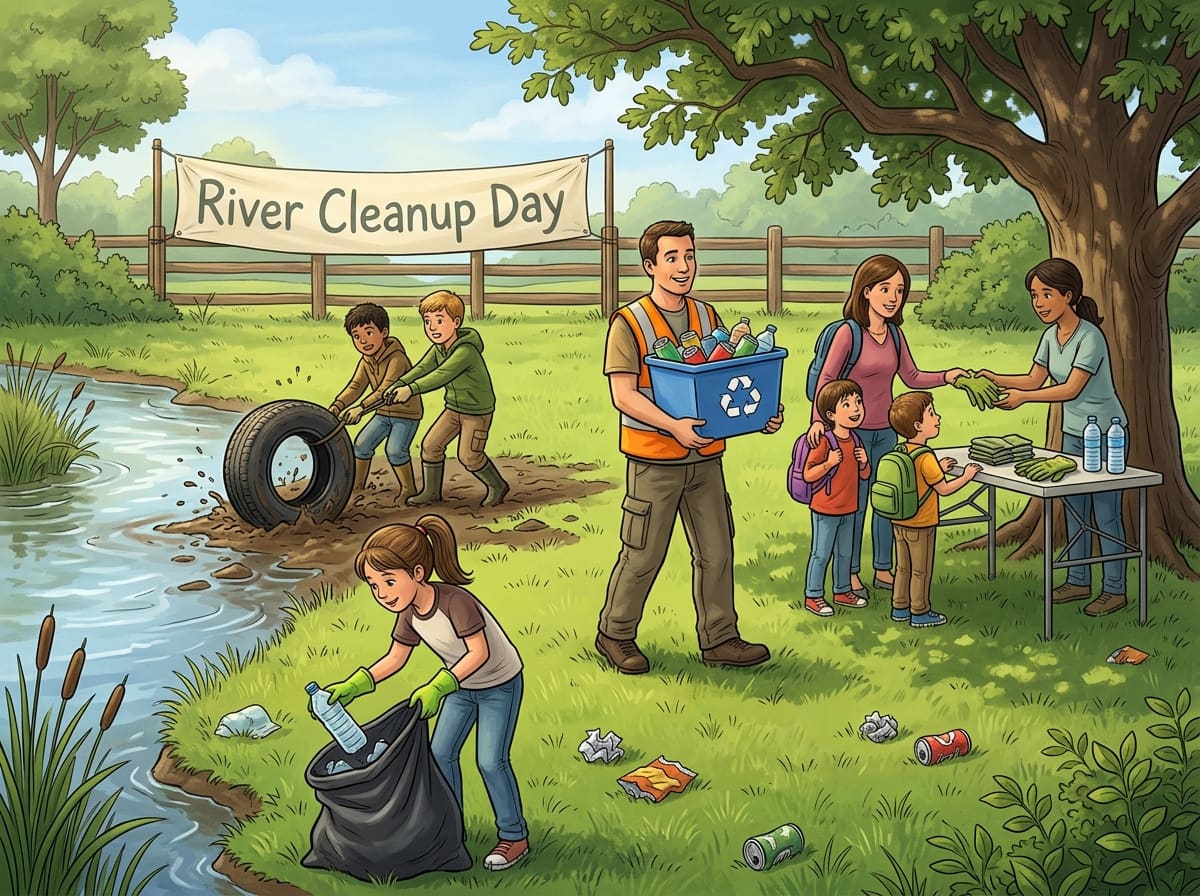
It is a sunny Saturday morning at a park beside a river. A banner on a fence says "River Cleanup Day."
Near the water, a girl wearing green gloves is picking up a plastic bottle and putting it into a big black trash bag.
A man in an orange vest is carrying a blue recycling bin full of cans and bottles.
Two boys are pulling an old tire out of the mud at the edge of the river.
At a small table under a tree, a woman is handing out water bottles and gloves to people who just arrived.
Look at the picture. Listen to the model student first. Then answer.
This picture shows River Cleanup Day. What are the people doing?
Scoring rubric
| Level | What it looks like |
|---|---|
| 4: Exemplary |
|
| 3: Strong |
|
| 2: Adequate |
|
| 1: Attempted |
|
A strong sample response
They are cleaning the river. The girl is picking up trash and the boys are pulling a tire.
This is a level 1 task, so the model is one or two simple sentences. The answer gives the main idea ("cleaning the river") and two details from the picture, which matches the model.
What to look for
- The target here is a simple sentence that names what people are doing, such as "They are picking up trash."
- Words like "clean," "trash" and "pick up" show the student understood the picture.
- More detail is welcome but not needed for this task.
Prompt 5: Tier A tasks
Suggested time: about 1 minutes
Model answer: read this aloud first
Listen to the model student answer a similar question first.
Model answer
Transcript for the adult to read aloud. The student listens and does not read it.
Mr. Wilson: This picture shows a bake sale to help the animal shelter. Tell me about the picture. What are the people doing?
Ashley: Some kids are selling cookies and cupcakes at a table. A girl is putting money in a box. A man is buying a big chocolate cake. The money is for the animal shelter, so the dogs and cats can get food.
The student's own task
Look at the picture. Then listen to the question and answer it.
Social Studies: River Cleanup Day
Picture description
It is a sunny Saturday morning at a park beside a river. A banner on a fence says "River Cleanup Day."
Near the water, a girl wearing green gloves is picking up a plastic bottle and putting it into a big black trash bag.
A man in an orange vest is carrying a blue recycling bin full of cans and bottles.
Two boys are pulling an old tire out of the mud at the edge of the river.
At a small table under a tree, a woman is handing out water bottles and gloves to people who just arrived.
Look at the picture. Listen to the model student first. Then answer.
Tell me about the picture. What are the different people doing to help the park and the river?
Scoring rubric
| Level | What it looks like |
|---|---|
| 4: Exemplary |
|
| 3: Strong |
|
| 2: Adequate |
|
| 1: Attempted |
|
A strong sample response
A girl with green gloves is putting a bottle in a trash bag. A man has a blue box for recycling, with cans and bottles. Two boys are pulling a old tire out of the mud. And a lady is giving gloves and water to the people, so they can help too. They want the river to be clean.
This shows the level 3 target. The student describes four people, each in its own sentence, uses some specific words ("recycling," "tire," "mud"), and links two ideas with "so." Small errors ("a old tire," "blue box" for bin) do not get in the way of meaning.
What to look for
- Listen for several connected sentences, each about a different part of the picture, like the model's bake sale answer.
- A closing idea such as "They want the river to be clean" shows the student sees the purpose, not just the actions.
- If the student names only one person, ask, "What else do you see?" once, then let them continue.
Prompt 6: Tier A tasks
Suggested time: about 1 minutes
Model answer: read this aloud first
Listen to the model student answer a similar question first.
Model answer
Transcript for the adult to read aloud. The student listens and does not read it.
Mr. Wilson: Your class is going on a field trip to the zoo. What should students bring, and why?
Ashley: Students should bring a water bottle, because it is hot outside and they walk a lot. They should bring a lunch, too, because they stay all day. And they need a hat for the sun.
The student's own task
Look at the picture. Then listen to the question and answer it.
Social Studies: River Cleanup Day
Picture description
It is a sunny Saturday morning at a park beside a river. A banner on a fence says "River Cleanup Day."
Near the water, a girl wearing green gloves is picking up a plastic bottle and putting it into a big black trash bag.
A man in an orange vest is carrying a blue recycling bin full of cans and bottles.
Two boys are pulling an old tire out of the mud at the edge of the river.
At a small table under a tree, a woman is handing out water bottles and gloves to people who just arrived.
Listen to the model student first. Then answer.
Your family is going to the next River Cleanup Day. What should you bring, and why?
Scoring rubric
| Level | What it looks like |
|---|---|
| 4: Exemplary |
|
| 3: Strong |
|
| 2: Adequate |
|
| 1: Attempted |
|
A strong sample response
We should bring gloves, because the trash is dirty and maybe sharp. We need to bring water, because we work in the sun a long time. And we can bring a big bag for the bottles and cans, so we can recycle them.
Three things to bring, each with a reason joined by "because" or "so," which is the pattern in the model's zoo answer. This sits at the level 3 target: simple and compound sentences, everyday words plus a few specific ones ("recycle," "sharp").
What to look for
- Look for at least two items, each with a reason. Reasons are what lift this above a list.
- Items not in the picture are fine (a hat, sunscreen) if the reason makes sense.
- "Because" and "so" are the key linking words at this level.
Prompt 7: Tier B/C tasks
Suggested time: about 1 minutes
Model answer: read this aloud first
Listen to the model student answer a similar question first.
Model answer
Transcript for the adult to read aloud. The student listens and does not read it.
Mr. Wilson: A class put ice cubes in three places and timed how long they took to melt: in the refrigerator, on a classroom desk, and on a sunny windowsill. Tell me what happened.
Ashley: The ice cube in the refrigerator melted the slowest. It took about two hours. The one on the desk took about forty minutes. The one on the sunny windowsill melted the fastest, in only about fifteen minutes.
The student's own task
Look at the chart. Then listen to the question and answer it.
Science: The Ramp Experiment
Picture description
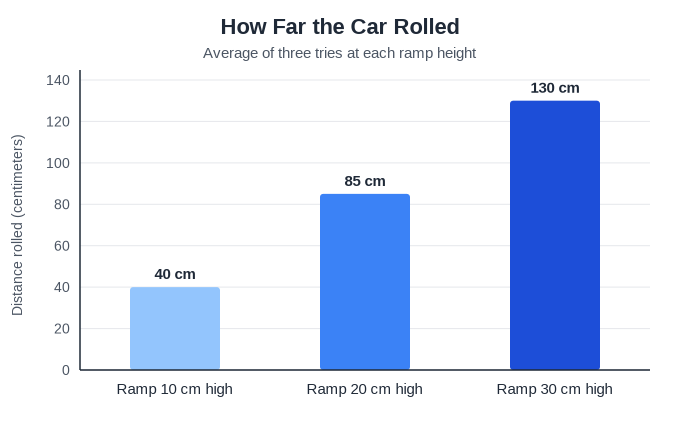
A fourth-grade class let a toy car roll down a ramp. They did the test with the ramp at three different heights, three times each, and measured how far the car rolled across the floor after it left the ramp.
When the ramp was 10 centimeters high, the car rolled about 40 centimeters.
When the ramp was 20 centimeters high, the car rolled about 85 centimeters.
When the ramp was 30 centimeters high, the car rolled about 130 centimeters.
Look at the chart. Listen to the model student first. Then answer.
Look at the chart about the ramp experiment. Tell me what happened when the class changed the height of the ramp.
Scoring rubric
| Level | What it looks like |
|---|---|
| 4: Exemplary |
|
| 3: Strong |
|
| 2: Adequate |
|
| 1: Attempted |
|
A strong sample response
When the ramp was the lowest, 10 centimeters, the car only rolled about 40 centimeters. When they made it 20 centimeters high, the car went farther, about 85 centimeters. And at 30 centimeters, the car rolled the farthest, about 130 centimeters. So every time the ramp got higher, the car went farther.
This is the level 3 task in Tier B/C: describe the results accurately. The student uses every number with its unit, compares with "farther" and "the farthest," and sums up the pattern in a last sentence, which goes slightly beyond the model's ice cube answer.
What to look for
- Check that the student matches each ramp height to the right distance and says the units.
- Comparison words ("farther," "the farthest," "higher") are the language target here.
- Explaining why is the next task, so a description alone is a full answer to this one.
Prompt 8: Tier B/C tasks
Suggested time: about 1 minutes
Model answer: read this aloud first
Listen to the model student answer a similar question first.
Model answer
Transcript for the adult to read aloud. The student listens and does not read it.
Mr. Wilson: Why do you think the ice cube on the sunny windowsill melted the fastest? What do you predict would happen to an ice cube outside on a hot summer day?
Ashley: I think the windowsill ice melted fastest because the sunlight was heating it the whole time. Heat is what makes ice change into water, so the more heat, the faster it melts. The refrigerator was cold, so it barely got any heat. If you put an ice cube outside on a hot summer day, I predict it would melt even faster than on the windowsill, maybe in just a few minutes, because the air and the sun would both be heating it.
The student's own task
Look at the chart. Then listen to the question and answer it.
Science: The Ramp Experiment
Picture description
A fourth-grade class let a toy car roll down a ramp. They did the test with the ramp at three different heights, three times each, and measured how far the car rolled across the floor after it left the ramp.
When the ramp was 10 centimeters high, the car rolled about 40 centimeters.
When the ramp was 20 centimeters high, the car rolled about 85 centimeters.
When the ramp was 30 centimeters high, the car rolled about 130 centimeters.
Listen to the model student first. Then answer.
Why do you think the car rolled farther when the ramp was higher? What do you predict would happen if the class made the ramp 40 centimeters high?
Scoring rubric
| Level | What it looks like |
|---|---|
| 4: Exemplary |
|
| 3: Strong |
|
| 2: Adequate |
|
| 1: Attempted |
|
A strong sample response
I think the car went farther because when the ramp is higher, the car is going faster at the bottom. It falls a longer way, so it has more energy when it reaches the floor, and that energy keeps it rolling. On the low ramp it was barely moving at the bottom. If they made the ramp 40 centimeters high, I predict the car would roll about 175 centimeters, because each time they added 10 centimeters, the car went about 45 centimeters farther. But it might crash or fall off if the ramp is too steep.
This reaches the level 5 target. The student gives a cause ("faster," "more energy"), contrasts it with the low ramp, and makes a prediction backed by the pattern in the data. The last sentence adds a sensible limit. Linking words ("because," "so," "but," "if") carry the reasoning, as in the model.
What to look for
- A strong answer has two parts: a reason and a prediction. Check for both.
- The student does not need the word "energy," but a reason about speed or force should be there.
- A prediction with a number from the pattern (about 170 to 180 centimeters) is strong; "it would go even farther" is a fair answer too.
- Compare the length and connection of the answer with the model, not the exact science.
Prompt 9: Tier B/C tasks
Suggested time: about 1 minutes
Model answer: read this aloud first
Listen to the model student answer a similar question first.
Model answer
Transcript for the adult to read aloud. The student listens and does not read it.
Mr. Wilson: Your school has enough money for one thing: new computers for the classrooms or new equipment for the playground. Which should the school choose? Give reasons.
Ashley: I think the school should buy new computers. First, students use computers in almost every subject, like reading, math, and science, so more kids would benefit every single day. Second, the computers we have now are so slow that we waste part of every lesson waiting. I know the playground is important too, and some people might say kids need exercise. But we already have a playground that works, and our computers barely do. That's why computers are the better choice.
The student's own task
Listen to the model student first. Then answer.
Your town has money for one new project: a bookmobile, which is a bus that brings library books to different neighborhoods, or a new playground at the town park. Which should the town choose? Give reasons, and tell why the other choice is not as good.
Scoring rubric
| Level | What it looks like |
|---|---|
| 4: Exemplary |
|
| 3: Strong |
|
| 2: Adequate |
|
| 1: Attempted |
|
A strong sample response
I think the town should choose the bookmobile. The main reason is that a lot of families can't get to the library, because it's far away or their parents work late. A bus that comes to their street would help those kids read more, and reading helps in every subject. Also, grown-ups could use it too, so it helps more people than a playground. Some people might say a playground is better because kids need to play outside. That's true, but the town already has a park, and the bookmobile would give people something they don't have at all.
This matches the level 5 model. It states an opinion, gives two developed reasons, names the other side and answers it ("That's true, but..."), and closes with a reason that ties back to the opinion. The sentences are varied and joined with "because," "so," "also" and "but."
What to look for
- Either choice is fine. Judge the reasons and how they connect, not the side.
- Answering the other side is what separates a level 5 answer from a level 3 one. The prompt asks for it directly.
- If the student gives only one reason, it is still an answer; compare it with the model's two reasons and counterargument.
Unofficial practice. This site is not affiliated with, endorsed by, or connected to WIDA, the Wisconsin Center for Education Research, or the Board of Regents of the University of Wisconsin System. WIDA and WIDA ACCESS are trademarks of the Board of Regents of the University of Wisconsin System. Every question here is original practice material written to match the published test design.