WIDA speaking practice for 1st grade
Printable version. Original practice written to match the published WIDA format, not questions from the official test.
Speaking prompts
On the real test these are scored by a trained person against a rubric. The rubric and a sample response follow each prompt.
Prompt 1: Pre-A tier tasks
Suggested time: about 1 minutes
Model answer: read this aloud first
Listen to the model student answer a similar question first.
Model answer
Transcript for the adult to read aloud. The student listens and does not read it.
Ms. Novak: Look at the animal next to the boy. What is it?
Jamal: A dog.
The student's own task
Look at the picture.
Social and Instructional: At the Park
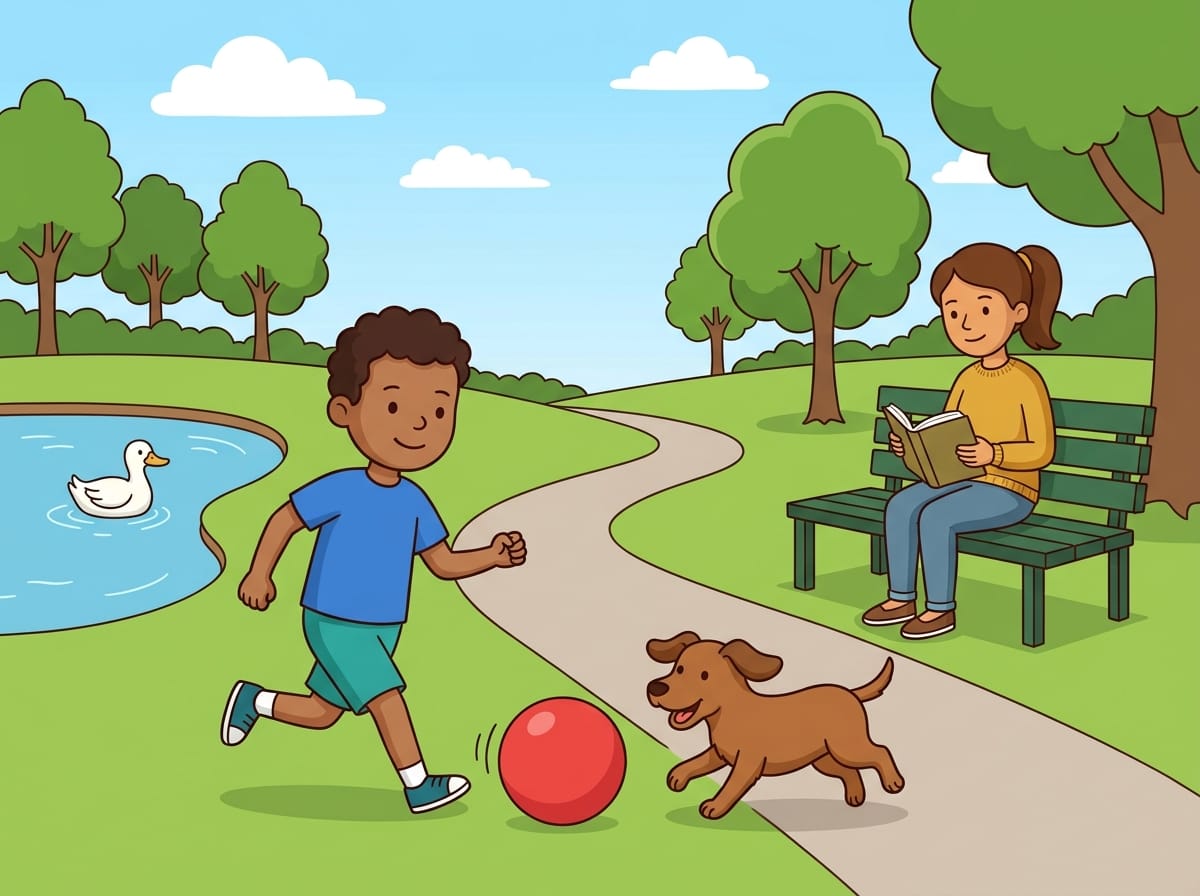
Picture description
A city park on a sunny day.
A boy is kicking a red ball. A brown dog is running after the ball.
A white duck is swimming in a small pond.
A woman is sitting on a green bench. She is reading a book.
Look at the picture. Listen to the model student. Then say your answer.
Look at the animal in the water. What is it?
Scoring rubric
| Level | What it looks like |
|---|---|
| 4: Exemplary |
|
| 3: Strong |
|
| 2: Adequate |
|
| 1: Attempted |
|
A strong sample response
A duck. It is a duck. The white duck is swimming in the water.
Level 1 is the target for Pre-A, so "A duck" on its own fully answers the task, just like the model student’s "A dog." The extra short sentences show a beginner reaching a little past the model. They are welcome but not needed.
What to look for
- Pre-A tasks are for students who are just starting English. On the real test they come before Tier A, and a student who answers them well moves on.
- Play the model first. Point out that the model student said one clear word with "a" in front of it.
- A single English word that names the animal is a real answer here. If the child answers in another language, say the English word and ask again.
Prompt 2: Pre-A tier tasks
Suggested time: about 1 minutes
Model answer: read this aloud first
Listen to the model student answer a similar question first.
Model answer
Transcript for the adult to read aloud. The student listens and does not read it.
Ms. Novak: Look at the bench. What color is it?
Jamal: Green. It is green.
The student's own task
Look at the picture.
Social and Instructional: At the Park
Picture description
A city park on a sunny day.
A boy is kicking a red ball. A brown dog is running after the ball.
A white duck is swimming in a small pond.
A woman is sitting on a green bench. She is reading a book.
Look at the picture. Listen to the model student. Then say your answer.
Look at the ball. What color is it?
Scoring rubric
| Level | What it looks like |
|---|---|
| 4: Exemplary |
|
| 3: Strong |
|
| 2: Adequate |
|
| 1: Attempted |
|
A strong sample response
Red. The ball is red. The boy is kicking the big red ball to the dog.
A one-word color, "Red," meets this level 1 task. The sample adds "The ball is red," the same pattern the model student used ("It is green"), and then one more sentence.
What to look for
- Pre-A tasks are for students who are just starting English. On the real test they come before Tier A, and a student who answers them well moves on.
- Colors are some of the first English words children learn. If the child knows the color but not the word "ball", that is fine; the task asks only for the color.
- If the child points instead of speaking, point too and say "Red. It is red." Then ask them to say it.
Prompt 3: Pre-A tier tasks
Suggested time: about 1 minutes
Model answer: read this aloud first
Listen to the model student answer a similar question first.
Model answer
Transcript for the adult to read aloud. The student listens and does not read it.
Ms. Novak: Look at the woman on the bench. What is she doing?
Jamal: Reading. She is reading a book.
The student's own task
Look at the picture.
Social and Instructional: At the Park
Picture description
A city park on a sunny day.
A boy is kicking a red ball. A brown dog is running after the ball.
A white duck is swimming in a small pond.
A woman is sitting on a green bench. She is reading a book.
Look at the picture. Listen to the model student. Then say your answer.
Look at the boy. What is he doing?
Scoring rubric
| Level | What it looks like |
|---|---|
| 4: Exemplary |
|
| 3: Strong |
|
| 2: Adequate |
|
| 1: Attempted |
|
A strong sample response
Kicking. He is kicking the ball. The dog is running to the ball.
This task asks for an action, which is harder than naming a thing. "Kicking" or "Kick ball" fully answers it at level 1. The sample matches the model’s pattern, "He is ___ing," and adds what the dog is doing.
What to look for
- Pre-A tasks are for students who are just starting English. On the real test they come before Tier A, and a student who answers them well moves on.
- Action words (verbs) are the step up in this task. "Play" or "Ball" alone shows some understanding; "kick" or "kicking" is the word to aim for.
- Act it out: kick an imaginary ball and ask, "What am I doing?"
Prompt 4: Tier A tasks
Suggested time: about 1 minutes
Model answer: read this aloud first
Listen to the model student answer a similar question first.
Model answer
Transcript for the adult to read aloud. The student listens and does not read it.
Ms. Novak: Look at the boy. What is he filling?
Jamal: The water bottle. It is for the rabbit.
The student's own task
Look at the picture.
Science: Our Class Rabbit
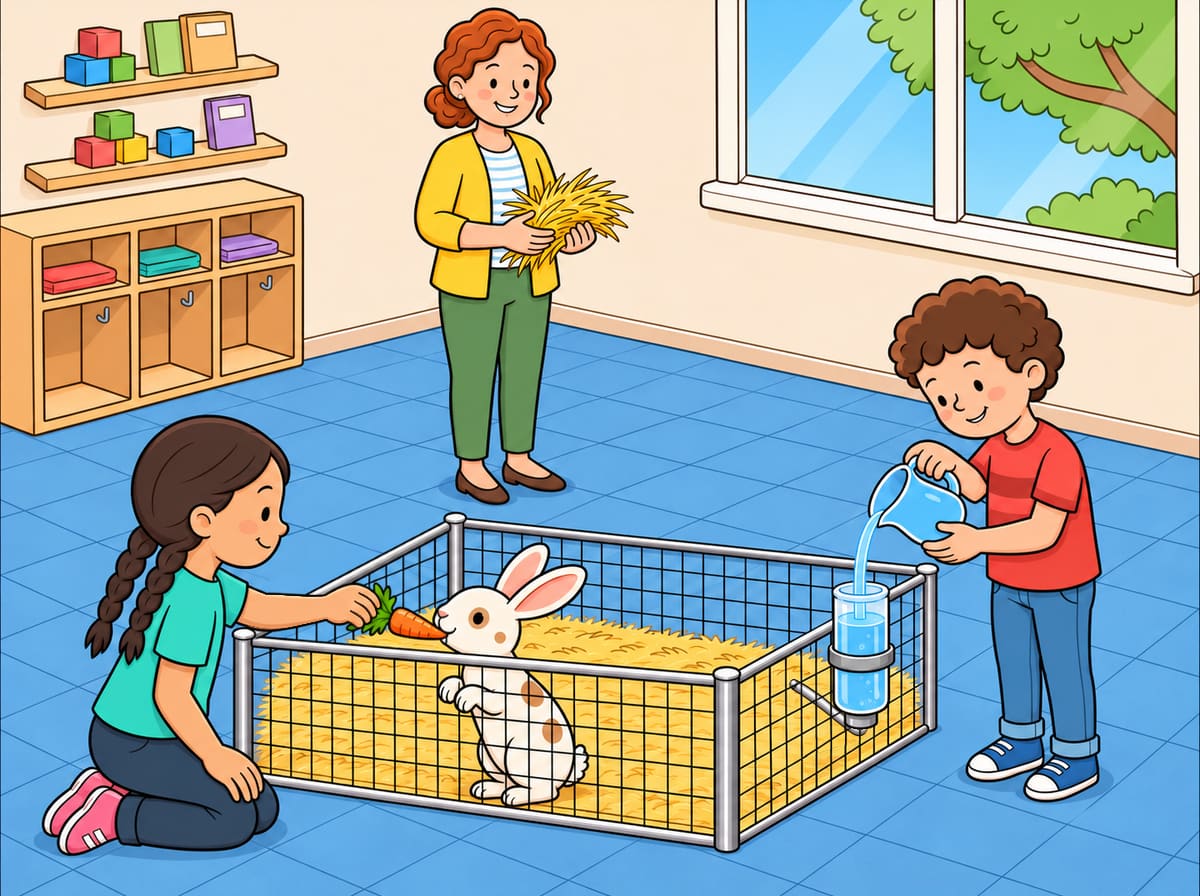
Picture description
A classroom has a pet rabbit in a pen. The rabbit is white with brown spots and has long ears.
A girl is giving the rabbit a carrot.
A boy is filling the rabbit’s water bottle.
The teacher is holding some hay for the rabbit’s bed and food.
Look at the picture. Listen to the model student. Then say your answer.
Look at the girl. What is she giving the rabbit?
Scoring rubric
| Level | What it looks like |
|---|---|
| 4: Exemplary |
|
| 3: Strong |
|
| 2: Adequate |
|
| 1: Attempted |
|
A strong sample response
A carrot. She is giving the rabbit a carrot. The rabbit is eating.
This is the level 1 task in the tier. "A carrot" answers it. The sample uses a full sentence and adds a detail, which is a little more than the model student gave, so it is at the top of the rubric.
What to look for
- Tier A tasks go from level 1 (a word or phrase) up to level 3 (a few simple sentences). Listen to the model to hear how much is expected.
- Naming the object is the core of this task. A child who says "Food" or "Orange" understands but needs the word "carrot"; teach it and ask again.
- Praise a full sentence like "She is giving it a carrot," but don’t ask for one; a word is a complete answer here.
Prompt 5: Tier A tasks
Suggested time: about 2 minutes
Model answer: read this aloud first
Listen to the model student answer a similar question first.
Model answer
Transcript for the adult to read aloud. The student listens and does not read it.
Ms. Novak: Tell me about the rabbit. What does it look like?
Jamal: The rabbit is white and brown. It has long ears. It is sitting in the pen. It looks soft.
The student's own task
Look at the picture.
Science: Our Class Rabbit
Picture description
A classroom has a pet rabbit in a pen. The rabbit is white with brown spots and has long ears.
A girl is giving the rabbit a carrot.
A boy is filling the rabbit’s water bottle.
The teacher is holding some hay for the rabbit’s bed and food.
Look at the picture. Listen to the model student. Then tell as much as you can.
Tell me what the children and the teacher are doing to take care of the rabbit.
Scoring rubric
| Level | What it looks like |
|---|---|
| 4: Exemplary |
|
| 3: Strong |
|
| 2: Adequate |
|
| 1: Attempted |
|
A strong sample response
The girl is giving the rabbit a carrot. The boy is putting water in the bottle, so the rabbit can drink. The teacher has hay. The rabbit eat the hay and sleep on it.
This is the level 3 task in the tier, and the sample sits at the top: it covers all three people, uses "so" to give a reason, and uses topic words (carrot, water bottle, hay). The small errors ("eat", "sleep") don’t get in the way of meaning.
What to look for
- Tier A tasks go from level 1 (a word or phrase) up to level 3 (a few simple sentences). Listen to the model to hear how much is expected.
- Check that the child talks about more than one person. Saying only "She gives carrot" is a part answer.
- If the child stops after one sentence, point to the next person in the picture and ask, "And him?"
Prompt 6: Tier A tasks
Suggested time: about 2 minutes
Model answer: read this aloud first
Listen to the model student answer a similar question first.
Model answer
Transcript for the adult to read aloud. The student listens and does not read it.
Ms. Novak: What does a fish need to live? Tell me two things.
Jamal: A fish needs water. It lives in the water. It needs food too. You give it fish food every day.
The student's own task
Look at the picture.
Science: Our Class Rabbit
Picture description
A classroom has a pet rabbit in a pen. The rabbit is white with brown spots and has long ears.
A girl is giving the rabbit a carrot.
A boy is filling the rabbit’s water bottle.
The teacher is holding some hay for the rabbit’s bed and food.
Listen to the model student. Then tell as much as you can.
What does a rabbit need to live and grow? Tell me two things.
Scoring rubric
| Level | What it looks like |
|---|---|
| 4: Exemplary |
|
| 3: Strong |
|
| 2: Adequate |
|
| 1: Attempted |
|
A strong sample response
A rabbit need food, like carrots and hay. And it needs water to drink. It needs a home too, a cage or a pen, so it is safe.
This level 3 science task asks for two needs, and the sample gives three, each with an example or reason ("like carrots", "to drink", "so it is safe"). That is more connected than the model, which places it at the top of the rubric despite "a rabbit need".
What to look for
- Tier A tasks go from level 1 (a word or phrase) up to level 3 (a few simple sentences). Listen to the model to hear how much is expected.
- What living things need (food, water, air, shelter) is a grade 1 science idea. The picture shows food and water, so the child can look at it for help.
- Count the needs with the child on their fingers. Two clear needs answer the task; reasons or examples make it stronger.
Prompt 7: Tier B/C tasks
Suggested time: about 2 minutes
Model answer: read this aloud first
Listen to the model student answer a similar question first.
Model answer
Transcript for the adult to read aloud. The student listens and does not read it.
Ms. Novak: Tell me about the children in the picture.
Jamal: Two kids are making a snowman. They rolled big snowballs and put them on top. A girl is pulling her sled up the hill, because she wants to slide down.
The student's own task
Look at the picture.
Social Studies and Science: A Snowy Day in Town
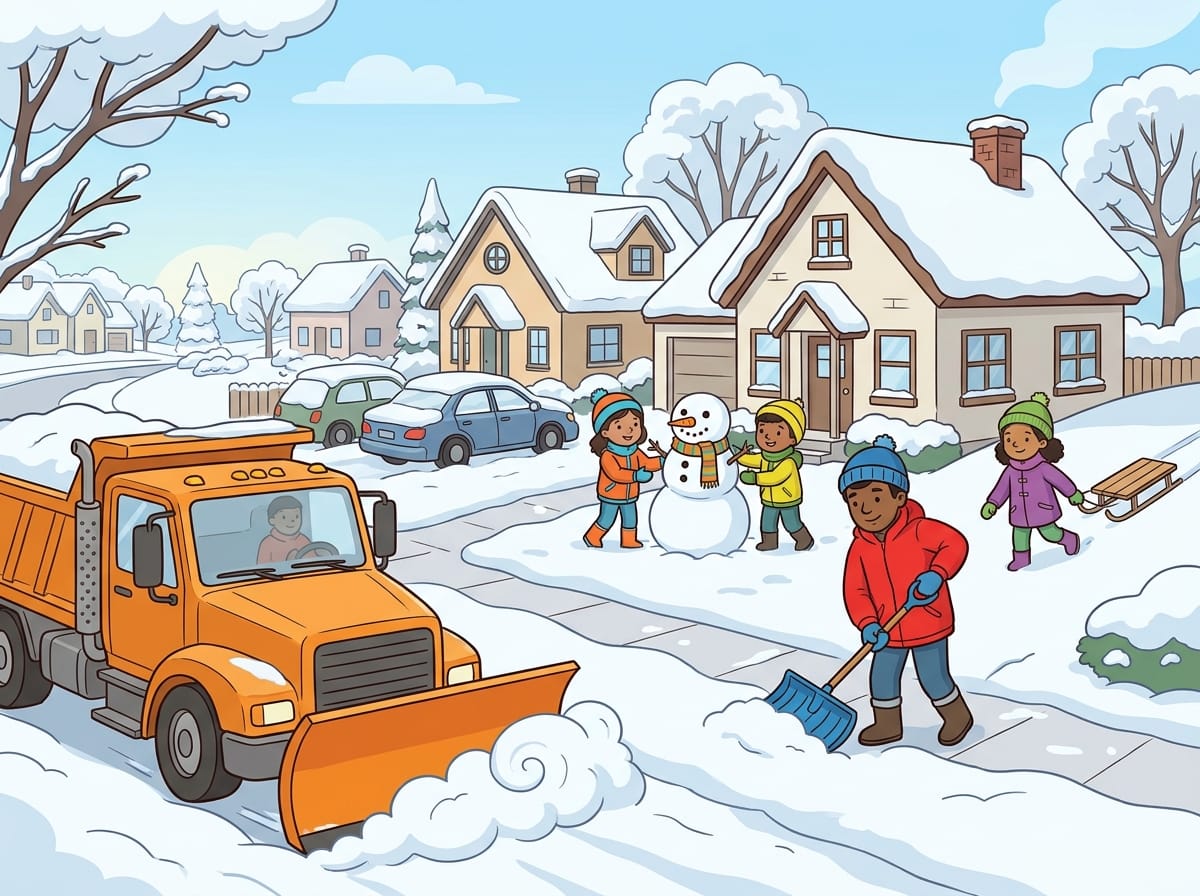
Picture description
A town street the morning after a big snowstorm. Snow covers the houses, the cars and the ground.
An orange snowplow is pushing snow off the road.
A man is shoveling the sidewalk in front of his house.
Two children are building a snowman. A girl is pulling a sled up a small hill.
Look at the picture. Listen to the model student. Then tell as much as you can.
Tell me what the grown-ups in the picture are doing.
Scoring rubric
| Level | What it looks like |
|---|---|
| 4: Exemplary |
|
| 3: Strong |
|
| 2: Adequate |
|
| 1: Attempted |
|
A strong sample response
There is a big orange truck. It is a snowplow, and it is pushing all the snow off the street. And a man is outside his house. He is shoveling the snow on the sidewalk, so he can walk.
This is the level 3 task in the tier. The sample names both grown-up jobs, uses the word "snowplow" and links ideas with "and" and "so", which matches the model student’s level.
What to look for
- Tier B/C tasks go from level 3 up to level 5. At level 5 the model student explains or gives reasons, using words like because, so and if.
- The task is about the grown-ups only. A child who describes the snowman has noticed the picture but missed the question; ask again, pointing to the truck and the man.
- Useful words: snowplow, shovel, sidewalk, street. If the child says "the big car that moves snow," that is good describing; give them the word "snowplow".
Prompt 8: Tier B/C tasks
Suggested time: about 2 minutes
Model answer: read this aloud first
Listen to the model student answer a similar question first.
Model answer
Transcript for the adult to read aloud. The student listens and does not read it.
Ms. Novak: How does the man with the shovel help? Explain.
Jamal: He is shoveling the snow off the sidewalk, so people can walk there. If he didn’t, the snow would get hard and icy, and someone could slip and fall. So he is keeping his neighbors safe.
The student's own task
Look at the picture.
Social Studies and Science: A Snowy Day in Town
Picture description
A town street the morning after a big snowstorm. Snow covers the houses, the cars and the ground.
An orange snowplow is pushing snow off the road.
A man is shoveling the sidewalk in front of his house.
Two children are building a snowman. A girl is pulling a sled up a small hill.
Look at the picture. Listen to the model student. Then explain as much as you can.
How does the snowplow help the people in this town? Explain.
Scoring rubric
| Level | What it looks like |
|---|---|
| 4: Exemplary |
|
| 3: Strong |
|
| 2: Adequate |
|
| 1: Attempted |
|
A strong sample response
The snowplow pushes the snow off the road. That helps because cars and buses can drive again. If there is too much snow, the cars get stuck and people can’t get to work or to the store. And the fire truck needs a clear road, so it can get to a fire fast.
This level 5 task asks the child to explain. The sample goes past what the picture shows: it gives a reason ("because cars and buses can drive"), what would happen without the plow ("if there is too much snow"), and a second, specific example (the fire truck). That matches the model student’s explaining, so it is at the top of the rubric.
What to look for
- Tier B/C tasks go from level 3 up to level 5. At level 5 the model student explains or gives reasons, using words like because, so and if.
- Saying only what the snowplow does ("It moves snow") is a level 3 answer. Level 5 adds why it matters to people.
- Prompt with "What would happen if there was no snowplow?" to help the child give a reason.
Prompt 9: Tier B/C tasks
Suggested time: about 2 minutes
Model answer: read this aloud first
Listen to the model student answer a similar question first.
Model answer
Transcript for the adult to read aloud. The student listens and does not read it.
Ms. Novak: Would you rather build a snowman or ride a sled? Tell why.
Jamal: I would rather ride a sled. Building a snowman is fun, but it takes a long time and my hands get cold. On a sled you go really fast down the hill, and you can go again and again. So sledding is more fun for me.
The student's own task
Look at the picture.
Social Studies and Science: A Snowy Day in Town
Picture description
A town street the morning after a big snowstorm. Snow covers the houses, the cars and the ground.
An orange snowplow is pushing snow off the road.
A man is shoveling the sidewalk in front of his house.
Two children are building a snowman. A girl is pulling a sled up a small hill.
Listen to the model student. Then tell as much as you can.
On a snow day, would you rather play outside in the snow or stay inside? Tell why.
Scoring rubric
| Level | What it looks like |
|---|---|
| 4: Exemplary |
|
| 3: Strong |
|
| 2: Adequate |
|
| 1: Attempted |
|
A strong sample response
I would rather play outside in the snow. Inside, I can play every day, but snow only comes in winter. Outside I can make a snowman and throw snowballs with my brother. It is cold, but I wear my coat and boots, so it is okay. Then I go in and drink hot cocoa.
This level 5 task asks for an opinion with reasons. The sample says its choice, gives two reasons, answers the other side ("It is cold, but..."), and ends in order with "then". Either choice is fine; the reasons are what is judged.
What to look for
- Tier B/C tasks go from level 3 up to level 5. At level 5 the model student explains or gives reasons, using words like because, so and if.
- There is no right choice. Listen for the child’s reasons: "because it is fun" is a start, and a level 5 answer gives two reasons with details.
- If the child gives one reason, ask "Why else?" or "What about the cold?" to help them build a longer answer.
Unofficial practice. This site is not affiliated with, endorsed by, or connected to WIDA, the Wisconsin Center for Education Research, or the Board of Regents of the University of Wisconsin System. WIDA and WIDA ACCESS are trademarks of the Board of Regents of the University of Wisconsin System. Every question here is original practice material written to match the published test design.